Thursday, August 26, 2010

The Most Dangerous Game


Please see Spectral Links for a newly added link to the 1932 film adaptation of "The Most Dangerous Game." As it is in the public domain, the film ( a classic) can be viewed in its entirety. I have also posted a link to the Ghost Box Records website.

Wednesday, August 25, 2010

Horror vs. the Enlightenment: Knowledge is King

Now that we have progressed through Carroll's description of horror as a genre and the monsters that inhabit its (formulaic) plotlines, we see the author's first explanation of what the horror stories really mean to us. Sure, we are filled with art-horror, but, for horror to continue to survive as an academic genre, we need to hear what these tales tell us about the relationship to our lives and the world around us. On pg. 129, Carroll says that "horror stories are predominantly concerned with knowledge as a theme." As we continue to read more works from this genre, Carroll thinks that we'll learn more about how we should act in our own search for knowledge. Are we overreachers that need to be checked, or discoverers that need to explore?
Carroll also points out that horror was developing at the same time as the Enlightenment, and puts those two in conflicting positions because of their positions regarding the search for what is real and what is not. But, isn't it interesting that both are concerned with the pursuit of human knowledge? The search for understanding, supernatural or not, is central to both. In this light, the first horror stories could be seen as either encouragement or warning, or some of each.

Cliffnotes version of the Complex Discover Plot

Doodled this during class.....serious post later.

The Sea Raiders


The story I have liked best so far in this philosophy of horror class is "The Sea Raiders" by H.G. Wells. This is a story of gargantuan man-eating cephalopods. The main character, Mr. Fison, has found a group of live Haploteuthis ferox devouring a human corpse. Trying to disengage the giant squid from the human remains, he ends up drawing their attention to himself and they chase him. I do believe this is an art horror story; there is an obvious repulsive and disgusting monster. They don't necessarily have supernatural smarts, like that of Jaws, because cephalopods are known for their unique intelligence anyway. They have been known to watch others perform a tedious task and using the knowledge of successful tactics that the other used, the one watching can perform the task in mere minutes compared to hours of the first. Their intellect as well as the size and agressive behavior as in this story are all reasons to beware. Especially being known for their man-eating tendencies causing them to be supernatural. Just thinking about giant, murderous squid is a frightening thought. This story had me on edge thinking of Mr. Fison. If I were him, already having been chased by the beasts, I would not have been able to go back out to look for the remains of that person on a boat in the middle of their turf. The ‘edge of the seat’ feeling together with the dread of the monster and the unknown is the intention of an art horror piece. Even if the monster is disgusting and repulsive alone, it feels like it is lacking as an art horror; those artistic features though, along with that edge of your seat feeling, is how horror works to exemplify the genre. I was getting nervous the more I read about them attacking the boat and it was hard to stop reading at that point. I needed to know if they would make it out so I could once again be able to go out on a boat without worrying about giant man-eating cephalopods. Seeing as they consumed a whole family of ten including a child, that will not be possible anymore.

What's Scarier Than an Angry Cephalopod?

A herd of ants that stretches ten miles long and two miles wide.

I couldn't help but notice that practically no one else took this position during the class discussions. It seemed that the menacing cephalopods took the center stage of terror between the two villains. The giant squid that seek out innocent sailors are proving themselves more horrifying than the ants.

But I am forced to disagree with this stance. Carroll talks about many things when defining horror. The ones that stand out for me are illiciting emotion from the reader and massification. While reading the two stories, I felt little to no emotional reaction as the squid digested the men. It was not grotesque enough. There was not enough description of limbs being ripped to shreds and blood shooting out in all directions. But for Leiningen? Oy. Now that was grotesque. The mental image of ox being eaten to the bone or of a man pulling his hand from the pit to discover it being eaten alive is enough to give me nightmares. It is disgusting. It is even more disgusting to think about the size of the ants. They are ants. They are not very large or menacing in appearance. They don't seem like something that would eat you down to the bone. This adds to their horror because it is so unexpected. Such a small creature doing that much damage is far more terrifying than a giant squid eating a man. It is conceivable to imagine a giant squid eating an entire man because a giant squid is, well, giant! It makes sense that it could easily digest a man based on its sheer size. What doesn't make sense is ants eating human flesh down to the bone.

Beyond that is the massification used specifically in Leiningen. I don't see the massification in the squid. They are giant squid. It is expected for them to be large. One could argue that the amount of squid that have gathered together is an example of massification, but I won't buy into that until the squid are ten miles long and two miles wide. Ten miles long and two miles wide. That's how many ants Leiningen faced. Millions of minute beings crowding together to do their bidding. An army of ants approaching, ready to tear you limb from limb.

Now that is horrifying.

Tuesday, August 24, 2010

Will Ferrell - Monster?

How does Carroll define a monster? It must be something that doesn't exist according to current science, it must be disgusting, and it must be fearsome/threatening. There are contradictions it would seem, once you realize that Jaws isn't technically impossible, of if you view Jigsaw as a horrific being. Norman Bates is just a crazy guy, simply speaking. Arguably, these are horrifying things, but they don't meet the criteria Carroll establishes. Carroll retorts with an explanation about Norman being "Nor-man", existing as two Genders, embodying the the impure combination of man and woman into one being.

If we permit a looser interpretation, we can allow Norman into our litany of monsters as he exists outside of our socially accepted behavior. And that appears to be the essence of what Carroll is discussing. Monsters represent the dread-inducing manifestations that exist at the fringes, or beyond the social norm.

Thus, Carroll is attempting to establish Art-Horror as consisting of an integral element that disrupts the ordinary with an extraordinary being (multitude of ants, super-intelligent shark, demonic inchworm, whatever) that represents violation of the status quo.

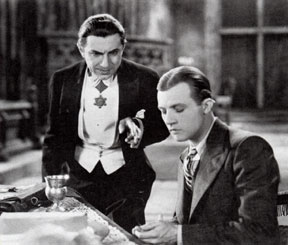
From this, I argue that Will Ferrell, in his various roles, acts as a hideous monster that works to undermine the order of our society. I am not denouncing Will Ferrell as a individual; much like Bela Lugosi, he acts to epitomize an actor in his genre. Will Ferrell consistently acts as a disgusting individual and threatens society by undermining values (think sexist, childish, alcoholic, sex addict, etc.). The only specific criteria he doesn't meet is that his characters can indeed exist within the confines of contemporary science. But, much like Jaws, I believe it takes a of faith to believe anybody can be as dense and idiotic as Ron Burgandy or Chazz Michael Michaels. I don't believe Jaws really exists, and neither do I believe Chazz Michael Michaels can really exist as such a horrible person (the former is, I permit, less credible).

The point I'm getting to is that such discussions of monsters is a way to portray what we regard as least human, or most destructive, to our order. Ants that can think tactically, Elder Gods that cause us to babble nonsensically, and Will Ferrels that refuse or ignore social graces. If this is the purpose of monsters in horror, to manifest that which ought not be (instead of what can't be), then Comedies accomplish the same goal.

At the very least it allows me to present another example of how Will Ferrell may be one of the better actors of portraying that which is truly horrifying by including this possibly NSFW picture (no nudity, but heavily suggested) Taken from Semi-Pro if you'd like to know.

Expectations

It stands to reason that one would tire of the same formula over, and over, and over again... and yet when it comes to entertainment and horror, as Carroll suggests, we seem content to have it that way. The complex discovery formula that he presents and its many variations really do occur in most works of horror that I've experienced, and it's not that the audience conveniently forgets that they've seen something like this before when they're enthralled in a scary movie, either. In fact, I think it's the very fact that the audience has experienced similar formulas that they garner more enjoyment from the experience. Just as we know to expect something sinister to occur when the doorknob slowly turns and the frantic violin music begins, so do we also -whether we can say so or not- know what to expect when we go into a movie that follows a familiar formula for good horror.
What's more: I think we like it that way. People like knowing what to expect, we like being able to predict the sequence of events. Though many will contest that they tire of those mediocre and very predictable films, movies and dramatizations, we all will pay to see a new and intriguing movie or read the new book that meshes original premises with those ever-occurring formulas. I think of it in the same way that people love to hear and tell the same stories over and over again. We, perhaps unconsciously, like knowing what might happen next. And it's not that we don't like being surprised, because there's plenty of room for surprise in a "formulaic" work, but we like getting the satisfying experience that these reoccurring patterns present. Much the same way that a good story will follow the pattern of exposition, rising conflict, climax, resolution and denouement, so does horror depend on a certain structure to satisfy the audience.
As mentioned above, no matter how much we like having a familiar course of events, the creators of a work of horror do still need to do some work to keep our interest. Even if we're sure of how a work will end, there's intrigue to be found in the many ways one might come to the conclusion. So perhaps it's accurate to say that the presence of any of the various formulae introduced by Carroll isn't indicative of a good work of horror, but rather these formulae are common characteristics among effective works of horror.

Monday, August 23, 2010

Lions and Tigers.... and Ants? O My!

A few days after reading Stephenson's "Leiningen Versus The Ants', I'm still struggling to find the horror in it, especially art-horror. Even if I place myself into Leiningen's shoes (with his thick skull as well), I still don't find that I am art-horrified by their actions. Ants are intelligent and strong beings. In fact, I looked into the facts on ants just to see the natural truth behind the story.

Did you know that an ant has the largest brain amongst insects? One 'ant site' even said that their brains have a similar processing power to a Macintosh computer. That certainly may be amazing, and maybe a bit terrifying, but nevertheless, natural at the same time.

Beyond that, there are colonies in South America which have over 700,000 members; now that's a supercolony! That may not be 20 square miles of ants, but they could still take up a large area of space.

Given these facts, I'm beginning to think Leiningen himself is closer to a monster than the hoard of ants that attacked his plantation. The ants never gave me a sense of impurity or out-of-placeness. They certainly can, and do, exist in large numbers, and some are more malevolent than others, but without the intent of being harmful to any of particular person. To me, the occurrence of the ants is no different than a tsunami tidal wave or a hurricane coming straight for me. It is not out to get me personally, but certainly will take me down if I am in its path.

One could argue that the ants may have shown super intelligence by building rafts from greenery, yet I still do not buy it. Some ants are know for their leaf cutting and if their brains truly are of such high processing power, I don't think that building a bridge across the moat is particularly out of natural context.

Maybe we can just add large and harmful colonies of ants to the list of natural things people are afraid of. In the remake of Wizard of Oz, a colony of ants could be the new personified animal Dorthy is afraid of and travels with along the Yellow Brick Road. I'm not entirely sure what they would need to go see the Great Oz about though.

Sunday, August 22, 2010


Noёl Carroll
The Philosophy of Horror

Carroll’s account of horror is modeled on Aristotle’s classic study of tragedy in the Poetics. Carroll analyzes the horror genre, broadly construed to include literature, film, theater, and painting, in terms of the “emotional effects” it aims to evoke in its audience. The primary such effect, according to Carroll, is an emotion that he calls “art-horror.”

Art-Horror

Carroll makes an important distinction between ‘natural horror’ and ‘art horror.’ The former is the sense of ‘horror’ captured in the statement “I am horrified at the idea of taking another philosophy class,” while the latter is the sense of ‘horror’ operative in statements like “ Nosferatu is a the greatest horror film ever made.”

“ “Art-Horror”, by stipulation, is meant to refer to the product of a genre that crystallized, speaking very roughly, around the time of the publication of Frankenstein—give or take fifty years—and that has persisted, often cyclically, through the novels and plays of the nineteenth century and the literature, comic books, pulp magazines, and films of the twentieth. This genre, moreover, is recognized in common speech and my theory of it must ultimately be assessed in terms of the way in which it tracks ordinary usage.” (The Philosophy of Horror, 13).

The Monster as a Necessary Condition of Art-Horror

Carroll argues that in order for a given work of art to be a member of the set of all works of art-horror it must feature a monster. Having a monster, however, is not a sufficient condition for inclusion in the set of the art-horrible ("Puff the Magic Dragon" is probably not a work of horror).

It is the hallmark of the art-horrible that it aim to produce a specific affect in its audience members. The monsters in a work of art-horror, then, must be regarded by the other characters in the work (and by the audience) as both fearful and hideously unnatural or revolting. Compare: Chewbacca and the Wolf-Man.

“The monsters of horror… breach the norms of ontological propriety presumed by the positive human characters in the story. That is, in examples of horror, it would appear that the monster is an extraordinary character n our ordinary world, whereas in fairy tales and the like the monster is an ordinary creature in an extraordinary world.” (Philosophy of Horror, 16).

Carroll contends that it is from the emotional reactions of the characters in the work that we take our cue as to the ‘violation of nature’ on display in a given monster.

Fear and Revulsion

The ideal art-horror monster is both fearful and revolting, as illustrated by the following passage from H.P. Lovecraft's At the Mountains of Madness.

“We had expected, upon looking back, to see a terrible and incredibly moving entity if the mists were thin enough; but of that entity we had formed a clear idea. What we did see—for the mists were indeed all too malignly thinned—was something altogether different, and immeasurably more hideous and detestable. It was the utter, objective embodiment of the fantastic novelists “thing that should not be”; and its nearest comprehensible analogue is a vast, onrushing subway train as one sees it from a station platform—the great black front looming colossally out of infinite subterraneous distance, constellated with strangely colored lights and filling the prodigious burrow as a piston fills a cylinder." H.P. Lovecraft

Monday, February 01, 2010

Paradox of Horror: A Violation of Reality

Why do we enjoy watching scary movies? Why do we wait in line for an hour just to get scared in a haunted house? Why do we spend hours a day reading horror novels, or watching "Ghost Hunters"? Because we love a thrill. We love the feeling of uncertainty. Sitting on the edge of our seat, waiting for what will happen next. Why do we enjoy seeing someone tied to a chair, receiving an ultimatum from Jigsaw in the Saw thrillers? It's all because of a little thing that Carroll likes to refer to as the "Paradox of Horror".
The Paradox of Horror is referred to as an attempt to rationalize the horrific, terrifying myths and fictions of todays literature as well as media. In my opinion, we enjoy being enthralled into stories that contain elements of death and immortality, because it is so far from what we would want to surround ourselves with. It's like looking at a car accident. We would never want it to happen to us, but we can't look away. Its an eerie thought, and such a peculiar thrill. We look for ways, day after day, to scare ourselves in some way. To test reality, in some sorts, is the best way to know you are living. When something is so close, yet couldn't physically harm us, we get a thrill, a rush of adrenaline. Something that we can get from movies, books, tv shows, and haunted houses. In different ways, this media can pull us in, and keep us until we break. We want a thrill, always looking for a way to keep yourself on the edge of your seat.
I personally love movies where people are literally ripped apart. I love the thrill of knowing something terrible is happening, but I am not hurt. I will stand in line in freezing temperatures just to walk through a haunted house and get scared. I love the thrill of knowing I can be scared, but its only for a moment. A moment that won't truly hurt me, but make my heart jump, and wake me up.
The Paradox of Horror is truly a violation of reality. We almost want these things to be real, but know that they never will be. We look at urban legends as something that could possibly be true, but hasn't been proven to us in real life. These things all give us thrills, in very different ways. We love it. And that is why Carroll proves humans to be "thrill seekers" of sorts. It's a way of life, a way to know that you are living.

The Tell-Tale Heart: Gothic-ly Fantastic


It is true that we are all so transfixed on figuring out the afterlife, that we enthrall ourselves into such horrific stories to fill our minds, just so we can “catch a glimpse” into the other world. We assume that these stories are not true-life, and will never be. Yet we enjoy places ourselves in the character’s shoes, just to see what it would feel like if we were faced with the horror on the pages of these books.

A story that we didn’t discuss, yet is wildly popular and highly read, is “The Tell-Tale Heart” by Edgar Allan Poe. Poe surrounds you with the nervousness and mad mind of the narrator, making you feel as though you are the murderer, the mad one. I find this story to be fantastic in many ways, as well as gothic in others. The “fantastic” is created throughout, which causes the reader to draw conclusions as to the missing parts of a plot, as well as the afterthoughts of endings. Why did the story end this way? And what really and truly occurred during this last scene? We are all left wondering, yet we love the fact that we can make up our own endings and scenes to such classic and horrific stories.

The narrator claims that he is “sensitive to what others cannot hear. Sensitive to be able to see and hear things in heaven, hell, and on earth that would otherwise not be experienced”. The over-sensitivity gives way to the reasoning behind why he kills his victim, an old man with a very strange eye. He developed an obsession with the eye, calling it “the eye of a vulture – a pale blue eye with a film over it.” No reason other than the obsession gave way to the murder.

For seven nights, the narrator would spend close to seven hours making his way through the creeky door, into the old man’s room, just so that he could witness his “vulture eye”. Every morning after his venture, he would act as cheerful as ever, being cordial and having small-talk with the old man, like nothing ever happened. And on the 8th night of the repeating visits, the narrator startles the old man in his sleep when the lantern he is using accidently clangs against the wooden door. The old man began to moan in terror, scared of the light that was coming before him. And there, in front of him, he saw the vulture eye.

As quickly as the eye caught the light, the narrator’s acute senses were awakened by a noise, which was the rapid beating of a heart. The “fantastic” finally comes into play when the question to the reader is, whose heart is beating so loudly? Is it his own, or the old man’s? The sound began getting louder and louder, as if the narrator believes the neighbors may begin to hear it. So he smothers the old man with his mattress, until the loudly beating heart, would beat no more.

After the old man is dead, the narrator dismembers him, leaving no traces of blood, so that there is no question of murder. He then took the pieces left of the body and placed them beneath the boards of the floor in the old man’s room. And at 4am, a knock came on the door. It was the police, coming to investigate reports of a “shriek”. There seemed to be no evidence after they searched the house, so the narrator pulled up a chair to sit in, on top of the boards that hid beneath it, the old man’s body parts.

The narrator began to hear the old man’s heart yet again. Pounding away in his ears, loudly, and even more loudly. The narrator became wild and uncontrollable, and after not being able to keep his composure, he admitted loudly to the deed of killing the man, and told them to rip up the boards underneath them, exposing the old man’s body. His conscience was literally eating him alive, exposing his guilt. His own beating heart, we assume, is the sound that he keeps hearing. But we are never told that it was his own heart. We have no idea, and in this case, we are dealing with both Gothic and Fantastic horror.

A Star Trap: Stoker’s Mystery Story – Not HORROR

One of Stoker’s stories that doesn’t fit Carroll’s typical horror story formula is “A Star Trap.” The story doesn’t have a monster, there is nothing out of the social norm, and it doesn’t fit any of the “disgusting” factors that make up a horror story. Even though it doesn’t have a monster it is still a very eerie story. It is more of a mystery and crime scene story than a scary story.

The story “A Star Trap” is mostly told through the first-person perspective. The story is told by a grown man who experienced a very dreadful event when he was younger. The grown man tells a committee of people what he experienced and what happened during that tragic night, which he had never told anyone about before.

The story begins with the narrator explaining that as a child he was an apprentice for a man named John (later calls him Jack) Haliday, who was a master machinist/carpenter. The narrator explains to the committee that he was helping Haliday construct a theatre production at a Victorian theatre called the Hulme. The man telling the story says that the Hulme isn’t the real name of the theatre, because he wants to hid the true identity of the place that the tragic event happened. As the narrator explains this, he asks the committee if they remembered the death of Henry Mortimer, a harlequin. He mentions that the case was never solved and nobody knows the true story behind the death, well everyone except him.

He explains to the committee why the death occurred, who killed Mortimer, and what happened to the evidence after the crime occurred. One of the first things that the narrator explains is why the death occurred. The narrator first explains that John (Jack) Haliday, the master carpenter, was an old man, but he had a young wife named Loo who worked as an actress in the theatre. He says, at first, that the couple was very happy and when they came back from their honeymoon everything was good. But as a year went by Jack Haliday became very unhappy.

The reason he had become unhappy was because Loo starting having an affair with Henry Mortimer. The narrator said, “I think the girls were all in love with him, the way they used to stand in the wings when the time was comin’ for his entrance” (222). The affair with Loo and Henry started when Henry took Loo home after practice. When this occurred “she never seemed to take her eyes off of him during every rehearsal, right up to the night of the last rehearsal” (223).

The narrator explains to the committee that everyone seemed to notice that the affair was happening. He even explains that even as a child he knew what was going on between the two, but said he did not want to make trouble so he never told Mr. Haliday. As the affair was going on, the narrator said he noticed some changes in Mr. Haliday. He said he noticed that Mr. Haliday was not well, pale, looked worried, and had a devil of a temper. Even though Haliday was sick and angry he still worked on the stage of the theatre.

One of the biggest works in the theatre was called “he trap.” The trap, as Haliday would call it, was life or death. He would always make sure that there was nothing wrong with the trap, because if something was defected then the person jumping through the trap would probably die. The trap was said to have been in a shape of a star and Mortimer was suppose to jump through it during the theatre production.

On the night that the production occurred the narrator noticed Mr. Haliday chiseling and sharpening something in his office. He did not know what he was sharpening, so he just went on his way. That night as the production began the apprentice (the narrator) noticed that Mr. Haliday kept looking at the star trap, but he didn’t say anything about it. The production still began and when it came time for Mortimer to jump through the star trap something disastrous occurred. The trap had not worked right when Mortimer tried to jump through it. After the jump, the star trap was in pieces on the ground and the body of Mortimer lay on the ground dead in many odd positions.

The audience, actors, and everyone else in the theatre were shrieking and wondering what occurred. The narrator explains that he went to the death scene and noticed that something was weird about the star. They noticed a weird looking piece of steel that was not usually apart of the star trap. The steel piece had many bent points and it seemed as if someone had put the piece in the star trap. He decided that this was the item that did not allow the trap to open like it was supposed to. The narrator explains that he took the steel item and put it in his pocket and walked away. He thought about who had put the item in the star trap and figured it was probably the item that Mr. Haliday was sharpening in his office earlier.

The narrator explains that he left the crime scene with the steel item in his pants’ pocket. Later that night, he remembered that he had put the steel item in his pants and decided that he did not want his master to get in trouble. He threw the evidence outside his window into a quarry. He knew that if his master was caught he would be charged with murder and later be hung. The narrator blamed Mrs. Haliday for the death of Mortimer because she was the one having the affair with him.
After he explains the story he tells the committee that he is the reason why Mortimer’s killer was never found. He was the only person who knew the true story behind the murder besides the killer’s wife (Mrs. Haliday) and the killer himself (Jack Haliday).

In the end, the story is told through a different perspective (third-person). The story ends with the committee talking about the story that the narrator had just told. One man on the committee knew that the story was true and knew exactly what the narrator was talking about (exact people and the real theatre). He explains that the event really happened in a place called Duke’s Theatre and he confirmed that the death really occurred. But there was another lady who calls the story a bluff. She mentions that the story is actually about a clown not a harlequin. She mentions that the carpenter at the theatre was her husband and the rest of the people have the story wrong.

In conclusion, this story is very unique. It really confused me in the end because I can’t figure out what actually happened. Was the story true? Who is telling the right story? All these questions are left for the reader to think about. For these reasons the story becomes eerie and fascinating. Because of these things the story is seen more as a mystery or crime scene story than a horror story. Stoker used a lot of great detail and the story was “dark” which made it more interesting to read. But I think I will stick with Dracula when it comes to picking a great Stoker story to read.
Sunday, January 31, 2010

The cemetery: Birthplace of Horror

While in London, our class visited Highgate cemetery. Established in 1839, this cemetery has become a rich part of London’s history. After surviving many acts of vandalism and natural aging, the cemetery was left to the care of The Friends of Highgate Cemetary who preserve, restore, and give tours of the grounds. Highgate cemetery is the sight where many have said real vampires have been found, however, The Friends of Highgate cemetery try to dispel these rumors. While in Dublin we also visited Mount Jerome Cemetery, an active cemetery and the final resting place of J.S. Le Fanu. a picture I took in Highgate Cemetery


In nineteenth century London, the perceptions of cemeteries were quite different than those today. They were not places to mourn the death of loved ones, but rather to celebrate the life of that loved one. People would often spend much of their free time in the cemetery where their loved one lay.

Dracula, written in 1897, shows evidence of these perceptions in that time period. In her journal entry from July 24, Mina Murray describes her favorite spot in Whitby.

“Between it and the town there is another church, the parish one, round which is a big graveyard, all full of tombstones. This is to my mind the nicest spot in Whitby, for it lies right over the town and has a full view of the harbor and all up the bay to where the headland called Kettleness stretches out into the sea.”

Mina Murray and Lucy Westenra subsequently spend much time here throughout the story. It is evident from this writing that Bram Stoker was accustomed to these positive perceptions of graveyards within the time period.

While cemeteries were often depicted as places of contentment, they have also been painted in a more sinister light. Within stories of the dead (and undead), it is almost impossible to not encounter the final resting places of many beings in the settings and plots. This can be seen in Dracula when Lucy resides and is destroyed in a tomb. It is also seen in J.S. Le Fanu’s Carmilla when Carmilla is found and destroyed in a graveyard. We are all familiar with scenes of hands arising from beneath the soil of a grave in classic horror films. The cemetery will most definitely play an important role in horror for a long time to come. Because we often associate cemeteries with the spiritual world, stories of the dead, undead, and ghosts can always begin and end in the cemetery.

The Highgate Vampire


In London we visited the Highgate cemetery because it was said that Bram Stoker got some inspiration from this cemetery for his book Dracula. After seeing this place in person I totally understand how anyone could get creeped out. There are tombstones on top of tombstones with vines and crosses everywhere. It is beautiful in a very mysterious way. It is definitely a place I would never want to go at night...and never alone. Knowing that Bram Stoker got inspiration from this place makes you think how some people will hold on to that idea and make it real. After all this is a very creepy cemetery and most ghosts and vampire stories always revolve around death and cemeteries.
Well, there are some interesting people out there who actually believe there is, or was, a vampire at Highgate. This all got stirred up in the 1960's by a group of younger people. They all said they saw "dark gray" figures and even thought they saw ghosts...like a woman in white, a tall man in a hat, and even voices and bells. (their minds could have easily played tricks on them because the atmosphere of this place makes it seem ghostly and just plain creepy...) There is also a story of a king vampire of the undead...which was a simple man who practiced black magic...was apparently buried on the land which eventually came Highgate. It has been said that modern saintist roused him. There was even a mass vampire hunt...where two men...both battling at each other as to who could actually slay the "vampire". The date was set for Friday the 13th...how fitting...there were TV people there and even mobs of hunters along with them...and made their way into the locked cemetery getting passed the cops as well....most of these people were fined or thrown in jail for vandalism...because of these people the idea of highgate having this vampire and ghosts is still fresh on peoples mind. It is up to us whether to believe it or not.

Shalken and the Painter

The story opens by describing a painting that has been painted. The author describes the painting and the setting is what appears to be in a chamber of what looks like a antique religious building. In the chamber is a man and a woman. The woman is in the foreground she is smirking and her face is illuminated by the lamp she is holding. The man is in the background, he is dressed in Flemish garb and is in the action of drawing his sword. The narrator then cuts to the story behind the painting.
Rose Velderkaust was the neice of esteemed painter Gerard Douw and the first and only love of Godfrey Shalken. Shalken was a student of Douw and spent much of his days trying to win the heart of Rose. Although he eventually does win her heart, he must still prove himself to Douw. Here is where the story takes an unexpected turn. One night Shalken is working late on a painting, while working he is disturbed by a unknown man in a cloak named Minheer Vanderhausen. Vanderhausen tell Shalken that he wishes to speak to Douw the following night and tells him to relay the message. Shalken delivers the message to Douw and Douw agrees to meet Vanderhausen. Douw and Shalken go to meet Vanderhausen. Vanderhausen wishes to take Douw's niece, Rose, in marriage. Vanderhausen proves his wealth to Douw and Douw being overwhelmed by his immense wealth, promises Rose to him. When a party is set for the two we finally get to see Vanderhausen. His skin has a bluish hue, even more odd than that he never blinks and his chest never moves, like that associated with respiration.
Rose is then taken by Vanderhausen and Douw never hears from her again until one night some time later Rose bursts into his house. She looked dreadful, so Douw and Shalken put her to bed. While in bed she begs them not to leave her side. They stay there with her for a long time until they think they see something in the next room. As soon as both of them have exited the room the door slams closed and they begin the hear Rose screaming, but they cannot get the door open. When they finally do, Rose is gone, the window is open, and there are rings in the water below. No evidence of Rose was ever found.
Sometime later Shalken recieves word that his father had passed away and received arrangements for the funeral in Rottendam. When he reaches Rottendam the procession is not there so a man invites him to a chamber to enjoy a fire. While sitting there Shalken is overcome by sleep. He then wakes up to the vision of a woman in a white robe. Shalken then follows the woman. The woman stops at the stairs and Shalken then realizes it is Rose. Shalken continues to follow the figure until she stops beside a bed and pulls the curtain beside it. Shalken is horror stricken, behind the curtain was the image of Vanderhausen. Shalken then faints and lays there until he is found much time later. While Shalken is sure of what he has seen, no one really knows for sure what ever happened to Rose and Vanderhausen.
This story was interesting to me because is follows the pure fantastic genre. The pure fantastic is the genre where the author leaves it up the the reader to decide whether or not it was indeed a supernatural experience or if it could in some way be deduced by science. I am personally a fan of this genre because it is rare to find in a story and let the imagination run more wild than it would otherwise would. Also in this story LeFanu follows Carrol's checklist for a horror story monster. According to Carrol, a monster in a horror story must have the following: 1 The monster cannot be explained. As we see from this story no one can identify with Vanderhausen. During the story Douw travels to where Vanderhausen lives, and goes to everyhouse but no one knows of Vanderhausen. Also there is the issue of his skin color, not blinking and appearing to not breathe. 2 The monster is disgusting. As stated above, Vanderhausen violates all of our norms. His skin color is not that of a living individual, he does not breathe and never blinks.
After reading the story I thought that "Shalken the Painter" was a successful horror story. He provides us with a monster to be terrified of and then leaves the ending to us to decide how it acctually ended, supernatural or can we scientifically explain Vanderhausen and the Chamber scene.

The Fantastic and "The White Cat of Drumgunniol"

-not all white....but close ; )....outside Highgate cemetery

"The White Cat of Drumgunniol" by Sheridan LeFanu can be considered that of "the Fantastic". The characters see a girl in all white walking and then somehow walk across water and disappear, the ghost of a girl who has died recently. They also have this white cat association with death. Apparently this family has had this "curse" for some time now and they are considering it to be a hereditary cause. Every person in the family knows that there life will soon be over after seeing a white cat. It could easily just be a coincidence or maybe the cat really does foreshadow death for them.

The reason this is could be considered that of "the fantastic" is because the fantastic is nothing more than a matter of plotting for a story. The story is conflicted between a conclusion of a supernatural cause or a naturalistic one. This exact conflict is the distinct meaning of the fantastic. If there was no conflict of a supernatural or natural conclusion...there wouldn't be a fantastic plot.

The story is associated with would we think of as real people dealing with ghosts and this "white cat/death". The supernatural conflict is that this cat could be a symbol of death and may bring death to the members of the "cursed" family, it could also be the young girl ghost also...in a different form. The white cat magically appears by the dead body also...after the entire room is checked...the characters are always coming up with some excuse as to how the cat got in the room or how they must have missed it while searching. The characters themselves go back and forth with this conflict as well. The naturalistic conflict is the fact that it is just a white cat and that members of the family just happen to see it and as a coincidence die a week, month, days later. There is no way to actually prove that the white cat is bringing death to these people...but we are left at the end of the story never really knowing the real truth... it is left up to us to determine what we believe or want to believe.


Saturday, January 30, 2010

Paradox of Horror

Abby Murphy

Paradox of Horror

It is interesting to think of how scholars have long been mystified by the horror genre. Horror is typically classified as something that induces repulsion, disgust, and fear in the viewer/reader. These are normally emotions that we seek to avoid on a daily basis, but for some reason, we seek these emotions out when viewing art-horror. This is referred to as the paradox of horror according to Noel Carroll’s The Philosophy of Horror. The paradox of horror is an attempt to rationalize why we seek art-horror out when it harbors traits that we normally shun.

Carroll believes that art-horror has certain sources of attraction, pleasure, and added explanations that furthers our liking it. We derive pleasure from that which is distressful to us. There is a morbid fascination with an unknown force. In addition to the fear and disgust that art-horror evokes, Caroll states that some art-horror texts can be “allegorical readings that make their subjects appear wholly appealing and that do not acknowledge their repellent aspects.” However, repellency is part of the horror genre and is largely encountered. But if a moral lesson or message can be taken away from the plot, then the repulsion and fear felt before is just a part of the process associated with learning. For example, Dracula is a text that induces much fear and repulsion in the reader, but there is an allegorical lesson to be learned in the ending. The lesson is that trust must be placed in a higher deity, and to believe that evil will get its come-uppance. This overshadows the fear and disgust felt earlier, but does not obliterate it. Caroll says that fear leads to awe and wonder, and that it is this awe that affirms our deep seated human convictions about the world and our god.

We are attracted to the horror genre is because the emotions it prompts are comparable to the ones that we hold towards religion. H.P. Lovecraft mentions cosmic fear in Supernatural Horror in Literature and classifies it as something that gives the reader a profound sense of dread. According to Lovecraft, fear and religious feeling are instinctual and this is why we are drawn to them. Supernatural horror and religion are associated because they both incorporate concepts that are beyond the ordinary and can cause a fearsome paralysis if we feel threatened by its power. Yet, we find the power appealing. Monsters like Dracula fulfill our fantasies for coming into contact with something infinitely more powerful than ourselves. Dracula is ordinary in some ways, but not in others. He has the guise of a human being, and he can also live forever by draining the lives of others through bloodsucking. He is able to transform his shape(depending on the time of day) and has the strength of twenty men. Dracula even extends his power to control the beings around him. He can paralyze his victims(Mina and Lucy) and exerts his influence over wolves, rats, and the mentally ill(Renfield). Dracula is therefore able to rightly inspire cosmic fear in the reader, and is a force to be reckoned with. After all, he does have world domination on his mind.

"'My revenge is just begun! I spread it over centuries, and time is on my side. Your girls that you all love are mine already; and through them you and others shall yet be mine - my creatures, to do my bidding and to be my jackals when I want to feed.'" (Chapter 23)

We are also attracted to horror because its characters tend to represent, to some degree, the various psychological states of human beings. Dracula is a character that is believed to be a reference to the psychosexual desires that people are capable of harboring. The act of bloodsucking is associated with seduction. Dracula acts as the sinful aggressor towards Mina and Lucy, while the two women are viewed as helpless, innocent victims of Dracula’s advances. It is up to the male, Christian heroes to prevent Dracula from perverting their women. Caroll argues that the Dracula character is merely a manifestation of our innate sexual wishes. Dracula is the means by which the reader is able to make the connection between genital and oral sexuality. Human beings, like other creatures, are driven by the need to procreate. Dracula is an art-horror character that is able to touch base with one of our primary biological needs. He is a monster that sexually represents what makes society uncomfortable and his traits are what we as human beings normally, subconsciously repress. Dracula might be repulsive and disgusting to the reader, but at the same time he has a certain sexual appeal. He is of striking countenance and his brides are of equal beauty. Part of his cursed existence involves transforming his victims into the same sexual state that he embraces. Dracula’s three brides that live in the mountain castle have the same seductive influence over Jonathan Harker at the beginning of the Dracula novel.

"I was afraid to raise my eyelids, but looked out and saw perfectly under the lashes. The fair girl went on her knees, and bent over me, fairly gloating. There was a deliberate voluptuousness which was both thrilling and repulsive, and as she arched her neck she actually licked her lips like an animal, till I could see in the moonlight the moisture shining on the scarlet lips and on the red tongue as it lapped the white sharp teeth. Lower and lower went her head as the lips went below the range of my mouth and chin and seemed to fasten on my throat. I could feel the soft, shivering touch of the lips on the supersensitive skin of my throat, and the hard dents of two sharp teeth, just touching and pausing there. I closed my eyes in a languorous ecstacy and waited - waited with beating heart." –(Chapter 3)

Overall, Dracula and his brides may be parasitic, narcissistic, and predatory , but they also symbolize a representation of our innate, sexual desires turned loose.

To conclude, the paradox of horror is not a solvable one for scholars. However, the rationalization of it’s popularity is slowly being obtained over time. The reasons why an art-horror character such as Dracula are able to draw in so many readers are numerous. Yes, he does inspire fear and revulsion, but we also find him thrilling. The cosmic dread he evokes draws us in, and we marvel at his powers and abilities; and when we inspect him closely enough, we even begin to see bits of ourselves mirrored in him(pun intended). The fact that we can learn a moral lesson from the Dracula tale only enhances its popularity with readers. This is a story about coming together to confront wickedness, while stressing that one should never give up or give in to evil. The question that gets posed by Caroll when he discusses the paradox of horror is “Why horror ? ” For anyone who has read Dracula, the easy answer to this question would be “Why not ?”

The Judge's House

Abby Murphy

Free Essay Topic

The Judge’s House was easily one of my favorite short stories for this course. It made for an extremely gripping read. It certainly falls under the horror drama because of the fact that horror is the primary emotion evoked in the reader throughout the duration of the story. There are three reasons why this tale of horror is so successful at evoking fear and disgust in the reader. The setting, choice of villain , and plot conclusion all lend a helping hand in instilling the reader with a sense of dread and horror.

The setting is very moody and dark from the get-go. My reasons, as a reader, for finding the setting creepy have much to do with the location of the house that the main character is choosing to live/study in. Malcolm Malcomson heads out to the middle of the country in order to study for a standardized mathematics test(Mathematical Tripos) in peace and quiet.

“ There was only one place which took his fancy, and it certainly satisfied his wildest ideas regarding quiet; in fact, quiet was not the proper word to apply to it- desolation was the only term conveying any suitable idea of its isolation. It was an old rambling, heavy–built house of the Jacobean style, with heavy gables and windows, unusually small, and set higher than was customary in such houses, and was surrounded with a high brick wall massively built. Indeed, on examination, it looked more like a fortified house than an ordinary dwelling. But all these things pleased Malcolmson .’’

The rooms in the house are also said to be big and draughty, and vermin are found living within the walls. The time of night, in addition to physical location, is another creepy factor in this story. Malcolm always studies late into the evening, sitting by the fireside, drinking tea. The nighttime is associated with vulnerability and reflection, and Malcolm experiences plenty of harassment in the night hours. Rats emerge from the walls to glare at Malcolm. One particularly large and evil looking rat sits on the high backed chair near the fireplace. This large rat stares at Malcolm with a look that appears familiar and menacing. Malcolm is also at a disadvantage because he is by himself when all of this is happening on a nightly basis. This solitude contributes greatly to the horror aspect of the short story. Human beings are social by nature, and we find solace if others experience the same things that we are going through. The fact that nobody is around when Malcolm needs it the most is somewhat terrifying from the reader’s perspective. There is also a negative energy associated with the house. Visitors to the house even feel the negative vibes coming off of it.

“She was evidently curious to see the inside of the house; and though manifestly so afraid of the ‘somethings’ that at the slightest sound she clutched on to Malcomson whom she never left for a moment, went over the whole place.’’

The hangman’s rope that the judge used, and a portrait of the judge is on display in the house. Knowing what the judge was responsible for doing and seeing the method of his cruelty surely had some psychological influence on the new resident.

The choice of villain for this story also contributes to the horror feel. The villain in this case was an ex-judge who was notorious for delivering harsh sentences to prisoners. There was a portrait overhanging the fireplace in the room Malcolm studied in:

“ It was of a judge dressed in robes of scarlet and ermine. His face was strong and merciless, evil, crafty, and vindictive, with a sensual mouth, hooked nose of ruddy colour, and shaped like the beak of a bird of prey. The rest of the face was of cadaverous colour. The eyes were of peculiar brilliance and with a terribly malignant expression. As he looked at them, Malcolmson grew cold, for he saw there the very counterpart of the eyes of a great rat.’’

In addition, other smaller rats would stay in the walls and make gnawing sounds on the wood. The giant rat was only scared away in one instance. Malcolm was tossing books at it one night, and it was only after a bible was thrown that the rat tried to stop harassing Malcolm. Later on in the story, the rat turns into the judge and attacks Malcolm. It’s hard to think of anything more horrifying than an evil entity that can transition between forms to mercilessly pursue its victim.

Lastly, the plot conclusion greatly contributed to the overall mood of horror for this short story. Malcolmson’s world is completely torn asunder when he steps foot in the judge’s house. For the longest time, he tries to make the connection between the rats and the portrait of the judge. The knowledge that is derived from the moment of discovery does not end up saving his life however. The large rat manages to transform into the judge and hangs Malcolm with the sinister rope that hangs from the bell. What makes the ending all the more scary is that the judge is able to continue his reign of terror long after his own death. It is still evident that the judge takes extreme pleasure in taking the life of others. To round off the whole story, no outsider knows what truly killed the student. After Malcolm managed to ring the alarm bell he was strangled by the judge. When villagers arrived, they found the student’s body hanging and probably assumed that is was a suicide. The icing on the cake was that the judge’s picture was intact with the judge smiling malignantly in the portrait. So the truth will never be known by outsiders. Doubt is even cast into the reader’s mind as to whether or not there was a judge and army of rats haunting the house. Maybe it was all a figment of Malcolm’s imagination. He was by himself after all. Those lonely, late nights, tea drinking, and hours of studying might have placed too much stress on his nervous system. One could argue that he cracked under the pressure that he was placing himself under; and that the story of the judge that the land owner told him just grew in his imagination until the story merged with his reality. The choice as to what really happened lies with the reader. I personally believe that Malcolm was really seeing what he thought he was seeing. What all readers can agree upon is that this is a definite horror story that won’t be quickly forgotten. This is truly Bram Stoker at his best.

Her Habits- A Saunter

Abby Murphy

Aspects of Horror and the Fantastic in Carmilla


Out of the all short stories that fall under the horror genre, one of the more renown works is Joseph Sheridan La Fanu’s, Carmilla. This short story contains everything that defines a classic horror tale. One can even extrapolate further to classify Carmilla as art-horror. It first helps to look at what defines a written work as art- horror.

Noel Carroll states that art-horror is, “ identified as narratives and/or images predicted on raising the affect or horror in audiences.” Carroll then goes on to stress that horror is primarily emotion based. Horror is evoked by two emotions-fear and disgust. Horror is induced in short stories and novels when something unnatural invades our natural world. This can be typified by the presence of a monster of some sort -vampire, werewolf, etc. Not only must there be a monster, the monster must make the main character(and consequently the audience) feel revolt and disgust. This entity tends to be a violation against nature and soon comes to represent the battle that exists between good and evil. The monster also tends to go against social boundaries and is associated with being impure and unclean. The typical human response to such a creature is physical agitation( tension, cringing, shuddering, recoiling, paralysis, nausea, and sometimes screaming). This physical agitation then gets translated into an emotional state(horror). As an audience, we might be aware that what we are reading is fictional, yet we easily come to view the protagonist under threat of the monster as someone worth identifying with. Art-horror tends to bring out biological responses that not only stem from the need for self-preservation, but the need for preservation of our fellow man too.

Carmilla, is a tale of that would have certainly been scandalous in the days of La Fanu. In a nutshell, it’s basically a story about a lesbian vampire that’s in the process of finding her next meal/lover. A girl by the name of Laura is one of the main characters. She lives in Styria with her father in a countryside castle. Little entertainment by way of visitors ever happens at her lonely, country abode. However, one day a foreign carriage crashes outside the front gates and we are introduced to Carmilla. Carmilla ends up staying at the castle for an extended period of time while her mother is off handling urgent business. Laura quickly notices that Carmilla looks an awful lot like the woman who visited her one night in her childhood nightmare. The encounter with the unknown woman was terrifying and painful, yet Laura ends up liking Carmilla off the bat. They find that they have much in common and Carmilla is of extremely beautiful countenance. Eventually, Laura begins to have strange visits in the night from something and village girls in the town are dying from an undetermined cause. The truth about Carmilla being a vampire later comes due to a friend of Laura’s father. Carmilla is then hunted down by the townspeople and staked through the heart.

Carmilla is an art-horror drama for numerous reasons. Carmilla’s character is one that causes fear, revolt, and disgust once the audience comes to realize who she is. Even before the moment of discovery, Carmilla was held in suspect just because of the mere fact that she looked like the woman who visited Laura in childhood. Laura would even feel a nervous chill when she was in Carmilla’s presence and noticed that whenever she felt at her weakest, Carmilla seemed stronger. This yo-yo effect had an emotional and physical toll on Laura. Her health suffered when she was around Carmilla. Once Carmilla’s identity was revealed, Laura’s emotional outlook then proceeded to one of total disgust, fear, and horror. Carmilla does not evoke disgust based on her appearance. She had strangely beautiful facial features and knew how to verbally charm Laura. Laura would feel overcome with passion, adoration, and love whenever she was in Carmilla’s presence. They established a very close and strong bond early on in the plot. However, as we’d soon come to find out, Carmilla was a wolf in sheep’s clothing. Part of the reason why her identity remained a secret for so long is because she was able to blend in with normal people. Likewise, human beings are naturally drawn to beautiful things( exterior and interior) and Carmilla was said to be striking by all those who met her. Carmilla was at the end of the day, a perfect predator. She was able to seductively lure her victim in willingly and was met with little resistance.

Carmilla was also an unnatural creature that was infringing on the natural world. Everything about her existence violated the laws of nature. Vampires are what Carroll refers to as a type of horror fusion. Vampires are both living and dead. They must slowly extinguish the life of others in order to keep themselves living. Not only just living, but living potentially for all eternity. Unless they are stopped that is. The natural order to things is that we must age and die. Vampires go against the laws of nature by stealing the life of those that abide by natural order. Carmilla was also much worse in some ways than the typical vampire because she violated the social norms of the time. Lesbian love was frowned upon, and made her character all the more thematically forbidding. Parallels are drawn between vampires and a sexually charged atmosphere to begin with, but a lesbian vampire only enhances this image further. This is a violation against the normal sexual tendencies expected for a young woman. Sexual perversion is oftentimes associated with impurity and uncleanness. Again impurity and uncleanness, no matter the source, is part of what makes up the horror genre.

Additionally, Carmilla is a story that falls under the classification of fantastic/marvelous. The fantastic/marvelous is classified by thinking initially that there are naturalistic explanations for abnormal incidents, but towards the end of a plot there’s the conclusion that the incidents are supernatural in origin. Carmilla is not thought to be the cause of Laura’s ailments, childhood haunting, and the reason why townspeople are dying. These are all explained away by saying that there is disease and an overactive imagination to blame. The resolution of the story verifies that there is, however, a supernatural force to blame for all the town and Laura’s hardships.

In conclusion, the Carmilla tale not only typifies the art-horror and fantastic genre, it exceeds expectations by additionally being quite provocative, weird, and suspenseful. It has no true explanation at the end for why Carmilla singles out her particular victim, and it leaves open the fact that there might be are other vampires still roaming the country(Carmilla’s family, servants, ex-lovers, etc.) Horror therefore has a chance to live on in the minds of those readers most susceptible to their own imagination. The feeling of cosmic fear is perfectly maintained throughout the story and the conclusion still leaves one feeling suspended between two emotions. Relief that Carmilla met her demise, but questioning uncertainty that the story might not truly be over for long. Carmilla may be deceased, but she will live on in the imaginations of readers for years to come, making this the ultimate art-horror story.

“Yes, Atmosphere was my style”

While in London, the class took a trip to the Tate British Museum to compare the sublime works of Turner to the story of Dracula. The art of the sublime can be described as awe-inspiring, savage grandeur, a natural world unmastered by man, evidence of the power of God. Turner’s works have been described as fantastic puzzles that stirringly and truthfully measure the moods of nature. Turner also does a great job at portraying the vulnerability of humans amongst the sublime nature of the natural world. The humans in his pictures are often very small with little detail and are an insignificant part of the painting compared to the vast landscapes and their intricate details. Turner plays with the effects of light in his paintings creating a feeling of spirituality rather than recreating precise details of the landscapes as they are seen by the naked eye.

In the last room of the exhibit there was a direct quote from Turner on the wall, “yes, atmosphere is my style”. A key component to the book Dracula is the way Stoker sets the mood by describing the eerie scenery, setting one up for the story to come. In a way Stoker also masters the sublime in his writing. While Harker is on his way to Dracula’s castle writing in his journal he describes the landscapes around him. Harker has a feeling of being very small and not in control of anything around him. When the storm is rolling in and Dracula’s boat is coming into harbor, Stoker describes the scene in great detail creating fear by merely describing the natural events of nature. Turners painting, Snowstorm, was in my mind the perfect visual of the storm. There is uncertainty as to what is happening in the painting, it looks like nature is taking over control of the boat. Stoker also created uncertainty in the docking of the boat, leaving what was happening on board a mystery until the following chapter.

I feel Turner’s quote could be applied to both himself and the writings of Stoker. They both use the uncertainty of nature to control the feelings of the viewer or reader. Stoker’s descriptions of the landscapes seem to very similar to the visual representations of Turner’s. Both create a feeling of smallness and lack clarity in a way that it leaves you to fill in what is unknown. I feel that Turner could have been Stoker’s muse in the descriptions of nature in Dracula.