As a child I can recall listening to a number of ghost stories. The ghost stories were told as if they were based on a true story and that is why they were so spooky. To some, ghosts or spirits are a part of life and to others they are used in stories to frighten people. There are many people who believe they have heard or have seen a ghost/spirit in their home. So should we think they are crazy or believe that the supernatural exists? There is not significant evidence to question this, but many elements of what some people consider real and others imaginative is seen in films like The Haunting or The Innocents.
There are groups of people around the world called paranormal investigators. They dedicate their work in documenting paranormal activity in hopes one day to prove scientifically that ghosts exist. They also aid in helping people who believe their house is haunted. We need to understand that we have no scientific or physical evidence yet that proves the paranormal exist. The debate over the existence of the paranormal conveys a good element when creating horror films.
A film called The Exorcist is based on real life events. The Exorcist is a film that is about a girl who is possessed by the devil or evil being and is based on historical events. When watching a film like this it is easy to think how creepy that really would be. It makes me put myself in the shoes of the characters in the film and I have feelings of this could happen to anyone. When believing ideas of a film could happen to you it produces a fear that other films cannot produce. Does this mean that the supernatural are real? I believe this question is why films that are based on true events or films with ghosts are more alarming than films with giant ants or a person turning into a cat or werewolf. The argument about whether there really is ghosts or not provides a scare tactic. According to Carroll we need to have the evaluative thought that monster x like a ghost could be real. I believe this is why The Haunting and The Innocents were more frightening to me than Cat People, Them, Bride of Frankenstein, and Dracula. Cat People, Them, etc. involve scenes where you may not know whether a character will survive, if the monster will overtake all of humanity, or if the humans can beat the beast in the end. The scenes do not cause me to be terrified in the sense that I believe these monsters are real, but by feeling for the characters in the film and wanting the good to survive. These films cause me to laugh. The thought of a giant ant is so unrealistic it is funny. Also it is so unbelievable that a human like you and I can turn into a cat or a werewolf. This is so far fetch it seems ridiculous and is not scary. I am saying that I do not agree with Carroll’s explanation of art-horror is a decent one because films that are under the genre as fantastic to me are more horrifying than films that Carroll consider art horrifying. The Bride of Frankenstein is considered to some to follow along the lines of art-horror outlined by Carroll. This film is not fear provoking, I ended up feeling sorry for Frankenstein because all he wanted was to fit in and have a friend. It was sad that even the Bride that was created for Frankenstein was afraid of him. Instead of producing horror it shaped a sense of sorrow for the monster. The Fantastic films that we have viewed in class have been based on the fact that it could be a supernatural explanation or naturalistic. Having this back-and-forth thought of is it a ghost or just a woman who has gone crazy provides uncertainty, which can be startling.
Maybe I am more frightened by films such as The Haunting and The Innocents because of the stories that I remember from childhood seemed so real. The feelings that were created long ago are brought back when viewing films with ghosts in them. This is why I believe films about ghosts/spirits or films based on true stories are more shocking than the films that aren’t. Do you believe in ghosts??
Thursday, May 17, 2007

As we know the fantastic is the difference between something
two situations, a supernatural or naturalistic. For example,
in the film Suspiria, there were a lot of supernatural
situations that occurred but at the same time there were
naturalistic possibilities. For the killing that happened,
they were backed up with naturalistic excuses; such as
the dog killing its owner more so mutilating his face.
It is his Seeing Eye dog. Why would it just go crazy
like that? My reason, it was possessed. I don’t believe
that the dog would have psychological problems, he wasn’t
being taunted or provoked at the time he attacked his owner.

What about Sarah? She knew that whatever or whoever
it was coming for her. Even though she should have
been paying should have been paying closer attention
jumping into the wires that killed her, the witches
told her friend she just disappeared. Not that these
kinds of unfortunate situations couldn’t happen to
anyone but considering the place the girls are staying
someone should have heard something. How did Sarah know
that someone or something was after her? She did not seem
to have any psychological problems it is a possibility.

From Carroll’s point view , I belive he would see this movie as classified as “Art Horror”. There was a possible being that existedwhich was the monstrous witch that was revealed at the end it opposed a threat due to the murders of this film, it was certainly impure, and there was a lot of violence. Situations arised were the coginitive/ evaluative symptoms would come to place. Fear, cringing , screaming , and the “hair raising “ affect was definitely there, especially for me.
I really enjoyed this movie because of the suspense. It kept me wanting to watch.
Now That's Fantastic
In the last several decades, science has invented and explained things which were previously unimaginable. Our world is changing everyday and things seldom stay the same. With the invention of new technologies and the formation of new theories, our society is conditioned to expect the unexpected. Contemporary thought should lead us to not be surprised when or if science confirms the existence of aliens or ghosts or anything else that can be imagined. Because we live in a society continuously on the verge of scientific breakthrough the line between the natural and supernatural has been blurred. In the past decades, many things could not be explained by science and were thus of the supernatural world. Today with the advancement of science, one can no longer say that UFO’s or vampires or ghosts or haunted houses undoubtedly do not exist. The doubt that should creep into the mind of those who oppose the existence of these things is what drives the horror film genre. The thought that there could be a monster out there that rips the head and eats its victim is what is truly horrifying. Since this doubt exists, the word ‘supernatural’, meaning not of this natural world, cannot be used without a little doubt that the supernatural could actually be of the natural.
In the genre of the fantastic, the film proposes a question to the audience as to the nature of the events in it. According to Carroll, a film of the fantastic genre shows an event or scenario and then offers two explanations, one which is natural which can be explained with science and one which is supernatural. This creates suspense for the audience in wondering which explanation is correct. The film would then spend the remaining time exploring these two options, but ultimately leave the translation up to the audience. Often times, these films labeled as the fantastic will contain a horror plot and have scenes of ‘art-horror’. The problem with this description of the fantastic film genre is that the supernatural no longer exists in our contemporary society. Science is to the point where all things can be described as natural or having the possibility of being naturally discovered at a later time. Describing something as purely supernatural is limiting the boundaries of science and is; therefore, not realistic. Speaking to the religious institutions, God is an exception to this theory as He is not of this world, but all other monsters or aberrations are or have the ability to be a natural part of this world.
Since the supernatural has been thrown out, the whole genre of the fantastic must be thrown out as well. These films will then be considered suspense films since they propose two equally logical or ‘natural’ explanations for the events of the film. These suspense films then can be considered as suspense-horror or suspense-action films.
In the genre of the fantastic, the film proposes a question to the audience as to the nature of the events in it. According to Carroll, a film of the fantastic genre shows an event or scenario and then offers two explanations, one which is natural which can be explained with science and one which is supernatural. This creates suspense for the audience in wondering which explanation is correct. The film would then spend the remaining time exploring these two options, but ultimately leave the translation up to the audience. Often times, these films labeled as the fantastic will contain a horror plot and have scenes of ‘art-horror’. The problem with this description of the fantastic film genre is that the supernatural no longer exists in our contemporary society. Science is to the point where all things can be described as natural or having the possibility of being naturally discovered at a later time. Describing something as purely supernatural is limiting the boundaries of science and is; therefore, not realistic. Speaking to the religious institutions, God is an exception to this theory as He is not of this world, but all other monsters or aberrations are or have the ability to be a natural part of this world.
Since the supernatural has been thrown out, the whole genre of the fantastic must be thrown out as well. These films will then be considered suspense films since they propose two equally logical or ‘natural’ explanations for the events of the film. These suspense films then can be considered as suspense-horror or suspense-action films.
My Definition of Horror and the Fantastic
Just like when creating my monster last week, I really wanted to personalize what I believe what Horror is. I do differ a little from what Carroll believes is a true horror film. In Carroll's idea of horror he looks at the definition of "art horror"- meaning to stand on end, it has qualities of shuddering, shivering, shaking, screaming, and many other physical characteristics given to us by the horror we are watching. He then looks at the monster and tells us that in order to be a horror film, it must have a lagit monster that is threating, non scientific and disgusting. Also in most horror films there is a complex discovery that has an onset, discovery, confirmation and a confrontation. During the confirmation stage the monster is discovered in its full and then it moves onto its next stage of confronting it.
In my definition of horror I believe that there is 5 things that must take place at a minimum 1) something violent in this day and age 2) it violates the norm of what society believes is right 3) it gives us a feeling of "art horror" 4) it leaves with us fear of the unknown when we are back at home, in our car, or walking outside by ourselves 5) finally it leaves us with a feeling of unclosure. These five ideas of what horror is to me, are my ideas. I believe that the horror in the film must be relevant for today, meaning a monster that lived 8 thousand years ago will not scare me like a monster that is living today. Also, I believe the film must go with something that we believe is unmoral or disgusting. For example anything I talked about in my last post. I do agree with Carroll in the sense of feeling "art horror" from a monster, however, I disagree in part that the monster must be non-scientific. Movies like the Texas Chainsaw Massacre and Saw are perfect examples to me of horror films. The fourth definition I give is crucial in the affect the horror films have on people. Well then one question might be, what about a movie that leaves these feelings for some people and not for others? I believe the film must make an ordinary, reasonable, prudent person left with fear when they leave the movie. That means when a horror movie has no affect on Rambo packing 6 side guns and a bazooka on him compared to little red riding hood who would be shaking in her boots when she got done with the same movie. Then finally I believe horror films will almost always have a since of unclosure. Meaning that the thing could still be out there. Well what about Dracula and Frankenstein? thats why I say almost all horror films. There are ecceptions with this part of the definition.
Todorov's views on the fantastic are stated in his book The Fantastic: A Structural Approach to a Literary Genre (1975). that "the fantastic is that hesitation experienced by a person who knows only the laws of nature, confronting the apparently supernatural. (p. 25)" "The fantastic requires the fulfillment of three conditions. First, the text must oblige the reader to consider the world of the characters as a world of living persons and to hesitate between a natural or supernatural explanation of the events described. Second, this hesitation may also be experienced by a character; thus the reader's role is so to speak entrusted to a character, and at the same time the hesitation is represented, it becomes one of the themes of the work--in the case of naive reading, the actual reader identifies himself with the character. Third, the reader must adopt a certain attitude with regard to the text: he will reject allegorical as well as "poetic" interpretations (p. 33)." As mentioned in class and also in his book Todorov distinguishes between two different types of the fantastic. One that ends with the natural laws explaining the phenomenon or the "uncanny" and the other that ends with the supernatural or the "marvelous"
My view on this matter of the fantastic is that I dont totally agree with Todorov on most of his definitions and idea's on things. I disagree with the line that Carroll distinguishes between the fantastic marvelous and horror if there is such a thing as the marvelous. I believe that most of the fantastic marvelous again goes under the horror part of a film, except that which doesnt fright the reasonably prudent person. Also when he talks about the fantastic uncanny, I am confused why that is just not some other genre. The fantastic clearly is not being able to distinguish between the supernatrual and the natural. How can you give that definition and then go and say that it is one or the other.
In my definition of horror I believe that there is 5 things that must take place at a minimum 1) something violent in this day and age 2) it violates the norm of what society believes is right 3) it gives us a feeling of "art horror" 4) it leaves with us fear of the unknown when we are back at home, in our car, or walking outside by ourselves 5) finally it leaves us with a feeling of unclosure. These five ideas of what horror is to me, are my ideas. I believe that the horror in the film must be relevant for today, meaning a monster that lived 8 thousand years ago will not scare me like a monster that is living today. Also, I believe the film must go with something that we believe is unmoral or disgusting. For example anything I talked about in my last post. I do agree with Carroll in the sense of feeling "art horror" from a monster, however, I disagree in part that the monster must be non-scientific. Movies like the Texas Chainsaw Massacre and Saw are perfect examples to me of horror films. The fourth definition I give is crucial in the affect the horror films have on people. Well then one question might be, what about a movie that leaves these feelings for some people and not for others? I believe the film must make an ordinary, reasonable, prudent person left with fear when they leave the movie. That means when a horror movie has no affect on Rambo packing 6 side guns and a bazooka on him compared to little red riding hood who would be shaking in her boots when she got done with the same movie. Then finally I believe horror films will almost always have a since of unclosure. Meaning that the thing could still be out there. Well what about Dracula and Frankenstein? thats why I say almost all horror films. There are ecceptions with this part of the definition.
Todorov's views on the fantastic are stated in his book The Fantastic: A Structural Approach to a Literary Genre (1975). that "the fantastic is that hesitation experienced by a person who knows only the laws of nature, confronting the apparently supernatural. (p. 25)" "The fantastic requires the fulfillment of three conditions. First, the text must oblige the reader to consider the world of the characters as a world of living persons and to hesitate between a natural or supernatural explanation of the events described. Second, this hesitation may also be experienced by a character; thus the reader's role is so to speak entrusted to a character, and at the same time the hesitation is represented, it becomes one of the themes of the work--in the case of naive reading, the actual reader identifies himself with the character. Third, the reader must adopt a certain attitude with regard to the text: he will reject allegorical as well as "poetic" interpretations (p. 33)." As mentioned in class and also in his book Todorov distinguishes between two different types of the fantastic. One that ends with the natural laws explaining the phenomenon or the "uncanny" and the other that ends with the supernatural or the "marvelous"
My view on this matter of the fantastic is that I dont totally agree with Todorov on most of his definitions and idea's on things. I disagree with the line that Carroll distinguishes between the fantastic marvelous and horror if there is such a thing as the marvelous. I believe that most of the fantastic marvelous again goes under the horror part of a film, except that which doesnt fright the reasonably prudent person. Also when he talks about the fantastic uncanny, I am confused why that is just not some other genre. The fantastic clearly is not being able to distinguish between the supernatrual and the natural. How can you give that definition and then go and say that it is one or the other.
Wednesday, May 16, 2007
Horror Then , Horror Now
Can we truly argue in who’s to say what is considered scary? Horror is “to shudder” or “stand on end” according to Carroll Lovecraft. Horror films in the 1920’s seemed to have more suspense. What’s about to happen? Its does not seem to be as predictable as horror movies today? In the German 1920 film Nosferatu there was a lot of unpredictable moments in the movie. There were a few of cringing standing on end scenes as well, if and only if you put your mind frame into never seeing the movie in this era. Audiences in this time frame would be affected by this particular monster. Seeing this is one of the first monsters.
Would movies made in the 1920 and through the 1960’s survive in today’s society? I don’t think so, reason being is that I don’t think movies should throw you straight in to the drama right away. The audience want to be led into thinking something is about to happen. I would hate to watch something and here appears this thing or monster and wow, you know what will happen next. The movie is over. So basically, there isn’t a plot to draw people in.
Movies today, I would view as being scarier. There is a longer plot; there is more suspense and more drama. Drama plays a very important part in movies from the music getting slower then faster, then soft and louder and louder; the actor or actress screams, the scenes flash from one side of the room to the next then, appears the “monster”. For me, violence plays an important part as well. A horror film would not be right if there wasn’t any blood and a lot of it. That’s what keeps people watching. We love the disgusting, impure things in horror films. So without those qualities in a horror film, it isn’t a horror film.
Would movies made in the 1920 and through the 1960’s survive in today’s society? I don’t think so, reason being is that I don’t think movies should throw you straight in to the drama right away. The audience want to be led into thinking something is about to happen. I would hate to watch something and here appears this thing or monster and wow, you know what will happen next. The movie is over. So basically, there isn’t a plot to draw people in.
Movies today, I would view as being scarier. There is a longer plot; there is more suspense and more drama. Drama plays a very important part in movies from the music getting slower then faster, then soft and louder and louder; the actor or actress screams, the scenes flash from one side of the room to the next then, appears the “monster”. For me, violence plays an important part as well. A horror film would not be right if there wasn’t any blood and a lot of it. That’s what keeps people watching. We love the disgusting, impure things in horror films. So without those qualities in a horror film, it isn’t a horror film.
Meaning in Madness
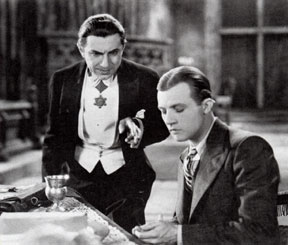
The movie industry has long been used to push the ideas of the filmmaker onto captivated movie-goers. Every film under the sun, from now humorous examples such as Reefer Madness to timeless classics such as Casablanca, seems to be layered with meaning and, dare I say, propaganda. When examining horror films, should these instances of secret meaning be considered? Does it make the film more or less art-horrifying? Perhaps taking a few examples into account would best unveil the potential horror of having our minds filled with more than thoughts of Bela offering us a nice glass of wine.
Beginning with Them, the primary theme is extremely obvious. Due to nuclear testing, ants in White Sands, New Mexico have grown to amazing sizes and have started feeding on human beings. Eventually, the ants spread out, and the horror is brought straight to L.A., where the ants have nested underneath of the city. After a vicious struggle, the ants are seemingly wiped out for good, but the character Dr. Medford warns the viewer that, “When man entered the atomic age he opened a door to a new world. What we'll eventually find in that new world nobody can predict.” This warning indicates that Medford is fearful of nuclear progression, a fear that, unlike giant ants, carries into the real world of 1953. Again, this theme is obvious, but that is not always the case.
Looking at Suspiria, there are also “hidden” themes, this time much more subtly. The witches in the film, by extending their evil lives through black magic for the sake of obtaining vast wealth, were fueled by what some sociologists call hyperconsumption (the desire to consume [i.e. purchase] more than one could possibly ever need or use). Near the beginning of the film, the character Susie is shocked at how frequently money is discussed by the staff and students of her new ballet school home, but is casually told that she will get used to it. The school itself is extremely lavish, filled to the brim with all manner of baubles, and there is even a servant to tend to the student’s needs. However, we come to learn that this wealth has been obtained through horrible means of magic, and any who begin to snoop are immediately (and quite horribly) dealt with. Susie’s final confrontation with the Black Queen (the leader of the witches) ended when Susie used one of the Black Queen’s own trinkets to destroy her (the tail-feather of an ornamental [and rather gaudy] peacock). Furthermore, after destroying the Black Queen with a bit of her own bric-a-brac, Susie must escape the house whose furnishings are exploding, potentially symbolizing that an entire (though dreadfully extended) life of hording money to consume for the self has all been for naught as the items that were horded were just as prone to mortality as the shell of a woman that purchased them. Was it worth the demented existence of the Black Queen for her to fill her life with meaningless junk that ultimately would crumble? In some way is the viewer similar to the witch for hording goods and using others for profit, leaving them (the witches via killing) when they are of no further gain?
For the crown jewel in analysis of undertone in horror, consider George A. Romero’s zombie movies, which begin with Night of the Living Dead and move all the way through the dawn and the day until ending with Land of the Dead. Romero has a lot to say about humanity in these four movies. In the first one, though the zombies are pretty horrifying in their penchant for feasting on the flesh of the living, the entity that seems most likely to doom our group of survivors is the group of survivors themselves. Constant bickering and fighting for control in the group builds up until some in the group seek to betray others and leave them at the mercy of the zombies. Furthermore, there are definite tones of racial segregation in the film, which leaves the ending a tad in the realm of the fantastic (did the Sheriff really know what was in front of him?). In the second film, the zombies all flock to the shopping mall. One human survivor, when asking why the zombies would go to the mall, is answered, “[It is some] kind of instinct. Memory, of what they used to do. This was an important place in their lives.” Romero is eager to point out the hyperconsumption of America in the 70s by representing shoppers with mindless zombies whose only purpose is to get what they want (i.e. flesh of the living, and perhaps a Tickle Me Elmo). Day of the Dead takes the theme of humans destroying themselves to shocking new heights (Romero even makes the zombies seem innocent and the humans monsters), and Land of the Dead is the result of such feuding for superiority in the face of imminent danger. After watching one of Romero’s films, a person is inclined to think just a little less of him or herself for being one of the badguys.
Do these secondary themes make the horror genre work? Does art-horror come from the thought of Frankenstein’s Monster having a smoke, or does it come from understanding that humans were truly responsible for all of the misguided suffering that he caused? The theme of nuclear testing and horrors that it can cause in the real world from Them. Perhaps the idea of hyperconsumption turning us into shells surrounded by useless trinkets that are of no benefit to us. Maybe the concept that humans are the truest foes to everything around, nature and mankind alike. The fear of giant ants, witches, or zombies may exist, for they are rather gruesome beasts to behold. However, perhaps what keeps the horror fan coming back for more is the idea that the horror presented on screen is more real than it seems. !
Beginning with Them, the primary theme is extremely obvious. Due to nuclear testing, ants in White Sands, New Mexico have grown to amazing sizes and have started feeding on human beings. Eventually, the ants spread out, and the horror is brought straight to L.A., where the ants have nested underneath of the city. After a vicious struggle, the ants are seemingly wiped out for good, but the character Dr. Medford warns the viewer that, “When man entered the atomic age he opened a door to a new world. What we'll eventually find in that new world nobody can predict.” This warning indicates that Medford is fearful of nuclear progression, a fear that, unlike giant ants, carries into the real world of 1953. Again, this theme is obvious, but that is not always the case.
Looking at Suspiria, there are also “hidden” themes, this time much more subtly. The witches in the film, by extending their evil lives through black magic for the sake of obtaining vast wealth, were fueled by what some sociologists call hyperconsumption (the desire to consume [i.e. purchase] more than one could possibly ever need or use). Near the beginning of the film, the character Susie is shocked at how frequently money is discussed by the staff and students of her new ballet school home, but is casually told that she will get used to it. The school itself is extremely lavish, filled to the brim with all manner of baubles, and there is even a servant to tend to the student’s needs. However, we come to learn that this wealth has been obtained through horrible means of magic, and any who begin to snoop are immediately (and quite horribly) dealt with. Susie’s final confrontation with the Black Queen (the leader of the witches) ended when Susie used one of the Black Queen’s own trinkets to destroy her (the tail-feather of an ornamental [and rather gaudy] peacock). Furthermore, after destroying the Black Queen with a bit of her own bric-a-brac, Susie must escape the house whose furnishings are exploding, potentially symbolizing that an entire (though dreadfully extended) life of hording money to consume for the self has all been for naught as the items that were horded were just as prone to mortality as the shell of a woman that purchased them. Was it worth the demented existence of the Black Queen for her to fill her life with meaningless junk that ultimately would crumble? In some way is the viewer similar to the witch for hording goods and using others for profit, leaving them (the witches via killing) when they are of no further gain?
For the crown jewel in analysis of undertone in horror, consider George A. Romero’s zombie movies, which begin with Night of the Living Dead and move all the way through the dawn and the day until ending with Land of the Dead. Romero has a lot to say about humanity in these four movies. In the first one, though the zombies are pretty horrifying in their penchant for feasting on the flesh of the living, the entity that seems most likely to doom our group of survivors is the group of survivors themselves. Constant bickering and fighting for control in the group builds up until some in the group seek to betray others and leave them at the mercy of the zombies. Furthermore, there are definite tones of racial segregation in the film, which leaves the ending a tad in the realm of the fantastic (did the Sheriff really know what was in front of him?). In the second film, the zombies all flock to the shopping mall. One human survivor, when asking why the zombies would go to the mall, is answered, “[It is some] kind of instinct. Memory, of what they used to do. This was an important place in their lives.” Romero is eager to point out the hyperconsumption of America in the 70s by representing shoppers with mindless zombies whose only purpose is to get what they want (i.e. flesh of the living, and perhaps a Tickle Me Elmo). Day of the Dead takes the theme of humans destroying themselves to shocking new heights (Romero even makes the zombies seem innocent and the humans monsters), and Land of the Dead is the result of such feuding for superiority in the face of imminent danger. After watching one of Romero’s films, a person is inclined to think just a little less of him or herself for being one of the badguys.
Do these secondary themes make the horror genre work? Does art-horror come from the thought of Frankenstein’s Monster having a smoke, or does it come from understanding that humans were truly responsible for all of the misguided suffering that he caused? The theme of nuclear testing and horrors that it can cause in the real world from Them. Perhaps the idea of hyperconsumption turning us into shells surrounded by useless trinkets that are of no benefit to us. Maybe the concept that humans are the truest foes to everything around, nature and mankind alike. The fear of giant ants, witches, or zombies may exist, for they are rather gruesome beasts to behold. However, perhaps what keeps the horror fan coming back for more is the idea that the horror presented on screen is more real than it seems. !
Tuesday, May 15, 2007
The Change of the Monster
A recent trend in the horror film requires greater reflection. On one hand, we have not seen a decrease in the number of films that surely would fall into the horror genre; nevertheless, the explanation of horror has changed in recent years. Within this new approach, movie-goers have witnessed a shift in tactics. The classical ‘mystic’ explanations for the vampires, were-wolves, and zombies have given away to a different breed of killer with a readily understandable scientific explanation. The philosophy of ‘Art-Horror’ by Noel Carroll offers great insight into the nature of the monster, but inevitably opens the door for a wide variety of interpretations leading to the inclusion of some monsters into the realm of horror that might be denounced by other critiques.
In light of Carroll’s development in the thought of ‘art-horror’, some movies might call into question the validity of films that are posed as ‘horror films’ with monsters whose presence in the world, at one time, could only be explained through supernatural means. We might then ask if adding a scientific explanation to the abnormal occurrence of some monsters in field of modern movies has effectively removed these characters from the horror genre into the fantastic. An obvious example of this move can been seen in newer vampire movies. In previous times the vampire was a creature neither dead nor alive and had definite strengths and powers which derived from his connection with evil, as in the movie “Bram Stoker’s Dracula”.

In the recent movie “Blade” this trend was officially stopped, and was substituted by a vampire whose existence could be explained by a virus. Other movies, such as “Underworld”, have followed suit, and though they retain some supernatural elements vampirism is portrayed as something scientifically plausible.
Other monsters have met similar fates. The dreaded brain-eating zombie in now routinely viewed as a freak of nature, rather than a supernatural villain. “Resident Evil” and “28 Days Later” both portray the ‘zombie’ as a global threat that began with the misuse of science, which though exaggerated, still remains possible from the viewer’s positions. The question remains as to whether or not this trend has had a greater impact on the monsters of older generations. If the newer creatures can now be understood from the view of a microscope, does that call into question the validity of older monsters in the horror genre?
The impact of the supernatural is most likely something that will not disappear from entertainment. In many ways, the supernatural carries more weight in producing the authentic experience of ‘art-horror’ rather than the use of ‘the fanatic’ as defined my Carroll. Then how are we to understand this new trend in movie production? A new twist on an old favorite usually does not go over well with most fans. Speaking for those fans, it is doubtful that many would prefer to understand Dracula as anything less than the ‘Prince of Darkness’, which carries supernatural (thus, unexplainable) connotations. At one level we might be tempted to discredit the monsters of this new trend, and yet there does appear to be room for the new creatures of the night. While many would probably like to see a return to the old days, perhaps in the end it is our definition of ‘art-horror’ that requires modification. And while natural explanations might be stretched at times in modern films, they do push the boundaries of what darkest parts of the imagination can conceive. In the end, for those of us who do believe in the supernatural, perhaps there is room a wide range of the impure, because there is always something more foul that creeps in the darkness.
Pleasant nightmares kids!
Monday, May 14, 2007
Earned Endings and Weak Plots
Dracula, Nosferatu, Cat People, I Walked With a Zombie, Bride of Frankenstein, and The Haunting, while considered by some to be significant horror films, are horrifying to me as an English student. Since writing stories in elementary school and now as a future Language Arts teacher, I can attest that I am more horrified by the lack of Aristotelian plotline. Remember in grade school being given that plotline to help plan the story?

From my viewing of each of these films, I have yet to see a traditional Aristotelian plot. From a future teacher's perspective, the plots of these films thus far has been a nightmare! The Introduction of the movie seems to go on forever or give a lot of irrelevant information and the rest of the movie is rising action. The climax comes near the end of the movie with little or no falling action or resolution.
Now, I understand that a lot of the suspense and fright of these movies comes from not knowing exactly how the stories wind up. A feeling of unknowing is distressing for many because they will wonder for some time after the movie is over "Was she crazy or was she really possessed? Was the house really haunted or were all the people insane? Who is the monster in the movie?" and so on. This is a good scare tactic, one that many of these movies use to up the suspense factor of a movie.
However, we have studied both of the most popular horror movie plot types: Complex Discovery Plots and Overreacher Plots. The Complex Discovery Plot has four parts -
1) Onset - where we see evidence of the monster, or the actual monster,
2) Discovery - where someone discovers that some "thing" is causing the problems,
3) Confirmation - the discoverer has to prove to everyone else that the monster exists, and
4) Confrontation - where the people confront the monster and a scuffle takes place, ultimately leading to one side winning.
The Overreacher Plot also has four parts -
1) Preparation - where we see the scientist setting up and learn of the experiment,
2) Experiment - we see the experiment actually happening
3) Experiment Goes Bad - obviously, something goes wrong with the experiment and a monster is created
4) Confrontation - the created monster is confronted, often by the scientist who made him.
Neither of these two popular horror plot types includes much of a resolution. This is fine, this is not my argument. My argument is that thus far, these movies have lacked a suspenseful, "horrifying," scary rising action. Then the climax is like "BAM!" from out of nowhere and then the movie is over. This is not how it should be; these are not good plotlines. So many of these movies could be so much better, so much scarier, if the rising action were focused on more instead of introducing the characters with random details and stories about the pasts of the characters.
In "I Walked With a Zombie," there were three scenes that I can remember that would qualify as appropriate rising action conflicts (the scene of the two women in the tower, the woman and man at the cafe with the singer, and the voodoo ritual scene). These scenes piqued our interest in the story and might have even caused a feeling of horror. Unfortunately, these scenes were weakly connected with scenes that quickly allowed our feelings of horror to disintegrate.
In my opinion, the worst film so far has been "Bride of Frankenstein." This could be due to the fact that I have read the novel and did not see "Frankenstein" before watching "Bride." Whatever the reason, the climatic ending of the monster killing everyone when his bride did not love him was completely "un-earned." In other words, the rising action did not quite fit the climax and ending. I felt cheated, because I sat and watched the whole movie and saw how Frankenstein was more just lonely and was getting to be more civilized and refined. To me, that was the major conflict, not the creation of a bride. (Though a bride could have been the answer to the conflict, except the creator was not trying to solve that problem.) Then when the bride was alive, I more just felt sorry for Frankenstein's monster that he was so hopeful that he wouldn't be alone anymore and his supposed bride was disgusted by him.
After watching The Haunting today, I have hope for the next movies that we watch. While The Haunting was also long on telling and introductions and backgrounds, it was better than the films from last week. I definitely felt some "art-horror" while watching this movie. I am more frightened by suspense and sudden-ness, but this movie had plenty of that in addition to inducing some fear of the unknown and The Fantastic. I am hoping that in the films to come I will be able to feel horrified by the events, instead of cringing at the weak plotlines.
Why Art-Horror?
While many believe that a quick scare can be innocent fun, the question exists, Why? Children love to run around in the dark with their hearts racing and screaming to heighten the rush, adults often can't resist a chance to panic a fellow worker or friend under the auspices that it was all "in fun." And everyone is given to agree that one should not take these incidents personally and just be a good sport.
But why is it considered childish to not want to be momentarily petrified?
There are those who will seek out any kind of terror and refer to it as a "thrill." Some recognized sports have the same effect as the Art-horror we have studied so far in class. For instance, many think bungy-jumping, skydiving and rock climbing can fit into the category of Horror, and has a similar physiological effect. But Art-Horror is visual and auditory. There is no real risk. One sits comfortably watching and listening to sights and sounds that drive the observer quite out of their seats. What makes one want to seek that kind of "entertainment?"
It is interesting to see how many horror films have changed over the years. Even though today's audiences may laugh at the melodrama of the films made in the 1920s and 1930s, we have to look at these older films to examine how we as an audience have changed. It is through the development of these older artistic endeavors that we can appreciate our own needs as an audience and consider what has changed. Do we still need to be panicked? What serves as a proper tool to petrify? And after the early films, why do we try to reach new heights?
When recently viewing the films Dracula, Cat People and The Haunting, I began to have another insight for the need to create suspense. There is a definite correlation between the building of expectations in the horror genre and the sexual tension experienced in real life. Many times they are brought together in the films themselves. But the anxious feelings, the unsure outcome, the need to continue to "find out" exists. The sexual overtones used in these and other films only serve to heighten the feeling of expectation. The use of gothic houses, black-and-white filming, shadowy figures all contribute to the "unknown" and build suspense for what is about to happen. Dracula has an eerie draw for women that is irresistible, the same as Oliver had for Irena in the Cat People and in other films, including The Haunting there is a feeling that release may come when the "horror" is found. The character of Eleanor seems sexually repressed and may find a release with Dr. Marquay, but instead, the need to follow these urges leads to her death.
I know many art-horror films of today are more explicit in their use of sex as a tool to build excitement and suspense. While watching the trailers for the movie Grindhouse, the use of violence and gratuitous sex is all too obvious. The horror for me would be to have to watch the entire movie.
I know I am not alone in feeling that overtones of sexual buildup only serves to enhance the suspense of many movies and books. But viewing movies in this way gives the "safe" feeling of catching a thrill. Could it be that this is the way humans have to be fashioned in order to face the many "thrills" of survival? Didn't our ancestors need to encounter many real dangers and horrors in the fight to survive? And wasn't that sexual tension present when cavemen sought a mate? Maybe humans need to enjoy the feeling of fright to be able to learn how to brace ourselves for the real deal.
What ever the answer, I'll still be game for a good horror flick and a comfortable seat. And I'm happy to be able to stop the film when the action gets too frightful. After all some days, driving to and from school can be scary enough.
But why is it considered childish to not want to be momentarily petrified?
There are those who will seek out any kind of terror and refer to it as a "thrill." Some recognized sports have the same effect as the Art-horror we have studied so far in class. For instance, many think bungy-jumping, skydiving and rock climbing can fit into the category of Horror, and has a similar physiological effect. But Art-Horror is visual and auditory. There is no real risk. One sits comfortably watching and listening to sights and sounds that drive the observer quite out of their seats. What makes one want to seek that kind of "entertainment?"
It is interesting to see how many horror films have changed over the years. Even though today's audiences may laugh at the melodrama of the films made in the 1920s and 1930s, we have to look at these older films to examine how we as an audience have changed. It is through the development of these older artistic endeavors that we can appreciate our own needs as an audience and consider what has changed. Do we still need to be panicked? What serves as a proper tool to petrify? And after the early films, why do we try to reach new heights?
When recently viewing the films Dracula, Cat People and The Haunting, I began to have another insight for the need to create suspense. There is a definite correlation between the building of expectations in the horror genre and the sexual tension experienced in real life. Many times they are brought together in the films themselves. But the anxious feelings, the unsure outcome, the need to continue to "find out" exists. The sexual overtones used in these and other films only serve to heighten the feeling of expectation. The use of gothic houses, black-and-white filming, shadowy figures all contribute to the "unknown" and build suspense for what is about to happen. Dracula has an eerie draw for women that is irresistible, the same as Oliver had for Irena in the Cat People and in other films, including The Haunting there is a feeling that release may come when the "horror" is found. The character of Eleanor seems sexually repressed and may find a release with Dr. Marquay, but instead, the need to follow these urges leads to her death.
I know many art-horror films of today are more explicit in their use of sex as a tool to build excitement and suspense. While watching the trailers for the movie Grindhouse, the use of violence and gratuitous sex is all too obvious. The horror for me would be to have to watch the entire movie.
I know I am not alone in feeling that overtones of sexual buildup only serves to enhance the suspense of many movies and books. But viewing movies in this way gives the "safe" feeling of catching a thrill. Could it be that this is the way humans have to be fashioned in order to face the many "thrills" of survival? Didn't our ancestors need to encounter many real dangers and horrors in the fight to survive? And wasn't that sexual tension present when cavemen sought a mate? Maybe humans need to enjoy the feeling of fright to be able to learn how to brace ourselves for the real deal.
What ever the answer, I'll still be game for a good horror flick and a comfortable seat. And I'm happy to be able to stop the film when the action gets too frightful. After all some days, driving to and from school can be scary enough.
Friday, May 11, 2007
Sweet Dreams...?
Through dreams, we can enter a fantasyland or even just alter reality as we know it. Much like films, dreams are safe. Even after a terrible nightmare, we wake up to the same ol’ world as when we went to sleep. In the film A Nightmare on Elm Street, Wes Craven introduced a figure that has incited insomnia among millions of viewers: Freddy Krueger.

To get a full appreciation for Krueger and his influence in pop culture, we need to take a look at the events surrounding his “existence.” His mother, a nun, was raped in an insane asylum, which resulted in her pregnancy with Freddy. Soon after his birth, Freddy was given up for adoption to a sinister man who would mistreat him until Freddy became a teenager and killed him. As an adult, Freddy married and had a daughter. A few years later, Freddy’s wife discovered that he was responsible for a string of twenty murders—all children. Freddy murdered his wife and was later arrested for murdering the twenty children. His daughter ended up in foster care and was eventually adopted.
To keep the story simple, Freddy wasn’t charged for the murders, which obviously infuriated the parents of the dead children. The parents decided to take it upon themselves to rid the world of the menacing Krueger, tracking him down in a boiler room and setting the place ablaze. Under realistic circumstances, he would have been burned to death...but as with most good storylines, things didn’t end as well as the parents expected. Three demons appeared and offered Freddy “eternal” life and the ability to turn dreams into reality. He (of course) accepted the offer. His remains were taken to a “junk yard” and locked in a red Cadillac.
Years later, in A Nightmare on Elm Street, Krueger returns to wreak revenge on the children of the parents who aided in his “murder.” He systematically enters their dreams and murders them. In the first film, the heroine (Nancy) brings Freddy into reality and turns her back on him, ridding him of his power (supposedly). Nancy walks into the sunlight, revealing that the previous occurrences must have just been an awful nightmare. In the end, however, we find that Freddy isn’t really dead—and it wasn’t really just a nightmare.
A Nightmare on Elm Street has staying power in the horror genre for quite a few reasons. Freddy himself is pretty darn terrifying-looking, especially to children. His charred, burned face would be a shock to run into in the broad daylight, much less in the murky darkness found in the movies he inhabits. Freddy is a perfect example of the fusion character Carroll talked about in his writings—he is a combination of life and death, and he gained the ability to “live” because of a deal he made with three demons. He defies science through his ability to inhabit and control dreams, and any physical harm he inflicts is brought back into reality when the person wakes up.
Although over fifteen years have passed since A Nightmare on Elm Street made its debut on the silver screen, the idea of a monster inhabiting dreams and turning them into reality is still threatening today. Dreams are a part of our psyche that can’t be explained or controlled sufficiently through modern science. To some, they are a prelude to actual events. To others, they reveal a part of ourselves we’ve hidden deep in our subconscious. To those who enjoy the horror genre, dreams offer the feared monster, Freddy, an eternal home. So...whatever you do...don't fall asleep!
Sequels-Do They Ruin The Original?

Jaws, Saw, Friday the 13th, Nightmare on Elm Street, Halloween, I Know What You Did Last Summer, Jurassic Park, Alien, Scream, Final Destination, Resident Evil, Frankenstein, The Grudge, Predator, Jeepers Creepers, Texas Chainsaw Massacre, The Ring, Blairwitch Project, Children of The Corn, The Excorcist, Carrie, Candyman, Lawnmower Man, Leprachaun, Godzilla, Anaconda, King Kong, and the list goes on. Each one of these movies mentioned above has a sequel. My question is, do the sequels ruin the original movie? Take Jaws, for example. This movie can only give you that terrifying, spine-tingling, adrenaline rush once; you can't get back the first time you see this monster claim his first victim in the movie, its priceless. After watching two hours of bloody horror and hearing scream after blood-curdling scream, could you really bring yourself to watch more? Many will say yes without any hesitation; but ask yourself, can you really perfect a masterpiece? When you put this film which took months to tape up against a film such as Saw, which took literally two weeks to put together, and ask the audience which sequel they would rather watch, what do you think the response would be? Everyone loves a scary movie and they usually don't want the movie to end because anyone watching a scary movie is usually very in to the gore and graphic nature of the film. Having said this, I would only assume that the majority of an audience asked whether they would like to watch the sequel of Jaws versus Saw would ultimately choose both.. This is true, though. I would say the same thing about these movies because I enjoyed watching them both. Unfortunately most of the time the sequels fall to the lashings of the critics and the audience as well. The reason for this? If you pay close attention to the critics or the cast of the sequel (or just pay attention in class), you will see that the director is a different person which means right there that the whole plot and storyline will be different from the original director. The cast also makes it difficult to fall into the mood you were in during the original. With theses two very important factors in play, the chances of the sequel to any horror movie being successful are slim to none in most cases. People just start to run out of ideas and they just put garbage up on the screen to make some money out of it. I have seen many, many horror movies and I can say one thing about sequels-they are nothing like the original and just get rather boring to be quite honest. So, my advice to anyone who has just recently seen a particularly good horror movie-don't watch the sequel! Chances are, there will be one within the year..
My 21st Century Monster

Monsters are one of the many scarry thoughts of a being from the mind and history. Starting with Bram Stoker's Dracula in the early nineteenth century representing a 15th Century cruel Romania ruler named Vlad III the Impaler. Vlad is remembered by many as a prince who defended his people from other foreign threats, like the Turkish invaders and German Merchants. Vlad used very torturous methods in killing these people, as you can see in the picture to the right. Why Bram Stoker used Vlad as Dracula? I believe that it is because if you look at Vlad's history he is already someone that we look at as disgust and fear. And what could be better for a basis of a horor story to take place then in his actual castle, Im scarred thinking about it, ugh!!
Also with Dracula there is so much symbolism in regards to Stoker's 19th century Romantic era. The Romantic era directly follows right after the Victorian era where people were supposedly more civalized and proper. In this Romantic period people were lets say more open to new experiences. Prostitutes and Pimps were running wild. However, with all of these new changes came new diseases. People were getting sick and dying because of this. Dracula in one theory symbolizes these prostitutes spreading the diseases. For example, Dracula (the "pimp") feeds off people by sucking their blood, in this process the victims are the women whom he poisened and soon turns into vampires (the "prostitutes"). Prostitutes obviously through having sex with many partners posioned society.
So basing my 21st century monster on someone like Dracula in our time will consist on many of different issues in our society. For example a monster could resemble things about the war on terror in Iraq that make us sick, the many different drugs that americans are getting their hands on, or something even gruesomer that symbolizes the sickness of people who molest kids and so on. (as I just mentioned in that last statement I was questioning on even putting that on my blog because its absolutely sick and disgusting that people even do that stuff. But thats exactly why I did, because in the days of Dracula, it was sick and disgusting things like that, that made as we know it today one of the most famous monsters of all time.)
I believe symbolism is important in a monster, but I also agree with Carrol's definition of one too. My monster would consist of being non existence with science, threatful, and disgusting.
Thursday, May 10, 2007
One scene Art-Horror
Can Art-Horror be present in just one scene? Can an indivual scene be considered art-horror even if the rest of the movie considered as a whole does not convey the criteria needed to fit Carroll’s idea of art-horror? Can it elicit the same emotion in the viewer? If a single scene can convey art-horror does it fulfill Carroll’s idea of what the objective of a horror movie should be? For example he has said “These events constructed to move the audience rhetorically to the point that one entertains the idea that unavowed, unknown, perhaps concealed and inexplicable forces rule the universe.” Must this be true throughout the whole movie?
I did feel certain art- horror emotions during a couple scenes in the movie I Walked with a Zombie. The best scene for this was the ending when Wes let Jessica out and followed her in the woods to kill her with the arrow from the statue of St. Sebastian. Then running away into the ocean to escape crossroads or something else. In this scene I felt there to be an immediate threat from a force that was unknown. A force that was guiding everyone’s actions even when Wes killed Jessica. The ominous beat of the voodoo drums in the background set the stage voodoo’s involvement at the beginning of the scene. The doll that looked like Jessica which was being pulled and then Jessica started walking towards the door or for me she was being pulled to the door. One could say that this was coincidence until it shows Jessica being stopped by the fence and consequently the doll being stopped. The main voodoo man who is in charge of this ritual whispers something to his assistant which, I assumed to be a possible way to help the ritual keep going which was how to get Jessica to out. I assumed that they found their man and Wes walked up to the gate to let her out and it showed the doll continuing to move as did Jessica. Wes follows her into the woods after grabbing the arrow. The Jessica voodoo doll is then pierced with an arrow and then Wes kills Jessica with the arrow. I am assuming that the voodoo ritual took place first and then the actions of the characters happened at the same time or right after due to the fact that the voodoos rituals were always showed first in the examples that I have just outlined. This voodoo force to me was impure and crossroads was the tool of voodoo. When he was going after Wes who was holding Jessica, I believed there to be a danger presented by Crossroads who was disgusting. Voodoo was an unknown force to me which, was inflicting it’s victims by taking away their free will. Wes’s reaction when he saw crossroads was a lot different than when Mr. Holland saw Crossroads walking to his house. Mr. Holland commands Crossroads to go away while Wes does not speak a word but, instead is forced without a fight into the ocean and into his death. It is as if Wes sees him as a monster and is horrified due to the immediate danger and to the fact in which he came out of his spell and realized that just killed Jessica. Did he commit suicide because he realized what he had just done? Carroll has said that, “I am interested in the emotional response that horror is supposed to elicit. I have approached this issue by assuming that the audience’s responses to the monsters in works of horror are ideally intended to run parallel to and often to be cued by the emotional responses of the relevant fictional characters to monsters.”
There is no cohesive monster or some can argue no monster at all throughout the story but, there was a not so right atmosphere and a single question of what is wrong with Jessica throughout the whole movie. Is she living or is she dead. Aside from the scene in which I had just discussed and two others including the stairwell scene and the trek to Haumfort, there are limited examples that at best show that Voodoo might be the monster in the form of an unnatural evil force. The stair well scene and the trek scene are still very short of eliciting carrols idea of art-horror emotion. The best examples that may show voodoo being the monster who controls free will, include the dinner with Wes, Mr. Holland, and Stacy where everyone is having a decent meal with the conversation turning very slightly sour but, as soon as the voodoo drums start up the conversation turns very blunt and very nasty very quickly. When Mr. Holland and Jessica are having their serious relationship discussion the drums beat in and the conversation takes a very obvious turn toward dark pecimissm. Also there is the question posed by Stacy’s boss at the very beginning which sets the tone for movies and a possible question “Do you believe in witch craft?”. At the end scene discussed above there is still no conclusion that the monster inside of crossroads has been the menace all along.
Art-horror can exist in only one scene even if the movie as a whole does not include it. It depends somewhat on the type of viewer you are and what you pay attention too. The lack of cohesion for a monster throughout the story definitely takes away from the intensity in emotion that I think most people will feel in this end scene but, for an average viewer who is not trying to look very closely at the film or scrutinize it will not have very much emotion taken away due to the lack of cohesion or a specific monster targeted out. This will be true if other things such as atmosphere play a greater roll.
I did feel certain art- horror emotions during a couple scenes in the movie I Walked with a Zombie. The best scene for this was the ending when Wes let Jessica out and followed her in the woods to kill her with the arrow from the statue of St. Sebastian. Then running away into the ocean to escape crossroads or something else. In this scene I felt there to be an immediate threat from a force that was unknown. A force that was guiding everyone’s actions even when Wes killed Jessica. The ominous beat of the voodoo drums in the background set the stage voodoo’s involvement at the beginning of the scene. The doll that looked like Jessica which was being pulled and then Jessica started walking towards the door or for me she was being pulled to the door. One could say that this was coincidence until it shows Jessica being stopped by the fence and consequently the doll being stopped. The main voodoo man who is in charge of this ritual whispers something to his assistant which, I assumed to be a possible way to help the ritual keep going which was how to get Jessica to out. I assumed that they found their man and Wes walked up to the gate to let her out and it showed the doll continuing to move as did Jessica. Wes follows her into the woods after grabbing the arrow. The Jessica voodoo doll is then pierced with an arrow and then Wes kills Jessica with the arrow. I am assuming that the voodoo ritual took place first and then the actions of the characters happened at the same time or right after due to the fact that the voodoos rituals were always showed first in the examples that I have just outlined. This voodoo force to me was impure and crossroads was the tool of voodoo. When he was going after Wes who was holding Jessica, I believed there to be a danger presented by Crossroads who was disgusting. Voodoo was an unknown force to me which, was inflicting it’s victims by taking away their free will. Wes’s reaction when he saw crossroads was a lot different than when Mr. Holland saw Crossroads walking to his house. Mr. Holland commands Crossroads to go away while Wes does not speak a word but, instead is forced without a fight into the ocean and into his death. It is as if Wes sees him as a monster and is horrified due to the immediate danger and to the fact in which he came out of his spell and realized that just killed Jessica. Did he commit suicide because he realized what he had just done? Carroll has said that, “I am interested in the emotional response that horror is supposed to elicit. I have approached this issue by assuming that the audience’s responses to the monsters in works of horror are ideally intended to run parallel to and often to be cued by the emotional responses of the relevant fictional characters to monsters.”
There is no cohesive monster or some can argue no monster at all throughout the story but, there was a not so right atmosphere and a single question of what is wrong with Jessica throughout the whole movie. Is she living or is she dead. Aside from the scene in which I had just discussed and two others including the stairwell scene and the trek to Haumfort, there are limited examples that at best show that Voodoo might be the monster in the form of an unnatural evil force. The stair well scene and the trek scene are still very short of eliciting carrols idea of art-horror emotion. The best examples that may show voodoo being the monster who controls free will, include the dinner with Wes, Mr. Holland, and Stacy where everyone is having a decent meal with the conversation turning very slightly sour but, as soon as the voodoo drums start up the conversation turns very blunt and very nasty very quickly. When Mr. Holland and Jessica are having their serious relationship discussion the drums beat in and the conversation takes a very obvious turn toward dark pecimissm. Also there is the question posed by Stacy’s boss at the very beginning which sets the tone for movies and a possible question “Do you believe in witch craft?”. At the end scene discussed above there is still no conclusion that the monster inside of crossroads has been the menace all along.
Art-horror can exist in only one scene even if the movie as a whole does not include it. It depends somewhat on the type of viewer you are and what you pay attention too. The lack of cohesion for a monster throughout the story definitely takes away from the intensity in emotion that I think most people will feel in this end scene but, for an average viewer who is not trying to look very closely at the film or scrutinize it will not have very much emotion taken away due to the lack of cohesion or a specific monster targeted out. This will be true if other things such as atmosphere play a greater roll.
Not Your Grandma's Horror Film Anymore
After viewing the movies we've seen this week, I think it's safe to say that the horror film sof today are entirely different than those of yesteryear. I sometimes wonder how these films were scary to some, but after diving into the guts of the films, I can see how, in their times, they could have evoked fear. Producers back in the day were able to do things with scenery and camera angles that created a sense of suspense and fear.
In Cat People, they were able to keep you on the edge of your seat during the swimming pool scene, not because they had some elaborate scene, but because of the way they controlled the lighting and the background noise. You are constantly wondering what is going to come next and whether or not Irena is going to turn into a cat and cause harm. You never see actual harm done, but you are left in wonder when you see the robe that is torn to shreds. They time the music perfectly so as to make your heart jump at just the right time.
In the Bride of Frankenstein, the costume of the monster is tremendous. The way he looks and talks is enough to make you feel unnerved. But then as the movie progresses, you almost feel sympathy for the monster and I think that causes most of the horror to disappear.
Today's horror films are altogether different. In these days, it is all about getting into your mind and making you think. For the most part, you don't see huge monsters like the Wolfman and Frankenstein, but more everyday people turned wrong. For example, in the Saw series of movies, you wonder what gruesome task the people are going to be made to do in order to spare their life. It aims at getting inside your head and ripping your heart out.
The monster in this case, John, starts out as someone in a hospital seeking treatment. When he is treated so terribly, he seeks revenge. This movie works at evoking fear because you have to try to figure out how all of the people are connected and why each of them was targeted. Part of the suspense is seeing what people will do when they are put in a situation in which they have to make a choice and not necessarily one that will be completely beneficial to them. You get to almost put yourself in the characters shoes and think about what you would do if you were in the same position.
Movies of today focus more on gore and blood, with each trying to be more terrifying and bloody than the last. Movies of the past focused more on suspense and drama. Both methods are effective, however after seeing movies that are made now, it is much harder for any of us to be terrified of something that was made 60 or 70 years ago
In Cat People, they were able to keep you on the edge of your seat during the swimming pool scene, not because they had some elaborate scene, but because of the way they controlled the lighting and the background noise. You are constantly wondering what is going to come next and whether or not Irena is going to turn into a cat and cause harm. You never see actual harm done, but you are left in wonder when you see the robe that is torn to shreds. They time the music perfectly so as to make your heart jump at just the right time.
In the Bride of Frankenstein, the costume of the monster is tremendous. The way he looks and talks is enough to make you feel unnerved. But then as the movie progresses, you almost feel sympathy for the monster and I think that causes most of the horror to disappear.
Today's horror films are altogether different. In these days, it is all about getting into your mind and making you think. For the most part, you don't see huge monsters like the Wolfman and Frankenstein, but more everyday people turned wrong. For example, in the Saw series of movies, you wonder what gruesome task the people are going to be made to do in order to spare their life. It aims at getting inside your head and ripping your heart out.
The monster in this case, John, starts out as someone in a hospital seeking treatment. When he is treated so terribly, he seeks revenge. This movie works at evoking fear because you have to try to figure out how all of the people are connected and why each of them was targeted. Part of the suspense is seeing what people will do when they are put in a situation in which they have to make a choice and not necessarily one that will be completely beneficial to them. You get to almost put yourself in the characters shoes and think about what you would do if you were in the same position.
Movies of today focus more on gore and blood, with each trying to be more terrifying and bloody than the last. Movies of the past focused more on suspense and drama. Both methods are effective, however after seeing movies that are made now, it is much harder for any of us to be terrified of something that was made 60 or 70 years ago
Nosferatu verse Dracula
What makes an art-horror movie more shocking? What characteristics make a vampire more frightening to the audience? There are many elements of a film to be considered when determining which is more shocking. To know which vampire is more frightening it is important to analyze different aspects of the films and to understand Carroll’s theory of what makes a monster. Count Dracula is a monster that has survived for decades and is seen every year on Halloween.
Halloween is that time of year where kids can dress up as someone else whether it is fearsome or not. They go from door to door and say trick-or-treat in order to receive candy. Many people like to attend haunted houses in order to receive a rush of adrenaline by being spooked. When I was a kid and dressed up as Dracula I pictured Todd Browning’s portrayal. I wore a long cape with a white dress shirt underneath and black pants. My hair was slicked back and face was painted white. I also had fake teeth with fangs.
There are many different ideas of what makes a vampire according to Murnau and Browning. From an audiences perspective Nosferatu is seen as more mysterious and eerie. His appearance is like a dead corpse. He is frightening with his rodent-like features of two front pointy teeth, long sharp fingernails, a hunched back, busy eyebrows, creepy pointy nose, and dark eyes. Nosferatu has extensive make-up done to create an image of a monster. Nosferatu was a silent film so the director used a great deal of imagery. The shots of castle Orlok were used to set a spooky place where the vampire lurked. The movie setting is dark and has a blue tint to it creating the scenes for nighttime. The camera shots involved different angles some of which were a long oval to create drama within the scene. The horror in Nosferatu is caught by the darkness of the castle and the expressions on the characters faces. Hutter, a victim in Murnau’s Nosferatu keeps his distance from the vampire and is a little reluctant to follow him, but does because he needs the money. Most of the castle is very dark with many angular shapes throughout. The music that was used sounded like a flute that would sound higher pitched when they were getting closer to the vampire.
Todd Browning has a different take of Dracula and creates a handsome looking man who has dark hair that is slicked back. He wears suits, which create a look of normalcy. Dracula from Todd Browning’s perspective is a brighter happier man. This aspect of Dracula makes it easier to lure people into his castle. A lot of the shots incorporated background images such as; large cob webs, scary spiders, bats, and dirt throughout the castle. Also the director chooses to produce shots that made the castle look very large with big arches and sculptures inside.
According to Carroll’s view of what creates a monster would Nosferatu or Dracula be considered more scary or more of a monster? Carroll says that vampires are impure, disgusting, and fearful, which tells us they are considered monsters. Carroll views a vampire as dead/undead and the term used for this is fusion. The rats follow Nosferatu and are found in his coffin, which brings one to associate it with impurity and disgust. This is especially seen where the director chooses to have a close up shot of Nosferatu’s face and a rat coming out of his coffin. Dracula is considered a monster according to Carroll, but at first is not seen as disgusting as Nosferatu. Dracula is seen as handsome and normal. In this instance I believe Carroll would see Nosferatu as more scary and would fit his definition of a monster more closely, but later in the film it is revealed that both Nosferatu and Dracula are impure creatures that suck the life out of innocent beings in order to survive. In the end Dracula and Nosferatu are both monsters that would be frightening, disgusting, and impure. From what is seen in the two films I believe Carroll would lean toward the side that Nosferatu is scarier and monstrous because of the more frightening look the director gives to the character.
Halloween is that time of year where kids can dress up as someone else whether it is fearsome or not. They go from door to door and say trick-or-treat in order to receive candy. Many people like to attend haunted houses in order to receive a rush of adrenaline by being spooked. When I was a kid and dressed up as Dracula I pictured Todd Browning’s portrayal. I wore a long cape with a white dress shirt underneath and black pants. My hair was slicked back and face was painted white. I also had fake teeth with fangs.
There are many different ideas of what makes a vampire according to Murnau and Browning. From an audiences perspective Nosferatu is seen as more mysterious and eerie. His appearance is like a dead corpse. He is frightening with his rodent-like features of two front pointy teeth, long sharp fingernails, a hunched back, busy eyebrows, creepy pointy nose, and dark eyes. Nosferatu has extensive make-up done to create an image of a monster. Nosferatu was a silent film so the director used a great deal of imagery. The shots of castle Orlok were used to set a spooky place where the vampire lurked. The movie setting is dark and has a blue tint to it creating the scenes for nighttime. The camera shots involved different angles some of which were a long oval to create drama within the scene. The horror in Nosferatu is caught by the darkness of the castle and the expressions on the characters faces. Hutter, a victim in Murnau’s Nosferatu keeps his distance from the vampire and is a little reluctant to follow him, but does because he needs the money. Most of the castle is very dark with many angular shapes throughout. The music that was used sounded like a flute that would sound higher pitched when they were getting closer to the vampire.
Todd Browning has a different take of Dracula and creates a handsome looking man who has dark hair that is slicked back. He wears suits, which create a look of normalcy. Dracula from Todd Browning’s perspective is a brighter happier man. This aspect of Dracula makes it easier to lure people into his castle. A lot of the shots incorporated background images such as; large cob webs, scary spiders, bats, and dirt throughout the castle. Also the director chooses to produce shots that made the castle look very large with big arches and sculptures inside.
According to Carroll’s view of what creates a monster would Nosferatu or Dracula be considered more scary or more of a monster? Carroll says that vampires are impure, disgusting, and fearful, which tells us they are considered monsters. Carroll views a vampire as dead/undead and the term used for this is fusion. The rats follow Nosferatu and are found in his coffin, which brings one to associate it with impurity and disgust. This is especially seen where the director chooses to have a close up shot of Nosferatu’s face and a rat coming out of his coffin. Dracula is considered a monster according to Carroll, but at first is not seen as disgusting as Nosferatu. Dracula is seen as handsome and normal. In this instance I believe Carroll would see Nosferatu as more scary and would fit his definition of a monster more closely, but later in the film it is revealed that both Nosferatu and Dracula are impure creatures that suck the life out of innocent beings in order to survive. In the end Dracula and Nosferatu are both monsters that would be frightening, disgusting, and impure. From what is seen in the two films I believe Carroll would lean toward the side that Nosferatu is scarier and monstrous because of the more frightening look the director gives to the character.
Horror Attraction-vs- Hierarchical Needs
What is the attraction to horror? Is it the feeling of being scared due to the unknown? Are we attracted to horror on some psychological level that exposes us to taboo and restricted thoughts or behavior? Or is it the thrill of being exposed to obscure scenes of reality in a safe, controlled environment? The attraction appeals differently to various people on different levels. However, the fact remains that horror as an art form has developed its own genre.
N. Carroll defines art-horror as " an audience member in an analogous emotional state to that which fictional characters beset by monsters are described to be in, then: audience member is art-horrified by some monster X, if and only if 1) the audience member is in some state of abnormal, physically felt agitation (shuddering, tingling or screaming) which 2) has been caused by a) the thought: the monster is a possible being; and by the evaluative thoughts: that b) said monster has the property of being physically (and perhaps morally and socially) threatening in the ways portrayed in fiction that c) said monster has the property of being impure, where 3) such thoughts are usually accomplished by desire to avoid the touch of the monster." Carroll's definition explains the audience's physical and emotional reactions as a result of being art-horrified. This sensation and attraction to horror can be viewed as a contradiction to the social norm as related to establishing safety and security as the foundation of human hierarchy of needs.
I base this proposal of contradiction on the fact that seeking out art-horrific experiences contradicts the basic human hierarchy of needs. The basic human need is to establish safety, security and order in one's everyday life. Subjecting yourself to situations that conjure up emotions of fear and disgust and physical reactions such as chills and uneasiness seem to defy the social norm of needing and maintaining a safe, secure environment.
Whatever the attraction for individuals to horror, i.e., fear of unknown, psychological exposure to taboo thoughts or behavior, or just the thrill of horror experiences in a safe environment, the fact remains that there is an established genre for art-horror. With an established need, horror artists will continue to provide horrific plots and situations for the demanding audiences regardless of hierarchical needs in our society.
N. Carroll defines art-horror as " an audience member in an analogous emotional state to that which fictional characters beset by monsters are described to be in, then: audience member is art-horrified by some monster X, if and only if 1) the audience member is in some state of abnormal, physically felt agitation (shuddering, tingling or screaming) which 2) has been caused by a) the thought: the monster is a possible being; and by the evaluative thoughts: that b) said monster has the property of being physically (and perhaps morally and socially) threatening in the ways portrayed in fiction that c) said monster has the property of being impure, where 3) such thoughts are usually accomplished by desire to avoid the touch of the monster." Carroll's definition explains the audience's physical and emotional reactions as a result of being art-horrified. This sensation and attraction to horror can be viewed as a contradiction to the social norm as related to establishing safety and security as the foundation of human hierarchy of needs.
I base this proposal of contradiction on the fact that seeking out art-horrific experiences contradicts the basic human hierarchy of needs. The basic human need is to establish safety, security and order in one's everyday life. Subjecting yourself to situations that conjure up emotions of fear and disgust and physical reactions such as chills and uneasiness seem to defy the social norm of needing and maintaining a safe, secure environment.
Whatever the attraction for individuals to horror, i.e., fear of unknown, psychological exposure to taboo thoughts or behavior, or just the thrill of horror experiences in a safe environment, the fact remains that there is an established genre for art-horror. With an established need, horror artists will continue to provide horrific plots and situations for the demanding audiences regardless of hierarchical needs in our society.
The Unknown
The fear of the unknown. Must you always be aware of or know what you are afraid of? Can the unknown create fear? It seems as though the unknown is at least as effective, if not more effective. In some of Noel Carroll’s writings he states that you need to know what you are afraid in order to have fear. And we know that without fear, there is no art-horror. I wonder why you can’t fear something you don’t know? It seems to me that the unknown is just as mysterious, if not more, than knowing who the monster or threat is. A whole horror film could be and has been built upon and based on the unknown. The lurking and the noises brought on by such a creature, but not knowing what the creature/monster looks like.
In the case of the films we watched thus far, for instance “Cat People,” it was the not knowing that embarked fear. The most famous scene within the film “Cat People” is the swimming pool scene, in which Alice is going for a swim in the pool at her apartment building. Dark surrounds her, and she hears someone lurking within the building. Not knowing who is in fact after her, builds the excitement and the suspense. While we have suspicions on who it may be, that being Irena (the one believed to be one of the cat people), we are not positive of that. The same feeling comes from the film “I Walked with a Zombie.” In the scene where Betsy is leading Mrs. Holland through the woods and fields. The idea of not knowing what could come next or not knowing what to expect, brings about fear. The wind is blowing, you can hear drums in the distance; as she walks through the woods dead animals hang, and then at the end stands a man, tall with eyes wide open. Even though the whole movie is not based upon the suspense of not knowing who the monster is, that part brings about fear in the audience and the characters as well (mainly in Betsy).
Other films that come to mind, with respect to not knowing who the culprit is throughout a large portion of the film, includes: “Scream”, “I Know What You Did last summer”, “From Hell”, and “Saw.” In these movies the suspense of not knowing who is after them is part of the excitement. In “I Know What You Did Last Summer” the audience and the characters alike are sitting back waiting to see what happens and who in fact does know what happened last summer. In “Scream,” there are telephone calls and spook happenings, but the other characters and the audience are not sure who is in fact behind all the madness, or who is in fact behind the mask. (Side note: Would Carroll consider “Scream” a horror film? Is there in fact a monster in the film, with respect to Carroll’s definition? It seems not.) Nevertheless, there are films out there that leave the audience and characters guessing. The art of the unknown is just as gripping as the art of the known.
For instance, imagine you are asleep in bed and you hear a loud bang. You are immediately awoken from your sleep and go out to see what caused this noise. The thought of someone being out there adds more than knowing what actually caused the loud bang. If you know that the big bang was caused by your dog knocking down a lamp or something of that sort, you are more at ease to go back to sleep. Now I’m not saying that if you went out and saw a horrifying monster or creature that you wouldn’t be in fear. I am simply saying that not finding anything can also brings about fear. This brings more suspense and builds up fright. You don’t know what is out there and are up wondering if someone is going to come through that door.
Overall, it seems as though there is in fact a fear of the unknown. Sometimes the idea of not knowing who is committing all these massacres within horror films is actually scarier than knowing who is doing them. At least you know who to look out for and who to run from. There’s always that notion that if you don’t know who the culprit is, you could be sitting right next to him without knowing. I find this fearful.
In the case of the films we watched thus far, for instance “Cat People,” it was the not knowing that embarked fear. The most famous scene within the film “Cat People” is the swimming pool scene, in which Alice is going for a swim in the pool at her apartment building. Dark surrounds her, and she hears someone lurking within the building. Not knowing who is in fact after her, builds the excitement and the suspense. While we have suspicions on who it may be, that being Irena (the one believed to be one of the cat people), we are not positive of that. The same feeling comes from the film “I Walked with a Zombie.” In the scene where Betsy is leading Mrs. Holland through the woods and fields. The idea of not knowing what could come next or not knowing what to expect, brings about fear. The wind is blowing, you can hear drums in the distance; as she walks through the woods dead animals hang, and then at the end stands a man, tall with eyes wide open. Even though the whole movie is not based upon the suspense of not knowing who the monster is, that part brings about fear in the audience and the characters as well (mainly in Betsy).
Other films that come to mind, with respect to not knowing who the culprit is throughout a large portion of the film, includes: “Scream”, “I Know What You Did last summer”, “From Hell”, and “Saw.” In these movies the suspense of not knowing who is after them is part of the excitement. In “I Know What You Did Last Summer” the audience and the characters alike are sitting back waiting to see what happens and who in fact does know what happened last summer. In “Scream,” there are telephone calls and spook happenings, but the other characters and the audience are not sure who is in fact behind all the madness, or who is in fact behind the mask. (Side note: Would Carroll consider “Scream” a horror film? Is there in fact a monster in the film, with respect to Carroll’s definition? It seems not.) Nevertheless, there are films out there that leave the audience and characters guessing. The art of the unknown is just as gripping as the art of the known.
For instance, imagine you are asleep in bed and you hear a loud bang. You are immediately awoken from your sleep and go out to see what caused this noise. The thought of someone being out there adds more than knowing what actually caused the loud bang. If you know that the big bang was caused by your dog knocking down a lamp or something of that sort, you are more at ease to go back to sleep. Now I’m not saying that if you went out and saw a horrifying monster or creature that you wouldn’t be in fear. I am simply saying that not finding anything can also brings about fear. This brings more suspense and builds up fright. You don’t know what is out there and are up wondering if someone is going to come through that door.
Overall, it seems as though there is in fact a fear of the unknown. Sometimes the idea of not knowing who is committing all these massacres within horror films is actually scarier than knowing who is doing them. At least you know who to look out for and who to run from. There’s always that notion that if you don’t know who the culprit is, you could be sitting right next to him without knowing. I find this fearful.
Who Needs Monsters?
Some of my favorite monsters from some of my favorite horror films include: The wolf man, Michael Myers from Halloween, Leatherface from The Texas Chain Saw Massacre, Jason from Friday the 13th , Freddy Krueger from A Nightmare on Elm Street, Chucky from Child’s Play, Jack from The Shining, and the demented and mutated families from both The Hills Have Eyes and The Devil’s Rejects. These monsters are typical monsters as defined by Noel Carroll in that they do not exist according to contemporary science but do have the possibility of existing in our society. These monsters are also very disgusting according to my accounts and are impure due to either fusion of multiple organisms into one being, fission of multiple personalities or alter-egos, the magnification or massification of revolting things, or metonymy as stated by Carroll. But the question is, are these monsters a necessary entity for a piece to be included into the Horror genre?
Think about everyday life and how often we are not only afraid of actual objects like spiders or snakes but are frightened by certain situations which may arise and are not caused by any monster or supernatural power (excluding The Almighty, of course). Our fear of certain situations can often be much more horrifying to us than any monster can be. These are situations like being stuck in an elevator or any tight space or hanging from a rope 700 feet in the air, etc. These are phobias that will cause an involved person the same ‘Art-Horrified’ feelings both physical (raised heart-rate, extreme nervousness, nausea, etc) and cognitive (the mind acknowledging the presence of both the phobia and the danger in the situation) that Carroll states a horror film monster would.
Here, proposed is the theory that the only necessary property of a horror film is that it gives its audience the feeling of horror. It should be irrelevant how the film accomplishes this goal. The inclusion of a monster can, from now on, be considered an added bonus to viewing a horror film, but not a necessary component. If the audience gets the feeling of being horrified or ‘Art-Horrified’ according to Carroll during the viewing of the film then it should be considered a horror film.
Next, it will be attempted to create a subject for a horror film using the theory proposed above and without using a monster but still horrifying the audience. One day a man named Steve decides he will climb the Red Rock Hills of Arizona. Steve loves rock-climbing and is very good at it. This time; however, he decides to venture alone since no one else is willing. Here Steve is breaking the number one rule of climbing, be he is confident nothing will happen. Steve arrives at the hills early in the morning and begins his journey across and over the hills. As he is climbing he slips and falls and lands in a grotto between the large boulders. To his surprise, his arm is stuck in between these two massive rocks and he cannot move. Hours pass by and Steve is still stuck. It’s impossible to dislodge his arm from between the rocks, his water is running low, his food is eaten and his cell phone has absolutely no service. To make matters worse, nighttime in Arizona is often frigid for the unprepared. Steve has two options, sit and wait for passers by to hopefully come and save him before he dies from dehydration, or amputate his arm with the small pocketknife he carries with him. Now tell me this situation wouldn’t make even the noblest of the all even a little uncomfortable.
Think about everyday life and how often we are not only afraid of actual objects like spiders or snakes but are frightened by certain situations which may arise and are not caused by any monster or supernatural power (excluding The Almighty, of course). Our fear of certain situations can often be much more horrifying to us than any monster can be. These are situations like being stuck in an elevator or any tight space or hanging from a rope 700 feet in the air, etc. These are phobias that will cause an involved person the same ‘Art-Horrified’ feelings both physical (raised heart-rate, extreme nervousness, nausea, etc) and cognitive (the mind acknowledging the presence of both the phobia and the danger in the situation) that Carroll states a horror film monster would.
Here, proposed is the theory that the only necessary property of a horror film is that it gives its audience the feeling of horror. It should be irrelevant how the film accomplishes this goal. The inclusion of a monster can, from now on, be considered an added bonus to viewing a horror film, but not a necessary component. If the audience gets the feeling of being horrified or ‘Art-Horrified’ according to Carroll during the viewing of the film then it should be considered a horror film.
Next, it will be attempted to create a subject for a horror film using the theory proposed above and without using a monster but still horrifying the audience. One day a man named Steve decides he will climb the Red Rock Hills of Arizona. Steve loves rock-climbing and is very good at it. This time; however, he decides to venture alone since no one else is willing. Here Steve is breaking the number one rule of climbing, be he is confident nothing will happen. Steve arrives at the hills early in the morning and begins his journey across and over the hills. As he is climbing he slips and falls and lands in a grotto between the large boulders. To his surprise, his arm is stuck in between these two massive rocks and he cannot move. Hours pass by and Steve is still stuck. It’s impossible to dislodge his arm from between the rocks, his water is running low, his food is eaten and his cell phone has absolutely no service. To make matters worse, nighttime in Arizona is often frigid for the unprepared. Steve has two options, sit and wait for passers by to hopefully come and save him before he dies from dehydration, or amputate his arm with the small pocketknife he carries with him. Now tell me this situation wouldn’t make even the noblest of the all even a little uncomfortable.
Where have all of the screams gone?
Why is it that old films, such as the ones that we have watched this week, don't seem to get us on the edge of our seats? Could it be that we are so used to watching films in color rather than black and white? Could it be that the blood and gore aren't used as much in the older films? The most horror that I experienced this week was most definately not from any of the films that we have watched. I can only remember one film that grabbed my interest, and I wasn't even that interested, it was "I Walked with a Zombie." Only one scene actually woke me up and that was when Betsy and Jessica ran in to the black man while running to the fort and that wasn't even that scary.
I don't mean to come off as everything that we have watched this week was bad, but I am just not used to those kinds of films and to be honest they aren't very horrifying, to me at least. It could be that all of the films that we have watched are labeled as "B" films, but I think that it is due to the fact that everything in each film appeared to be so fake. The older films from the early/mid 1900's may have been frightening to people then, however, I would imagine that most of us would agree that these films aren't very horrifying. I believe that it has something to do with the fact that none of the films we have watched have been in color, so they don't appeal much to our generation. I don't know about the rest of you, but I enjoy some blood and gore, not just a monster chasing people. I guess it is because I have grown so accustomed to the all of the blood and gore and if a "horror" film doesn't have that, then it doesn't interest me. Take, for example, "The Bride of Frankenstein" that we watched. I have heard good things about that film and was expecting to be a little horrified, but to be honest, it was quite boring...more funny than horrifying. But, again, that could be because the effects didn't seem real and it was in black and white. I don't mind watching these older films, but I can't wait to see a good film with some great horror scenes!!
I don't mean to come off as everything that we have watched this week was bad, but I am just not used to those kinds of films and to be honest they aren't very horrifying, to me at least. It could be that all of the films that we have watched are labeled as "B" films, but I think that it is due to the fact that everything in each film appeared to be so fake. The older films from the early/mid 1900's may have been frightening to people then, however, I would imagine that most of us would agree that these films aren't very horrifying. I believe that it has something to do with the fact that none of the films we have watched have been in color, so they don't appeal much to our generation. I don't know about the rest of you, but I enjoy some blood and gore, not just a monster chasing people. I guess it is because I have grown so accustomed to the all of the blood and gore and if a "horror" film doesn't have that, then it doesn't interest me. Take, for example, "The Bride of Frankenstein" that we watched. I have heard good things about that film and was expecting to be a little horrified, but to be honest, it was quite boring...more funny than horrifying. But, again, that could be because the effects didn't seem real and it was in black and white. I don't mind watching these older films, but I can't wait to see a good film with some great horror scenes!!
Wednesday, May 09, 2007
Old School Horror vs. New Horror
As we watch these movies in class from many years ago we realize how frightening they were to people. When people went to watch these movies such as Bride of Frankenstein and Cat People in the theatre they would actually be scared. They showed this by yelling and jumping out of their seats. Today it seems as though movies do not have the same affect on people. During my years of going to the movies I have never seen anyone yell, make a noise or jump out of their seats. I have only seen people jump because of a loud noise or someone popping out during a scene. Not so much because they were scared of the so called monster, but because it was unexpected.
I am unsure if the movies written in the forties and fifties were more scary or if the writers today are not making scary enough movies for our times. Are the writers trying not to make scary movies and focusing on a different genre such as gory movies? Or are the writers given only certain parameters that they have to abide by? All these questions arise, but the answers seem to be unclear. It seems today that there is many more gory films then there are scary. Such movies such as SAW which depict gory acts of mutilating human bodies in different ways seem to be more popular. Are these movies more likely to scare us in today’s world than scary? The answer to this could be yes and seems to be very true.
In today’s world are we able to distinguish what is reality and what is fantasy better than those in the forties? Is that the answer to why we are not as scared and those years ago were? Since our technology have developed at a high rate is it easier for us to distinguish that monsters look too fake and unimaginable. I believe sometimes movies get so caught up in the newest technology that the audience realizes how fake and animated the movie is. Looking back at older movies they had to work hard to make a set and create a monster. I feel like these movies are more realistic then the movies today. Today’s movies are longer and paced faster then the older movies which helps draw out the confrontation with the monster. By doing this it makes the movie more suspenseful and able to explain the characters and plot in detail.
To understand the reasoning of why movies do not have the same affect on people of today then those many years ago is hard and probably has multiple answers. Whether it be that we can distinguish fantasy from reality better now or that writers can’t come up with or are not aloud to make scary enough movies. There are many famous horror films from the forties and fifties, but it is hard to find one that’s looked upon today. This could be because horror films are not as impacting and seemed to be more focused on gory movies than scary.
I am unsure if the movies written in the forties and fifties were more scary or if the writers today are not making scary enough movies for our times. Are the writers trying not to make scary movies and focusing on a different genre such as gory movies? Or are the writers given only certain parameters that they have to abide by? All these questions arise, but the answers seem to be unclear. It seems today that there is many more gory films then there are scary. Such movies such as SAW which depict gory acts of mutilating human bodies in different ways seem to be more popular. Are these movies more likely to scare us in today’s world than scary? The answer to this could be yes and seems to be very true.
In today’s world are we able to distinguish what is reality and what is fantasy better than those in the forties? Is that the answer to why we are not as scared and those years ago were? Since our technology have developed at a high rate is it easier for us to distinguish that monsters look too fake and unimaginable. I believe sometimes movies get so caught up in the newest technology that the audience realizes how fake and animated the movie is. Looking back at older movies they had to work hard to make a set and create a monster. I feel like these movies are more realistic then the movies today. Today’s movies are longer and paced faster then the older movies which helps draw out the confrontation with the monster. By doing this it makes the movie more suspenseful and able to explain the characters and plot in detail.
To understand the reasoning of why movies do not have the same affect on people of today then those many years ago is hard and probably has multiple answers. Whether it be that we can distinguish fantasy from reality better now or that writers can’t come up with or are not aloud to make scary enough movies. There are many famous horror films from the forties and fifties, but it is hard to find one that’s looked upon today. This could be because horror films are not as impacting and seemed to be more focused on gory movies than scary.
Changing with the times
If you look at “classic” horror films and compare them to the horror films of today, the difference between the two are undeniable. Our tolerance for gore has increased to the point that pricey special effects and impressive make-up artists are necessary to convince us to buy a movie ticket. Today’s films have a weak plot, but don’t hold back when it comes to blood baths, torture, nudity, and lets not forget: dim-witted teenagers.
In the past, some of the best films were the ones that were made on a low budget, that didn’t include special effects or high paid actors. Val Lewton and Jacques Tourneur are the best examples of this. They wanted horror to be inflicted in the viewer without them even seeing the source of their fear. They succeeded at this by using shadows, camera angles and whatever else it took to finish the film in three weeks. What was it about these cheap “B” movies that captured our attention? And when was the turning point in the genre that made filmmakers want to remove the mystery of horror and turn to straight-forward killing and bloodshed?
The lack of exposure to the unknown was the main reason people were so frightened by past films. Those same films, when watched today, could be thought of as comical or even boring. But with decades of bringing to light the feeling of horror and the sense of being afraid, we need a stronger stimulus in order to reach the same affect. Consequently, this has produced blood-spattered blockbusters that lack a substantial storyline.
The only films of today that could have the potential of becoming classics would be those by director M. Night Shyamalan. His films focus more on psychological twists that evoke the feeling of fear in the audience, rather than relying on monsters that reek havoc on towns. In his film The Sixth Sense, the audience was oblivious to the fact that Bruce Willis was one of the “dead people”. Strange intellectual twists that send the reader on an emotional roller coaster may be the key to making his films modern day “classics” of horror. The envelope of our emotions is successfully being pushed.
In the long run, who knows what horror films are going to be like. What extent are filmmakers going to go through to make us feel the same fear we do when we watch films like Texas Chainsaw Massacre or Thirteen Ghosts? There may even be a time where classic horror films are not even discussed or thought of except in college classrooms.
In the past, some of the best films were the ones that were made on a low budget, that didn’t include special effects or high paid actors. Val Lewton and Jacques Tourneur are the best examples of this. They wanted horror to be inflicted in the viewer without them even seeing the source of their fear. They succeeded at this by using shadows, camera angles and whatever else it took to finish the film in three weeks. What was it about these cheap “B” movies that captured our attention? And when was the turning point in the genre that made filmmakers want to remove the mystery of horror and turn to straight-forward killing and bloodshed?
The lack of exposure to the unknown was the main reason people were so frightened by past films. Those same films, when watched today, could be thought of as comical or even boring. But with decades of bringing to light the feeling of horror and the sense of being afraid, we need a stronger stimulus in order to reach the same affect. Consequently, this has produced blood-spattered blockbusters that lack a substantial storyline.
The only films of today that could have the potential of becoming classics would be those by director M. Night Shyamalan. His films focus more on psychological twists that evoke the feeling of fear in the audience, rather than relying on monsters that reek havoc on towns. In his film The Sixth Sense, the audience was oblivious to the fact that Bruce Willis was one of the “dead people”. Strange intellectual twists that send the reader on an emotional roller coaster may be the key to making his films modern day “classics” of horror. The envelope of our emotions is successfully being pushed.
In the long run, who knows what horror films are going to be like. What extent are filmmakers going to go through to make us feel the same fear we do when we watch films like Texas Chainsaw Massacre or Thirteen Ghosts? There may even be a time where classic horror films are not even discussed or thought of except in college classrooms.
Tuesday, May 08, 2007
What Makes a Monster... Fairy Tales vs. Horror Movies
I'm sure you have met the Wicked Witch of the West from the Wizard of Oz, the Beast from Beauty and the Beast, and Shrek. We have also been introduced to Pinhead from Hellraiser, Michael Myers from Halloween, and Freddy Krueger from Nightmare on Elm Street. All of these characters have been introduced to inflict an emotion on the viewer. The directors, producers, and actors want you to have the feeling in the pit of your stomach telling you that something is not right. However, through the meeting of these characters, the later group evokes more fear in the audience then the first group. The Wicked Witch of the West tries to thwart Dorothy's plans of returning home to Kansas and even threatens to kill Dorothy and all of her friends. The Beast is a lonely, selfish prince who is placed under a magic spell and turned into a hideous beast until he can find true love and have that love returned. Finally, Shrek, the Ogre who lives in an enchanted forest and likes to be alone. So what makes these characters so different from Pinhead, Michael Myers, and Freddy Krueger? The later were created to evoke art-horror in the viewers. Throughout the following paragraphs, we will determine what makes a monster and how these monsters of horror movies compare to those in fairy tales.
 Pinhead, a character in Hellraiser was once human. After the war, he lead his life as an explorer of hidden treasures. His transformation to the Dark Prince of Pain comes through his opening of the Demonic Lament Configuration. His character creates the emotions of terror and disgust. In the movie, Kirsty bargains with Pinhead offering him more souls to spare hers. He tortures his victims, making their deaths long, drawn out and death does not end his victims sufferings. This character qualifies as a monster under Carroll's view because he is impure, his creation is outside of what science tells us, and he evokes the fear and disgust noted before.
Pinhead, a character in Hellraiser was once human. After the war, he lead his life as an explorer of hidden treasures. His transformation to the Dark Prince of Pain comes through his opening of the Demonic Lament Configuration. His character creates the emotions of terror and disgust. In the movie, Kirsty bargains with Pinhead offering him more souls to spare hers. He tortures his victims, making their deaths long, drawn out and death does not end his victims sufferings. This character qualifies as a monster under Carroll's view because he is impure, his creation is outside of what science tells us, and he evokes the fear and disgust noted before.  As far as Michael Myers character goes, he defies death in every film. He seems to be unbeatable and when you finally think you have one, it turns out that he is not dead after all. His nature of cheating death makes him a mystery to science today. He is an impure character as seen in his love of killing and his yearning to kill his sister. His mere presence is terrifying because he has the tendency to be found in the background unseen by anyone and no matter how fast his victims run, he is always right behind them. His mask may not be the most terrifying mask out there, yet his large body and threatening demeanor made him into the terrifying monster he is today.
 Freddy Krueger has to be one of the most terrifying monsters to date. He would torture and kill the children from his neighborhood in the boiler room of the power plant where he worked. He had a special room in his basement with his torture devices and newspaper clippings from his crimes. His wife found his secret room and he killed her in front of their child for "snooping around in daddy's special work. He was arrested but because the search warrant was not signed correctly he was released. Parents of the murdered children found Freddy in his boiler room, trapped and killed him. Before he died, three dream demons appeared and gave Freddy the ability to "Be forever," and turn dreams into reality. His powers enabled him to inhibit the minds of his victims as they were dreaming. Any physical harm occurring in the dream world would transfer over into reality making it easy for him to commit multiple murders. His face is distorted from his death which immediately causes terror on sight. He is impure which is seen as he kills multiple people before and after death. His life after death and his special powers defy and knowledge of science to date. He is the classic monster exemplified by the emotions cast on the audience members.
On a lighter note, fairy tale monsters are not able to produce half the amount of fear that the horror movie monsters create. A character like pinhead would never be found in a fairy tale which is why fairy tale monsters are more endurable. The Wicked Witch of the West may be frightening to a young child but to the rest of us, her presence is more amusing. She has an impure nature, she defies science as we know it because she can fly on a broomstick and vanish into thin air, and in younger children instills in them a fear of disgust and terror. Children fear her for her threats and ability to do things no one else can understand. However, as children grow up and still watch the movie she becomes amusing because of her green face and hands and her strange voice and weird sayings like, "I'll get you my pretty, and your little dog too."

The Beast from Beauty and the Beast may seem terrifying at first but as we get to know him we see a softer, lovable side. His creation is abnormal for he is transformed by a beautiful witch. He instills terror in children when we see his temper flair and his beastly form is enough to scare any child. In the beginning he has monster like qualities which change throughout the movie as he meets Belle and falls in love with her.

Finally, Shrek, the ogre who likes to be left alone and will do anything to keep it like that. He also starts out mean and scary, yet he can't even compare to the likes of the Wicked Witch of the West or the Beast. When he scares the people in the first part of the movie some are struck with a feeling of unease. However, this changes as we get to know him and he and Donkey start on their quest.
After meeting all of these "Monsters" it is easy to see where the separation of fairy tales and horror moves begins. Horror movies produce a monster that begins and ends as the monster. At the end of the movie, the feelings of distress are not lifted even if the monster is defeated. Fairy tales make lightheartedly of monsters. In the beginning of a fairy tale, we are introduced to the monster, yet in the end we have a different picture. The monster could be truly defeated, change into a handsome prince, or even show us his/her lovable side. Whatever happens in a fairy tale, there is always a happy ending where the feelings of dread and unease are lifted and the audience is happy.
We know that monsters come in all shapes and sizes and can be found in different types of movies. Carroll may not see the "Monster" in a fairy tale, but it is safe to say they are their and the only difference comes when we compare the actions of the monsters. In the end, we have to decide for ourselves. Are fairy tale monsters still monsters...
Monday, May 07, 2007
Paying for a Thrill...
As children, we're told to avoid staying home alone,talking to strangers, and putting ourselves in dangerous situations. Why is it then, as we age, we seek out movies completely contradictory to what our parents/grandparents/adults told us? What is it about horror movies that keep us coming back for more? Even children seek the thrill of being scared. I can recall being around six years old and asking my parents to "tell me a scary story!" People pay good money to sit in a theater for two hours and be frightened--on purpose. Bear with me in the next few paragraphs as I try to answer the question, "Why do we pay to be scared?"
To figure out why we like to experience fear, we need to have a good, working definition of fear itself. Merriam-Webster's Dictionary defines fear as "an unpleasant often strong emotion caused by anticipation or awareness of danger" (Merriam-Webster, 2007). It's the idea that some hidden, dreadful harm might befall us if we, say, go up to the "haunted" attic, look under the bed, or peek in the closet. Movies are a way for us to explore that danger without actually putting ourselves in harms way. By watching horror movies, we can explore primal human emotions without(pardon the pun) fear of being looked down upon by our peers. We can face our internal fears without worrying about physical or social harm.
Most of the time, we attend movies to escape reality for a bit. Few would deny that it's nice to sit in a dark theater for a brief period and immerse oneself in an imaginary world, away from the hustle and bustle of everyday life. When it comes to horror movies, however, we ironically put ourselves in a place we would never want to be in real life. This may be due to the safety offered by the situation. The difference between horror in the movies and horror in real life is we can choose to press the "pause" button or leave the theater when things become too scary. We maintain a sense of control; yet we're still able to get that momentary rush. All of this is well and good...but it still doesn't answer the question of why we want that rush, and why we choose to get it through such movies as The Exorcist, Carrie, or the Nightmare on Elm Street series.
As I mentioned before, movies as a medium allow us to explore aspects of humanity and society without engaging in the practices or ending up in the situations ourselves. We can look at the situation from the point of view of an outsider, make our judgments, and leave the theater without any lasting consequences (other than a possible nightmare). Another point is, with many horror movies, we know that danger is imminent before the characters even have a clue. Directors and writers utilize suspenseful music, shady lighting, and off-beat camera techniques to "clue us in."
Horror movies give us the opportunity to be "smarter" than the characters onscreen and thus give ourselves a mental "pat on the back" for having the ability to navigate sticky situations. In other words, for some, horror movies can be an ego trip. We're smarter than the "dumb" character who just had to go running up the stairs to where we know the big, bad monster is hiding, waiting to kill the innocent (yet gullible) victim. In this aspect, we are able to retain control of an otherwise unnerving situation and thus not be paralyzed with fear in the same way as the characters.
When it comes down to it, one hundred people can watch the same horror movie and each of them can come away with a different idea of the movies internal meaning. Still, at the end of the day, there is one common factor of us all: the investigation of that primal human emotion, fear, is something that will continue to intrigue us for many years to come.
To figure out why we like to experience fear, we need to have a good, working definition of fear itself. Merriam-Webster's Dictionary defines fear as "an unpleasant often strong emotion caused by anticipation or awareness of danger" (Merriam-Webster, 2007). It's the idea that some hidden, dreadful harm might befall us if we, say, go up to the "haunted" attic, look under the bed, or peek in the closet. Movies are a way for us to explore that danger without actually putting ourselves in harms way. By watching horror movies, we can explore primal human emotions without(pardon the pun) fear of being looked down upon by our peers. We can face our internal fears without worrying about physical or social harm.
Most of the time, we attend movies to escape reality for a bit. Few would deny that it's nice to sit in a dark theater for a brief period and immerse oneself in an imaginary world, away from the hustle and bustle of everyday life. When it comes to horror movies, however, we ironically put ourselves in a place we would never want to be in real life. This may be due to the safety offered by the situation. The difference between horror in the movies and horror in real life is we can choose to press the "pause" button or leave the theater when things become too scary. We maintain a sense of control; yet we're still able to get that momentary rush. All of this is well and good...but it still doesn't answer the question of why we want that rush, and why we choose to get it through such movies as The Exorcist, Carrie, or the Nightmare on Elm Street series.
As I mentioned before, movies as a medium allow us to explore aspects of humanity and society without engaging in the practices or ending up in the situations ourselves. We can look at the situation from the point of view of an outsider, make our judgments, and leave the theater without any lasting consequences (other than a possible nightmare). Another point is, with many horror movies, we know that danger is imminent before the characters even have a clue. Directors and writers utilize suspenseful music, shady lighting, and off-beat camera techniques to "clue us in."
Horror movies give us the opportunity to be "smarter" than the characters onscreen and thus give ourselves a mental "pat on the back" for having the ability to navigate sticky situations. In other words, for some, horror movies can be an ego trip. We're smarter than the "dumb" character who just had to go running up the stairs to where we know the big, bad monster is hiding, waiting to kill the innocent (yet gullible) victim. In this aspect, we are able to retain control of an otherwise unnerving situation and thus not be paralyzed with fear in the same way as the characters.
When it comes down to it, one hundred people can watch the same horror movie and each of them can come away with a different idea of the movies internal meaning. Still, at the end of the day, there is one common factor of us all: the investigation of that primal human emotion, fear, is something that will continue to intrigue us for many years to come.
Thursday, May 03, 2007
A Genealogy of Horror


Here for your amusement and edification are a few quotes from important theorists of the supernatural.
The Horror Genre and the Sublime:
As Lovecraft notes, the “weird” makes it appearance in the various arts long before the establishment of the horror genre itself in roughly the 18th Century. Lovecraft points out that one finds the “weird” in ancient tragedies and poems, in folksongs and folklore, in the various religious and mystical traditions of the world, and in towering artistic figures like Shakespeare and Cervantes.
Both the aesthetic concept of the sublime and the literary genre that we have come to call “horror” are products of the 18th Century.
Edmund Burke, A Philosophical Enquiry Into the Origin of our Ideas of the Sublime and Beautiful (1757)
“Whatever is fitted in any sort to excite the ideas of pain, and danger, that is to say, whatever is in any sort terrible, or is conversant about terrible objects, or operates in a manner analogous to terror, is a source of the sublime; that is, it is productive of the strongest emotion which the mind is capable of feeling.”
Immanuel Kant, The Critique of Judgment (1792)
Kant countenances two forms of the sublime, the mathematically sublime and the dynamical sublime in nature. The first has to with immense size that defeats our powers of apprehension, the second with the contemplation of the defeat of human products (and lives) by the forces of nature.
Rudolf Otto, The Idea of the Holy (1923)
The “Numinous”- Religious emotion has an archaic connection to terror. “It may burst in sudden eruption up from the depths of the soul with spasms and convulsions, or lead to the strangest excitements, to intoxicated frenzy, to transport and to ecstasy. It has its wild and demonic forms and can sink to an almost grisly horror and shuddering.”
“Awe” and “awfulness”, “he stood aghast”, and the German gruseln (as in “gruesome”), are terms that testify to the connection between the “holy” and the “dreadful.”
Religious Dread- “Its antecedent stage is ‘daemonic dread’ (the horror of Pan) with its queer perversion, a sort of abortive offshoot, the ‘dread of ghosts’. It first begins to stir in the feeling of ‘something uncanny’, ‘eerie’, or ‘weird’. It is this feeling which, emerging in the mind of primeval man, forms the starting-point for the entire religious development in history. “Demons” and “gods” alike spring from this root…”
“… the natural man is quite unable to ‘shudder’ or feel horror in the real sense of the word. For ‘shuddering’ is something more than ‘natural’, ordinary fear. It implies that the mysterious is already beginning to loom before the mind, to touch the feelings.”
H.P. Lovecraft, “Supernatural Horror in Literature,” 1945
“The oldest and strongest emotion of mankind is fear, and the oldest and strongest kind of fear is fear of the unknown.”
The “unknown”, and the experience of dreams, condition our emotional lives in such a way that there is “an actual physiological fixation of the old instincts in our nervous tissue.”
“The appeal of the spectrally macabre is generally narrow because it demands from the reader a certain degree of imagination and a capacity for detachment from everyday life. Relatively few are free enough from the spell of the daily routine to respond to rappings from outside…”
For Lovecraft, the appeal of the weird will continue to be felt, at least by a few, in the age of science and reason. The basic reason for this, according to Lovecraft, is that we are “hard-wired” psychologically to fear the “cosmic unknown.” In combination with imagination and wonderment, the feeling of cosmic fear nourishes the impulse to create and enjoy works of art treating of “weird” events and places.
“Children will always be afraid of the dark and men with minds sensitive to hereditary impulse will always tremble at the thought of the hidden and fathomless worlds of strange life which may pulsate in the gulfs beyond the stars, or press hideously upon our own globe in unholy dimensions which only the dead and the moonstruck can glimpse.”
Tuesday, May 01, 2007
Welcome to the Philosophy of Horror

This group blog exists in order to provide a forum for philosophical thought about horror films and literature. Some of the works we will discuss over the next few weeks include the James Whale Frankenstein films, Jacques Tourneur's Cat People and The Curse of the Cat People, H.P. Lovecraft's "The Colour Out of Space", and F.W. Murnau's Nosferatu.
Subscribe to:
Posts (Atom)