Sunday, May 24, 2009

Ju-On

In 2003 Ju-on came out, being a Japanese horror movie a lot of people knew that it would be frightening because the Japanese have an odd view on horror, everything the produce is for the most part is scarier than the American  version on the same movie and plot. I also think that people thought Ju-On was more frightening then the American Grudge is because Ju-On in not in English so for the most part you are more focused on what is going to on the screen (scary wise) then it what the subtitles are saying. This movie was very well produced, in the beginning of the movie while Rika (the volunteer social worker) was upstairs trying to figure out what was going on, and what was making all that noise, it really kept you on the edge of your seat because you didn’t know what was going to happen next (so it was a form of suspense) and even after Rika found the little boy she still didn’t realize that he was part of the monster, so to the viewer you didn’t know if he was just a lost little kid or if there was something wrong. Rika figured out that the house was haunted when she saw the black shadow came and killed the older lady, even after the shadow killed the lady, people still didn’t understand why the people were dying when they saw the shadow (were they dying of fear, or was the shadow straight up killing them). After people would enter the house it seemed like they were dying because of what they saw happened to the lady who was murdered by her own husband, after people left the house and went back to their normal life they seemed ok, until they started thinking about what happened in the house, once they starting thinking about it, they started to want all the lights out and have no form of light in the room they were in (which seems like it’s another way the monster is bringing them in, because the monsters only come out in the night)  at the end of the movie it seemed like Rika realized that when she put her hands over her eyes she could see everything that had happened and that would bring the lady back.

Being that this was the first ever Japanese that I saw as well as a few other people, I think it scared people even more, because no one really knew what to expect (was it going to be bloody or were they going to try and mess with peoples mind), I think that not know what you are going to get into is going to scar people, but also make them want to watch it even more. The movie is one of the best produced scary movies I think I have seen in a while, because even though I know it isn’t real but it still is scary and creepy. It is a good horror movie and it also has some suspense in it to, making you want to watch the movie all the way to the end.   

Saturday, May 23, 2009

The Complex Discovery Plot

Their are two things people look for when they go see horror films: plot and disgustingness or gore. Plot is what separates horror films from other horror films. The plot in horror films tends to be fairly predictable. The most common plot scheme is the complex discovery plot. The complex discovery plot has four parts to it: onset, discovery, confirmation, and confrontation.


The first part is onset. Onset is where the audience first comes to realize that their is monster. Onset begins the horror film. It can happen in one of two ways. The first way is the audience realizing directly that their is a monster. The audience will actually see the monster. The second way for onset to happen is not actually knowing their is a monster, but getting evidence that a monster exist. The monster may not be seen directly but destruction by the monster is seen by the audience. An example of onset is shown in The Ring in the first openning scene. The audience becomes aware of the monster when the two girls watch the movie and the one girl ends up dying.


The second part is discovery. Discovery is where one or more of the characters realizes their is a monster. The discovery of the monster to some of the characters can be through surprise or investigation. An example of discovery is shown in The Ring. The main character in the movie finds out that the little girl and the movie is killing people by investigating and going to the cabin where her niece first watched the film with ring and the little girl in it. During the discovery their is a third party that does not believe in the monster or the supernatural being. This leads into confirmation.

Confirmation is the third part of the complex discovery plot. During confirmation the party that believes in the monster is trying to convince the party that does not believe in the monster. More than one party can need to be convinced. An example of confirmation can also be seen in The Ring. The main character's best friend does not believe that after watching the movie is what is causing the people to die. As the main character goes through the investigation, she tries to convince her best friend of the power of the movie and the little girl in the film.

The last part of the plot if confrontation. Confrontation consist of the characters meeting up with the monster or supernatural being. The most common confrontation is a battle between the characters and the monster. In The Ring when it gets closer to the day of the main character's death, she comes in contact with the little girl and tries to get all the deaths to stop happening. Besides the disgusting and fearsome monster, plot is one of the main reasons people go to see horror films even though the plot is a predictable scheme especially on horror.

Friday, May 22, 2009

Playing Pretend

The ability to have real emotional responses to completely imaginary and fictitious stories is one of the paradoxes of fiction. Similarly there is a paradox of horror, of how we can be scared by this truly fictitious event. Noel Caroll put forth the theory that ‘just the thought’ alone was a significant enough to elicit a physical/emotional response. Caroll builds from a previous work called the Pretend theory, a theory that makes the attempt to say we are playing a game of make believe with ourselves, and have pretend emotions. Caroll’s theory is a reduction of the pretend theory, saying playing pretend is a little too much, but rather our thoughts are sufficient. Caroll doesn’t give enough credit to his predecessor’s work. It is the ability to play pretend that allows for a mind to just use thoughts to such a strong degree that they can bring us to an emotional response.
People are not born with a mind’s eye, or an inner voice, but rather develop these traits through playing pretend. Neural connections and networks in the brain are what allow us to perform all the functions we do in life. With the absence of these networks the human mind doesn’t know how to perform the task. Take walking for instance, the brain is relatively a blank slate, and we developed motor movement skills by repeatedly trying. Humans don’t just get up and walk around, but we learn to balance, try to stand, try to balance while standing, try to stumble, etc. With each attempt and failure the brain innately strengthens certain pathways that lead the desire outcome, and weakens others until an acceptable network is established and we can walk. Similarly with our minds eyes and inner voice we develop these things gradually, we build schemas, learn the difference between me, and other, and then start to develop understanding of the world around us by playing pretend. We willingly put ourselves into a different perspective and let the neural networks strengthen appropriately. By pretending to be the doctor helping fluffy the bear we can then begin to imagine a completely fictitious world (like fiction, or horror) and what it would be like to deal with the problems and events that a real doctor would be going through. Simultaneously this enables the ability for people to be empathic. Empathic people can look through the eyes of another and experience (at least a minor degree of comparability) what the other person experience, like the doctor and fluffy the bear. It is important to realize the development past playing pretend, and as we get older we no longer need to act out the situations but we can conjure up a hypothetical situation with a strong degree of realism and we can begin to entertain ‘what ifs’ these hypothetical situation mature with our library of life experience and final round off into the ability to conjure up a strong realistic world in our thoughts and explore them thoroughly.
The thought of an event or depiction can bring out real responsive emotions, however it is important to understand the development and how the little pieces of a own development connect together to allow us to be able to participate in those feelings. By doing so we can grow in a richer understanding of what the feelings really are, they aren’t pretend, but they are emotions stimulate (and in some sense an extension of) an imaginary event. It is the development of a minds eye and an empathetic capability (from playing pretend) that allows for us to utilize thoughts to make qausi-real fictitious events.

The Haunting (1999) vs. House on Haunted Hill (1999)

The haunted house is always thought of as just a house that is occupied by ghosts, zombies, or other ghoulish creatures. Well, The Haunting and House on Haunted Hill take the haunted house to a whole new level. The monster in these two movies is actually the houses. These two movies are about houses that are possessed by past occupants who are trapped in the house. Does this new definition of "haunted house" evoke fear in the audience? Which movie is more effective at causing the audience to fear a house?

The Haunting takes place in an old mansion, that is possessed by its first owner and maker, Hugh Crane. Hugh Crane made the mansion for children, but somehow all the children who came to the mansion always disappeared. Hundreds of years later, a professor decides to do a study on fear. The three subjects have no idea of the history of the house, until the professor lets them in on the secret. As the movie progresses the house comes to life. It starts out subtle with pounding on walls and doors and then progresses to writing on walls in blood and then to actually moving.


The house is a fusion character because it is not only a house, but also possessed by a ghost. The Haunting does not use gore to evoke fear, but suspense in not knowing what is going on. We don't understand as an audience what is causing the house to act this way. The audience isn't sure if someone is trying to scare the group of people or if the house is really possessed. The Haunting does not use the complex discovery plot. I believe that if it had, the fear of the house would not be there. The house can evoke fear in the fact that it has so many rooms, the characters are easily lost in the house. The Haunting does a great job at creating suspense, but it did not evoke fear in me when I was watching it.


House on Haunted Hill takes place in an old insane asylum that was caught on fire and all but 5 people died. Dr. Vannicutt was the head of the asylum and had gone mad. He started operating on the patients and doing procedures that were not approved. Dr. Vannicutt possesses the asylum and all the enter are killed and trapped inside with all the rest of the souls that died the night of the fire. 5 people are invited to the house many years later to stay for a night and if they do, then they will receive 1 million dollars in the morning.


The house is a fusion character, like in The Haunting. This film does not use the complex discovery plot either. It does evoke a lot more fear though. The background story of the asylum itself is more frightful and the asylum is more disgusting. There are all sorts of deformed bodies in cases, procedure rooms that involve torture, and a room with a huge tub of blood. The movie has a lot of gore and is way more graphic. I feel that this house is the better of the two at evoking fear from its audience. I was truely scared while watching. It was not just suspense, but fear and disgust at what the house was doing.


The new definition of haunted house is definitely scarier, but does it really matter whether the house is occupied by ghosts or possessed by one? It can be a fearsome and disgusting creature either way. The possession of a house evokes fear, because a house is an everyday object that the human mind does not put with being possessed. A house is usually a sanctuary, but in these films, it becomes a type of hell.

Fear

When you are watching a film that has been defined as a horror film, what is it that gets to you and puts you on edge, makes you uncomfortable and agitated? What inspires that strong emotion that we’ve learned to refer to as FEAR?

We have viewed a number of films in class that have been labeled as horror films, yet no one in class seems to respond to any of the films in the sense of fear, or seem to be slightly uncomfortable. So, why is it that these films have been referred to as horrifying?

In his book, The Philosophy of Horror: Paradoxes of the Heart, Noël Carroll refers to three strategies in dealing with fear, The Illusion Theory, The Pretend Theory, and The Thought Theory of Emotional Responses to Fictions. I tend to lean more towards The Thought Theory because it makes more sense than the other two and has fewer contradictions connected with it. This theory is based on the conjecture that it is the thought of “Monster X” that generates our state of art-horror, rather than our belief that “Monster X” exists. It also states that actual emotion can be generated by entertaining the thought of something horrible. The films viewed in class had no actual monster, but the events and the reactions of the characters led us to believe that something supernatural was going on, and the monster was left a mystery only for the audience to imagine what it would look like. Some of the films didn’t show what happened to the character that was confronted by the monster and left that as well to our imagination. I believe that since we are used to films where we see the “monster” and everything is so graphic and gory we are not able to react the same way to films where there is no monster and we don’t see any blood and gore. Also since we don’t see that capacity of the danger that the characters are in we are unable to label that scene with a horrific monster. According to Carroll, “It is not that we crave disgust, but that disgust is a predictable concomitant of disclosing that unknown.” He also states that art-horror is the price we are willing to pay for the revelation of that which is impossible and unknown.

Fear comes from the unknown. As Lovecraft narrates, “The oldest and strongest emotion of mankind is fear, and the oldest and strongest kind of fear is fear of the unknown.” We fear the unknown because we don’t know what to do or how we would react to it. We don’t know what’s coming so we don’t know how to prepare for it. We as humans live most of our lives in fear even though we don’t admit it or maybe even realize it, but if we truly and deeply think about our life we would realize that we live wondering “What if?” most of the time, we are always questioning the unknown and it frightens us not knowing the answer.

The Power of Suggestion

The power of suggestion is very strong. That's how hypnotism and magic shows work. I was hypnotized once at a show and I'm still not exactly sure what I experiences. It was a strange experience. I didn't think it would work on me because I am not one of those people who can fall asleep or be relaxed very easily. It takes a lot of effort for me to relax.  When the hypnosis process began, I found myself becoming completely relaxed. It almost seemed paradoxical. Throughout the entire hypnosis show I knew fully well what I was doing and hearing but it almost felt like I had no option but to follow the instructions I was given. Like I said, I'm still not exactly sure what happened. A lot of it was most likely the power of suggestion as well as the environment that I was in. I knew that I was supposed to be a part of an entertainment show, which more than likely influenced me to go along with the hypnosis even more than I already was. I felt very aware yet unaware at the same time. I think that sometimes this is the kind of effect that horror films can have on you.

            Have you ever watched a horror film in the theatre, or at home in a dark and cold basement with a bunch of your friends and been scared out of your mind until later when you realized that that movie was in fact not scary at all? When you are with all of your friends and you want to be scared, it's no longer just the film, but the watching of the film that becomes a source of entertainment. We want to be scared or we wouldn't be watching the film. Then, at the same time, we realize that we want to share this experience of being scared with our friends, so we become automatically more susceptible to the horror of the film.

            Then, the environment comes into play. If you watch a horror film in broad daylight, while listening to your little sister sing High School Musical songs upstairs, chances are you aren't going to be very afraid. If you are in your basement, with all the lights of, in the middle of the night and not a sound is heard around you, chances are that same movie is going to have much more of a horrific impact on you. The same thing goes for a movie theatre. There is a reason that movie theatres are dark. They set up the perfect atmosphere without interruptions that allow you to be scared. You may easily see a horror film and be absolutely terrified from it, but as soon as you walk outside into the daylight, you're fine. If it's night, however, you may leave the theatre flinching at every noise you hear on the way home.

            When I found out that we were going to watch the movie Ju-On in class, I was immediately excited. I love being scared and I had a feeling this movie would scare me. When time came for us to watch it, I immediately got the chills. I went from being very hot in the classroom to immediately being cold. I zipped up my sweatshirt and put my hood on my head, so as to "hide", in a sense. I hadn't even seen anything yet and I was already afraid! Even though someone would've thought I was watching the scariest movie ever made if they were watching me during it, I would have to, overall; say that the movie was just alright. I was scared for some parts of it, but after the fact of the matter, I realized that for the most part I was not. It's very easy to convince yourself that you are scared if you are in the right environment. As I said, it's the power of suggestion that is truly scary.

The Complex Discovery Plot in Candyman

In The Philosophy of Horror, Carroll defines what he calls the “complex discovery plot.” Carroll writes that this plot, consisting of an onset, discovery, confirmation, and confrontation, can be found in many horror movies. An example of the complex discovery plot in a horror movie would be in the movie Candyman.

The onset of the monster occurs when a graduate student at the University of Chicago, Helen Lyle, is working on a thesis about local legends and myths in the Chicago area. Helen and her colleague Bernadette Walsh focus on the myth of Candyman. Through the interviews that the two conduct, they learn that the legend of Candyman was first heard in 1819. According to legend, Candyman was the son of a slave and his father became rich from designing a device for shoes after the civil war. Candyman was sent to nice schools and grew up in a polite society. He had a talent as an artist and was sought after for documenting people’s wealth through portraits. Candyman had a job to capture a man’s daughter’s beauty; consequently, Candyman fell in love with her and got her pregnant; as a result, her father hired a gang of hooligans to kill Candyman. The men chased Candyman through the town to Cabrini Green where they preceded to saw off his right hand with a rusty saw. The group also poured honey on him and smashed bee hives over his naked body. The bees stung Candyman to death. The hooligans then burned his body and spread his ashes all over Cabrini Green. The legend goes on about how if one says Candyman’s name five times in the mirror he would come and kill the person with his hook for a right hand.

Helen eventually talks to one of the janitors at the University and the woman tells her about a woman, Ruthie Jean who was killed at Cabrini Green, the projects. One night Helen and her friend Bernadette were working on their thesis and decided to stand in front of the mirror and say Candyman four times. Helen was the only one to say Candyman the fifth time. The next day both women headed to Cabrini Green to investigate the killing of Ruthie Jean. They began taking pictures and discovered that the medicine cabinet where Ruthie Jean was had a hole in it where they believed the killer (Candyman) murdered her. A woman who lives in Cabrini Green, Anne-Marie McCoy, befriends them both and tells her what she has heard about Candyman and the death of Ruthie Jean.

Later, Helen goes back to Cabrini Green to see where Candyman is at now. She finds a young boy who takes her to a restroom outside of the compound where apparently Candyman murdered a young boy. When Helen goes inside the restroom she opens the last stall and finds the toilet filled with bees.

Candyman is first discovered by Helen in a parking garage at the University. He says to her “be my victim, I am the writing on the wall, I am the whispering in the classroom.” The next scene is Helen waking up at Anne-Marie McCoy’s apartment at Cabrini Green in a pool of blood where a dog’s head is chopped off and Anne-Marie’s baby missing. Helen is then arrested for the missing baby and the assault on Anne-Marie, however, she is not charged because the polic have not found the body.

The next portion of the movie focuses on Helen trying to prove her innocence, and make everyone understand that it was Candyman not her. The confirmation sequence occurs many times in this movie. Helen is constantly trying to maintain her innocence, while the other characters in the movie are skeptical of the existence of Candyman. When Bernadette comes to see Helen at her apartment, Candyman kills Bernadette and Helen is again framed for the death of her colleague. Helen is admitted into a psych ward and charged with first degree murder. She decides that the only way to explain to the psychologist about what happened in her apartment is for her to call for Candyman, when doing this, Candyman kills the psychologist and breaks the window so that Helen can escape and go to Cabrini Green to be sacrificed in place of Anne-Marie’s baby. Helen makes her way back to Cabrini Green to try and clear her name for the murder and missing child.

The confrontation sequence occurs when Helen arrives back at Cabrini Green. Helen begins to battle Candyman, but the fight is futile because Candyman quickly overpowers her. She meets Candyman and he has bees coming out of his mouth and kisses her she then blacks out and a wakes up to find writing on the wall that says “it was always you Helen.” She then walks outside and hears the Marie’s baby crying, she goes in the mountain of garbage and finds the baby. Helen tries to save the baby from the pile, but the Candyman appears and thwarts her efforts. While Helen is still battling the Candyman, the locals set the pile of garbage on fire, in an attempt to kill the Candyman, and consequently Helen burns to death, without overcoming the Candyman.

Thursday, May 21, 2009

Modern Day Expectations of Horror

Violence, blood, gore, and murder are seen everyday by modern society in the games we play, television we watch, movies we see, and even the advertisements we view. It is no surprise then, that when viewing things today, audiences expect bigger, better, bloodier scenes and stories. Furthermore, when today’s audiences view movies of other times, they are bored due to the quality, lack of color, and lack of contemporary action.
This thought is extremely applicable in the genre of horror. Today’s horror films include slashers, mondo-horror, and others which death of character is prominent and plot line is not focused on. These films centralize around the visual shock element of film. Yet, when audiences view horror films from the early 20th century, the lack of on screen violence and death tends to bore audiences. These films tend to be more psychological and less on-screen action.
Moreover, the technology of today has made past movies laughable instead of frightening. This is why most monster action was off-screen then. The effects were not realistic enough, and so it was left to the imagination most of the time. Today, audiences would be shocked if the action was left to the imagination. We expect to see the monster, the deaths, and so much more in even the worst horror flick.
These effects are observable. Show an audience The Bride of Frankenstein and one will probably hear a few chuckles due to special effects and other elements. Yet, show the same audience the latest slasher film and one is certain to get a few screams of terror and moans of disgust from the group.
These observations are just based on the mass reaction to such items though. There are always a select group of people who will enjoy and may even be frightened by the old horror films. I would propose that modern reactions are based on a three-fold argument. This would include a de-sensitizing of modern society, the development of technology within the cinematic companies, and a change of preference in film. These three things are interconnected in a way in which they influence one another and the society affected by them.
Because gore is shown so frequently, technology is increasingly better, and the interests of audiences concerning plot and characters have changed, old and classic horror films are laughable. There is little interest in them although much can be learned in terms of cinematography, editing, and story from these great works of art. It is possible that one day the trends of the industry will change and revert back to the old Hollywood way of doing horror. Until then though, audiences should be prepared for enough violence, blood, gore, and murder to last them a lifetime.

The Importance of Plot in Horror Films

In all horror films there is a plot. Even in the most gruesome slasher films, viewers of the films would say that the films have a plot. In Noel Carroll’s book, The Philosophy of Horror, he outlines the basic plot structure of any horror film. He discusses the complex plot, which adds an element of hesitation and discussion of what is happening amongst the characters of the film, over just the simple plot.

The plot structure contains three main parts with a fourth part added to the complex plot. The three parts are: onset, discovery, and confrontation. The onset is the part of the film where the viewers of the film learn of the monster or supernatural horror before the characters in the film do. The discovery is when the characters of the film learn of the monster or supernatural occurrence. Confrontation occurs when the characters in the film decided to confront the monster or supernatural thing in an effort to stop it from destroying everything. The confrontation normally leads to the resolution of the film where the characters either defeat the monster or thing, or it survives forever and waits for new victims. In the complex plot, the element of confirmation is added. Confirmation is when the characters in the film discuss the natural against the supernatural and decide if what is happening to them can be explained or not.

A film that shows all the elements of this plot would be, The Innocents. The Innocents is a film about a governess that goes to house to take care of two small children. The governess starts to see two people the previous governess and a man that used to live at the house. The housekeeper tells the new governess about how they were killed and how the two children adored the old governess and gentleman. The onset and discovery occur at the same time because the audience sees the ghost or spirit the same time the new governess does. The confirmation occurs because the governess must decide for herself if she is really seeing anything or not, which she decides that she is seeing something. She learns that the ghosts or spirits or trying to over take the bodies of the two children. The confrontation occurs when she confronts the spirits by making the two children confess that they see the spirits which breaks the power the spirits have over the children. The movie ends with the governess kissing the little boy after he has broken free from the spirit. The ending leaves the audience to imagine what happens and does not really realize the loose ends that the movie shows.

Plot is a very important element to any movie because without a plot there would be no movie. This outline of plots of horror films shows really what needs to happen in the plot to make it a horror film because without these basic ideas the story might be in a different genre than horror. That is why I think the ideas laid out by Noel Carroll show a good insight into the importance of plot and what should be shown to display a good horror film.

Monday, May 18, 2009

In the early 1900 and late 1800, horror was mostly based on horror novels. In most of these novels the fear came from the unknown, the reader did not know what the monster looked like so they would have to imagine what they thought the monster looked like. When you try to imagine a monster your mind wonders and you might start picturing the most horrifying thing you can think of. Because you are the only one who really knows what you are horrified by. So when directors decided to make movies about these novels, some people were more horrified back then, than they are today, because they did not know what the monsters were going to look like because they had no reference like we do today. According to Noel a monster must be disgusting and horrific and be something that is unknown. In the early 1920’s a horror film by the name of Nosferatu which was a silent film about a vampire was released and at that time it was considered one of the most horrifying films at that time because it was one of the first horror film, in our time and day most people wouldn’t see this movie as a horror film however back then because it was one of the first ever made horror films it made it more horrific. Horror comes from within each person, everyone is scared of something else, most people are scared of films that mess more with your mind then they are scared of films that have big green monsters, people fear the unknown more then they fear anything else because they don’t have anything to refer it to, and also because the they can’t be sure if there is something like that out there or not. Horror and the unknown can really mess with different people’s minds according to what they fear most. Noel has set certain criteria’s on what can become horrific, fission, fusion, magnification, massification, and metonymy. These are the 5 major things that make a horror film horrifying to some people, because these 5 things make a monster a monster and they are unreal and unknown which causes fear in some people’s minds. Being that fear is a humans strongest emotion, people in Hollywood like to focus on that, for some reason because no matter how much it seems to scare people it seems like people will always have this passion for watching horror film, some people might have sleepless night or have moments in the movie where they jump out of their seat, but in the end most of them will come back to watch another horror film. Fear might be one be our most sensitive and strongest emotion however it is also one the most curious emotion we have, we might fear something however in most people it doesn’t stop them.  

Sunday, May 17, 2009

The Horror Film: Return of the Viewer

Fear is, by definition, an unpleasant emotion caused by the belief that someone or something is dangerous and likely to cause threat. It's meaning is not one with a good connotation.  It would seem logical that a person would not wish that he or she experience fear, for, as stated in its definition, it is an unpleasant emotion. Yet, contrary to logic, we do just that.

            For centuries, people have subjected their minds to countless works of horror literature. Some of the classics such as, Mary Shelley's Frankenstein, Robert Louis Stevenson's The Strange Case of Dr. Jekyll and Mr. Hyde, and James Whale's Bride of Frankenstein, still invoke fear in us today. This tradition of telling horror stories carries on not only through literature, but also through film. But before going any further, we must talk about what "horror" really means.

            In the book, The Philosophy of Horror: Paradoxes of the Heart, Noël Carroll dives into a deeper, philosophical look at what makes horror, horror. He claims that for a piece of literature to be called a work of horror it must have one essential element - a monster. If without a monster, the piece of literature should be called a tale of terror, not horror. But how do we know if the story has a monster or not? According to Carroll, there are a few different ingredients that must be combined to create a "horror" monster. First, Carroll says, this monster must be an "extraordinary character in [an] ordinary world". This means that the monster must be out of place according to those around it. In class, the example was given that Chewbacca is just seen as one of the guys in the movie Star Wars. While he is out of place in our world, he is completely accepted in their world. On the other end of the spectrum, Frankenstein's monster in Mary Shelley's Frankenstein supposedly exists in our world as we know it and since Frankenstein's monster is not something we accept to be normal or natural we would, therefore, see it as a horror monster. The next element in creating a true horror monster is the need for the monster to invoke fear in the audience as well as disgust and repulsion. A horror monster must be fearful and impure, according to Carroll. A monster can exist in a non-horror story, such as the character of ET in the movie ET. He is seen as an extraordinary being, yet he is not fearsome or repulsive. In fact, we, as the audience, feel sympathy for him. It is the fearfulness and impurity that make horror monsters true "horror" monsters.

            If horror stories are meant to invoke fear in us and fear is an unpleasant emotion, then why would we seek out these horror tales as a means of entertainment? What makes us want to subject ourselves to horrifying ideas and visuals? Perhaps it is the rush of adrenaline we get from the sickening imagery that keeps us coming back. Or perhaps it is that we, as the viewers of the horror films, are aware that the situations we're seeing on the screen before us are not real. They are make-believe. We are occasionally scared enough to bring those fears outside of the theatre or our living room, but we are able to reason with ourselves enough to know that what we have just seen is fake. These two elements combined - the chemical reaction as well as the knowledge that what we're seeing is not real - are what allows us to continually subject ourselves to fearfully horrifying films.  

            Our obsession with horror stories really doesn't make sense. We seek out tales of monsters who are abnormal and unnatural so that we can feel afraid. It would seem that to do such a thing, to seek out something that by definition is unpleasant, would also be abnormal and unnatural, yet we all do it willingly. Why would we do that in a world where it makes no sense? Perhaps, in this case, we are the extraordinary characters in an ordinary world.

Saturday, May 16, 2009

Cat People and the Fantastic


Jacques Tourneour’s 1942 classic, Cat People, marked a turning point in horror cinema. Assigned to Tourneur and producer Val Lewton as a ‘creature feature’, the film skillfully explored mature themes of repression, shame, and anxiety while at the same time fulfilling its promise of horror. Tourneur and Lewton’s time working together produced horror films which accentuated the ‘fantastic’ aspect of horror. Namely, the doubt of supernatural involvement in the course of events, and the possibility of a naturalistic explanation until proven otherwise. Carroll summarizes Todorov’s theory of the fantastic by arguing that it “supplies us with the positive essence of the genre [fantastic]: that the events in the story be susceptible of two interpretations- one naturalistic and one supernatural- and that neither of these interpretations decisively outweighs the other” (Carroll 146).
The ‘fantastic’ horror tale can take one of two forms, the ‘fantastic uncanny’ and the ‘fantastic marvelous’, these stories are “ones which start in the fantastic vein but which opt for a naturalistic explanation of the anomalous events recounted [uncanny], and those which start in a fantastic vein and ultimately go with the supernatural explanation [marvelous]” (Carroll 150). Cat People is a fine example of the fantastic marvelous tradition.
Cat People begins by showing our protagonist/antagonist/monster (?) Irena, a young Serbian woman, at the zoo, drawing strange sketches of the panther on display. Her sketches reveal an image of a panther being impaled by a sword, foreshadowing her own demise. It is at the zoo where Irena meets her husband-to-be Oliver, a nautical engineer, and they quickly connect. At Irena’s apartment, it is revealed that Irena has a near obsession with the legend of King John of Serbia and the Cat People. According to legend, the Cat People were devil worshipping witches who were driven out, for the most part, by King John. Their curse, however, would continue through the present day, and Irena is afraid that she possesses this heritage. Oliver, a skeptic, seems upset (perhaps even disgusted) at this story, and urges Irena to move on. Over the course of the courtship, Oliver attempts to buy Irena a cat, but it recoils in fear of her. She mentions that animals have never liked her, once again reinforcing her fear of being one of the Cat People. Irena and Oliver fall deeply in love with each other and marry. Irena, upset with herself, tells Oliver that she ‘never wanted to love’. The ultimate fear in Irena is that she will transform into a cat person and brutally murder her husband if they were to embrace. Internal guilt and shame are the primary emotions that Irena experiences throughout the film, but quickly jealousy and anger enter the picture.
Frustrated by his wife’s distance emotionally and physically, Oliver turns to his co-worker Alice (who previously professed her love for Oliver). Alice advises Oliver to try a last ditch effort at psychiatric help for Irena. Irena’s troubled soul finds no solace in these sessions, and she begins to despair. Suspecting Oliver of an extramarital affair, Irena becomes enraged and jealous of Alice, and begins to stalk her. One final attempt is made by the psychiatrist, Dr. Judd, to convince Irena that her stories were just stories, and she was deceiving herself all along. The turning point of the film is when Irena informs Oliver that she ‘isn’t afraid anymore’ and is willing to move on in the marriage, but it is too late for Oliver, who professes his love for Alice. Photobucket

This drives Irena over the edge of anger into murderous intent. Irena, in the form of a panther, attacks Alice and Oliver when they are at work, but is driven off by a symbol of the cross. Dr. Judd, who stayed back at Irena’s apartment, is warned to stay away, but remains. Dr. Judd, believing the legends to be a lie, makes advances on Irena and kisses her, leading her to transform into a panther and kill him, but sustaining a fatal wound in the process. The film ends by showing Alice and Oliver at the zoo over the dead body of Irena, saying that ‘she never lied to us’.
Cat People is an example of the fantastic-marvelous horror tradition, leaving the reality of supernatural forces at work ambiguous until the final scenes. One could easily adopt a naturalistic explanation for everything in the film up to the point where Irena attacks Dr. Judd, but the alternative hypothesis is equally supportable. The plot structure supports two alternative interpretations of the events, until the final scenes, where Irena is revealed to be a true shape-shifting Cat Person, an art-horror monster.
All of the evidence supporting the supernatural explanation is (strongly) inferred by various editing techniques and the general structure of the film. When Irena confronts Alice on the street and at the indoor pool, we never actually see a metamorphosis, or even see the actual panther itself, but it is strongly inferred. Tourneur clearly steers the plot toward a supernatural direction (in the fantastic-marvelous tradition), but leaves just enough doubt to support the naturalistic explanation. Irena’s psychosis also is a strong piece of evidence that would support the naturalistic conclusion. The lingering question of ‘Is she just imagining it all?’ is never truly answered until the climax of the film. Many things in her life: her shame, guilt, and uneasiness about intimacy, her loneliness, and the constant exposure to the Panther ‘s howls at night would all contribute to her descent into madness.
Cat People generates in its audience a feeling of Fantastic hesitation, caught in between competing explanations for the events of the fiction. The end of the film seemingly answers any questions about the supernatural forces at work, showing Irena die from wounds sustained in her fight with Dr. Judd (while a Panther), but the camera never explicitly shows a dead panther-Irena. Also, at the end of the film Irena releases the panther from the zoo, leading the audience to believe that the police and authorities in the world of Cat People would uphold a naturalistic explanation, saying that Dr. Judd was killed by the wild panther.
Tourneur achieves the fantastic-marvelous conditions by his masterful use of lighting and editing. We are constantly thrust into shadowy environments (the pool, Alice’s walk home), raising further doubt about the potential of the supernatural at work, also adding to the suspense of the film. There are several point of view camera angles in Cat People which thrust the viewer into the position of the character in danger, and test the viewer’s faith in the naturalistic explanation (is that just a shadow on the wall, or is it a panther?) catpeople .

In conclusion, Cat People is a fine example of the Fantastic Marvelous type of horror story. Forcing viewers to decide on a naturalistic or supernatural interpretation throughout the film, only to secure the supernatural interpretation in the end.
Monster's Emotions in Horror

The night is young, the sky is black, and the rain is beginning to pour. Lighting and thunder consume the atmosphere. A tree begins to rattle against a window. Inside a house, there lays a child tucked under his covers terrified of the dark. Any minute he suspects a creepy and abnormal monster might pop out of his closet. The thunder continues to get louder and the tree starts to bang against the window even harder, and the child's begins to scream in response to fear. But what if that monster appeared in a "art-horror" film and as the audience you felt some empathy for that monster, and felt the opposite towards the other characters within the movie? In Mary Shelley's movies, Frankenstein and Bride of Frankenstein, as apart of the audience I felt some sort of empathy for the monster of Frankenstein for the way he was treated by the town.

According to Carroll in his book, Philosophy of Horror, a monster has to have certain characteristics in order to be "art-horrified." One is a state of abnormal , physically felt agitation (for example, suspense, fear, screaming, tingling). Two, is just the thought that the monster actually exists as a possible being, has the possibility of being physically threatening, and the monster has a impure presence. By the definition given by Carroll, the monster in Frankenstein meets these prerequisites. His actual being is impossible by the modern day science, he instills some sort of fear, and there is disgust over the monster. But when viewing the movie, there are certain scenes where I developed empathy for the monster. Yes, he did kill some of the townspeople but it seemed that it was done out of frustration because the people were scared of him and didn't know what to do with such a unusual creature. In Bride of Frankenstein, the scene with the monster and the blind man shows that the monster can be good and tamed. The blind man took him in without knowing who it really was and they became friends. The monster showed real emotions and all he wanted was a real friend. This was also shown in the ending scences of the movie, when the second monster was created and was shown to Frankenstein. At the first glimpse, he was filled with excitement because he could have a friend that was just like him. But when the second monster viewed Frankenstein, she was terrified and started screaming, and he didn't understand why she was acting the way she did. He was disappointed, and sad that she didn't like him and didn't even give him a chance as a possible friend. Out of disappointment, frustration, and saddness that is when he starts to attack and gets violent.

Another example that is similiar can be viewed by the monster of Irena in Cat People. In the beginning of the movie, you can see that she fell in love but is cursed by a old Serbian myth. She is horrified of her own existence and what she can become. She tries to get help, but she knows that nothing is going to be able to relieve her of this curse but death. But with her husband not being able to understand her sanity and weird personality, which drives her to become frustrated and jealous. With these emotions, she is prone to attack.

In conclusion, not all monsters have to be bloody and gory. Even though the monsters in Frankenstein and Cat People produce some sort of fear and disgust, as apart of the audience I felt a bit of empathy for them. They really just wanted to be good but in the end it is many emotions building up for them to produce the violent ways in which is instilled in them. With this, maybe next time you get scared of the dark, think twice before thinking it could be a violent monster, all they want could be just a friend to understand them for who they are.

Friday, May 15, 2009

Did Science Kill the Monster?

Noel Carroll uses 5 basic methods to create an horror monster that will terrify its audience, but is science killing the monsters? How can we be terrified when science can prove the impossibilities of such monsters, thereby making the monsters so unreal they are no longer terrifying to the audience?

Carroll’s first method for creation of a monster is fission. Fission is defined by the element of different identities, such as werewolves, alter-egos, doppelgangers, etc. For example, Irena from Cat People, turns into a leopard due to jealousy and a kiss from a man. Irena blames the curse on witchcraft from her homeland. Such a monster is disproved by science. Science can prove that a woman can’t turn into a leopard, like Irena does, due to the simple anatomy and physiology of humans. We can not morph into different animals and science does not back up witchcraft that would cause such a morph.

Carroll’s second method of creation of a monster is fusion. Fusion is the combination of two contradictory elements into one identity, such as vampires, ghosts, mummies, zombies, etc. For example, Frankenstein is a combination of body parts from multiple corpses. He is the product of one man trying to be God. Science would say that it is impossible to bring a man to life from sew together body parts and lightning. The human body is more complex than that and it would take more medical procedures to work, if it actually did happen.

Carroll’s third method of creation of a monster is magnification. Magnification takes already disgusting entities and enlarges them, such as ants, spiders, snakes, etc. Tarantula, is a prime example. It takes the ordinary spider and makes it huge. Science would find this to be improbable due to the fact that we are unable to enlarge such animals. Even radiation wouldn’t make a spider that big.

Carroll’s fourth method of creation of a monster is massification. Massification takes already disgusting entities and multiplies them to great amounts, such as thousands of ants, spiders, snakes, birds, and even vegetables. For example, the birds has an unreal amount of birds in one flock that are terrorizing a town. Science shows that animals usually stay with in certain numbers when it comes to living together. To many causes dominance issues and such.

Carroll’s fifth method of creation of a monster is metonymy. Metonymy doesn’t deal with the monster as much as it deals with the environment. It is a method that makes the environment just as creepy as the monster it self. For example, Dracula’s castle or the windmill that Frankenstein is created in. This doesn’t deal with the monster it self and therefore I will not give as much attention too.

Science can prove these methods as illegitimate and impossible to the laws of nature. Does this actually affect the audience? Can we still be scared by monsters that we know can’t exist? I believe that terror can still come from these impossible creatures for the simple fact that maybe science could go amuck and something disastrous, like these monsters, could really come to existence.

Does the definition of Horror change with time??

Would you say that the definition of Horror has changed over time along with everything else? What was defined or seen as horrifying might be viewed as amusing today!! Our view on what is horrifying in the true sense has changed since we're raised with a different sense of horror.
How should we define horror? Should we define it by the monster present? The plot of the story? The atmosphere? Or should horror be defined on personal terms?

So, what is Horror??? Sounds like a pretty simple question, doesn’t it? I’m sure that many of you already know the answer, or think that you do. Some would say that for a piece of fiction to be considered ‘horror’, there had to be a supernatural element. It didn’t matter what kind of supernatural element – vampires, ghosts, werewolves, zombies, witchcraft, curses, and so many more; but it had to be there, or they just didn’t consider it to be horror. According to Carroll, the monster is a necessary but not a sufficient component. I believe that there's more to horror than just a monster, the atmosphere, the sound effects and the reactions of the characters help us generate the feelings that the author originally intended.

What is horror really? If we take away all the monsters, the vampires and the ghosts, horror is about fear. It’s about abnormal occurrences happening to normal people, which they are often powerless to prevent. Lots of novels that aren’t considered horror are based around fear, some would say that that’s a different kind of fear. But is it? Imagine you are home alone and your hear a noise outside. There could be a ghost or a monster, or it could be a maniac with a knife or chainsaw. One is a scene straight from the pages of a traditional horror story or movie, and the other from crime. But is there any difference? Both focus on fear but one has a supernatural twist, and the other does not. For both types of fiction the fear comes from horrific and abnormal events happening to ordinary people. The fear is instilled in us by the belief that we might and can be in the position of the person in trouble.

So are we looking at horror in the strict terms of the supernatural? Most people would agree that two types of horror exist - supernatural horror, and horror that is based around the horrors of our real world – hate, murder, cruelty, insanity.

On a different aspect, according to Lovecraft, the true weird tale has something more than secret murder, or bloody bones; a certain atmosphere of breathless and unexplainable dread of outer, unknown forces must be present. Lovecraft says, "We must judge a weird tale not by the author's intent, or by the mere mechanics of the plot; but by the emotional level which it attains at its least mundane point." This gives us some freedom to define horror on our personal reaction to the literature or film. If something doesn't instill fear in you then can you say it is not Horror even though others can agree that it is??

According to the Horror Writer's Association (www.horror.org), the horror genre is just evolving, and what scared people 20 years ago isn't the same that scares people today. 'Just as our fears and terrors change with time, so too will the definition of horror, not just from age to age but from person to person.'What do you think of the genre, as opposed to the authors of old? What do you see as the future of this genre?

My Dilemma

My entire life when I heard the word "horror" I lumped a giant number of movies together. Everything from Jurassic Park to Friday the 13th and maybe even E.T. in my younger days. To me a horror film was anything that seemed scary and made me jump or uncomfortable. Of course for some people 101 Dalmatians could be scary if you happen to be very hyper-sensitive. Learning that horror is actually a very specific genre of film has really made me kind of rethink how I look at movies entirely. I am now thinking and pondering about whether a monster is "possible" or if some tree in the background might be a bit more menacing than I would have previously imagined. It also has made me think a bit about what exactly a monster is for me and why the things that scare me elicit that emotion from me.

My childhood fears mostly included storms and the creepy crawlies under rocks in the creek behind my home. For me horror doesn't as much come from things that I personally find scary but for me I think it's more of an evolutionary thing. We, just like many other animals, are hard wired to be scared of certain things from birth because of hundreds of thousands of years of our brain developing. For the most part we are scared of the dark, scared of animals like snakes, and if we encountered an animal larger than us that posed a threat I would imagine the majority of us would be at least a bit fearful. It seems that the response that we once used to possibly save our lives in a more "natural" lifestyle and setting we now use to create some excitement in our comparatively dull lives. I'd imagine our ancestors got enough excitement out of a day by taking down a Wooly Mammoth or fighting off a Saber Toothed Tiger without any real desire for any extra "spark" in their lives.

So why do we seem to enjoy being terrified? Why do we even go so far as to pay a ridiculous amount of money just to sit in a seat and wait to be frightened? Wouldn't most people say that we would naturally avoid a situation that will aversely effect our mood? It seems to me that our lives, for the most part, are mundane. Going to a movie and being able to live in someone else’s shoes for ninety minutes may be a escape for some of us from our own lives. Though I doubt many people wish to have a Cat Woman stalking them or a minion of the Devil creeping on them I do think that we all live in some envy of the crazy and action filled lives of those we see on the screen. The horror movies are especially exciting for people I think because instead of just guns-blazing action or in your face blood and guts thrillers that horror movies offer a sense of suspense and nervousness. I think a combination of those two things is something we can identify with and though the actual meat of the stories does not reflect our own lives we are still able to somewhat identify with the basic fears of the characters in the stories.

I think that movies in general are a great way for people to let their imaginations run wild. My favorite part of learning about the real genre of horror is that the basic principles and some of the biggest names in the area say, “less is more” essentially. The idea that you can build a mood during the course of a movie and bring the level of tension in a room without even showing a monster really is amazing to me. Rather than just having some grotesque monstrosity rambling around a set attacking its helpless victims the horror genre is really wanting to make you wish that is what was happening because of the terror it inspires. The best stories in my opinion are the ones that let you imagine your own side of the events and the actual story merely points you in the right direction. This allows the ending to be surprising but also to feel more personal and more real to the viewer or reader.

The lessons on the genre have really inspired me to want to go back and re-look at the films I previously considered horror but may reconsider to a point now. It also has started to let me look at the films more seriously and try to pick up the subtle things the director has done, good and bad, to try to create the desired fear and disgust created by the monster that is in a proper horror film.

The Hellbound Heart

Ever since I can recall, Clive Barker has been one of my favorite authors. I first started reading his books when I was in high school, and unfortunately, I have only barely tapped into his collection, reading only six of his works. One of his books in particular though stood out to me as being rather chilling. The book that I am referring to is, of course, The Hellbound Heart. In this book, there are two types of creatures which we are introduced to – one of these types of creatures is the Cenobites. If you are unfamiliar with this book, the Cenobites are a sort of gift - or curse, as we see in this case - which entrap Frank, one of the characters, in their own world. After a string of events, Frank is able to enter back into our realm, but only barely. His journey to the Cenobite world has left him weak and it’s only through blood in which he can return to his full human form.

In this story, we discover that it is Frank, not the Cenobites, who is the actual monster. When he first encounters Julia, his once lover, she responds with disgust and fear – the elements which Carroll claims to produce a horror monster. Frank’s skin has deteriorated and is therefore unimaginably gruesome to look at. But to enter back into his own world fully human again, Frank must enlist Julia’s help in a monstrous and devious plot.

Overall, I found this tale very chilling. Being one who favors mysteries with the occasional horror story, I found Clive Barker’s work especially enthralling. While I’m not one who is particularly susceptible to believing in things that go bump in the night, I must admit that this tale brought back childhood nightmares for me. As stated in class, perhaps horror movies tap into our unconscious mind and we regress to childhood beliefs about monsters and zombies. Carroll provides a different explanation as to why we relate to these fictional characters, stating that we believe the illusion which is presented to us either on screen or in books, and that we use our imagination to fill in the rest of the story. But isn’t it our childhood imagination that gave us the images of monsters under the bed, or the creatures we heard outside our windows at night? Our imaginations can lead us into our own fairy tale or concoct something so imaginable, tapping into our deepest fears to fuel it. Therefore, in seeing horror films, this theory of imagination is reignited within us, producing some of our own most feared images and taking us back to a time in which we believed these images to be real.

Carroll's Monster

When many people think of horror films, they think of monsters. According to Noël Carroll, author of The Philosophy of Horror, in order to be considered a horror movie, the movie must contain a monster. Although it is true that monsters can be found in genres other than horror (i.e. fairytales and science-fiction), monsters of the horror genre can be distinguished from monsters of other genres in many ways. In order to be considered a horror monster, Carroll writes that a creature must be fearsome, disgusting, and must be inconceivable by the standards of science.
A monster is considered fearsome if the characters in the movie are scared of it. In general, the responses of the audience of a horror movie are supposed to mirror the responses of the characters in the movie. If the characters in the movie are frightened of the monster, it can be shown by the character screaming, shrinking away from the monster, or trembling. If the monster in a horror movie elicits this kind of response from the characters in the movie, it can be assumed that the audience will exhibit similar responses. This type of response was shown in Nosferatu directed by Murnau. When Count Orlok arrives at his new home in Wisborg, the character of Ellen is frightened and startled upon seeing Orlok. She screams and appears to be frozen in fear. It can be assumed from the response of Ellen, that the response of the audience will be a one of similar fear.
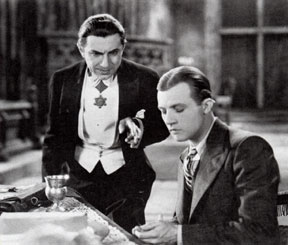
In his book, Carroll writes that monsters in horror movies are usually threatening, unclean, physically repulsive and disgusting. While many creatures in horror movies are associated with decay, contamination, dirt, and slime, some creatures, such as Count Dracula in Tod Browing’s Dracula, although not physically repulsive, are considered disgusting because they are impure. According to Mary Douglas’s study Purity and Danger, an object is considered impure if it does not fit into cultural categorization. Count Dracula, for example, would be considered impure because he is both a human and a bat. Because Count Dracula cannot fit into one category, his impurity creates a feeling of disgust. Frankenstein, as depicted in James Whale’s version of the book by Mary Shelly, is also considered impure because he is a composition of body parts from various dead people, which makes it difficult to categorize Frankenstein into either category of “dead” or alive.” A monster in a horror film can be physically disgusting, or the actions of the monster may be considered disgusting.
In addition to being fearsome and disgusting, a monster in a horror film must also be scientifically inconceivable. In movies, this can be portrayed by creating a character such as Count Dracula or Frankenstein, or by giving creatures certain traits such as magical powers or inhuman strength. The monster Dracula is considered to be scientifically inconceivable because the existence of a vampire has not been proven. According to science, vampires do not exist, therefore a vampire is considered to be inconceivable. Similarly, no one has been able to create life from a combination of dead body parts; therefore the concept of Frankenstein being created by a human is inconceivable.
According to Carroll’s definition, however, there are many creatures in horror movies that are considered to be “monsters” by the public. An example of this would be serial killers in movies that are considered to be “horror” movies. Carroll explains this by stating that some movies considered to be horror movies by the popular audience are actually “terror” movies. He says that serial killers are not scientifically inconceivable because serial killers actually belong to the everyday world. Because the notion that a human being will kill others is not scientifically inconceivable, that is, it is not beyond the laws of science; human beings cannot be considered monsters in horror films.

Sensory Experience

When you watch a film, you are constantly bombarded with noise, lights, and images at a rapid rate. This type of experience pulls an audience in, maintains their attention, and develops the story further. It is part of the reason why movie theatres have dark lighting and comfortable chairs; when an audience is submerged in such an environment, it is easier to tell a story using sensory experiences.

This truth is no different for horror films, and in fact, I would argue that sensory experience is the key element of a horror film. Not the plot. Not the characters. It is the images of the monster and the environment of the story, the noises, or lack thereof, of the surroundings, and the lighting and cinematography used during scenes which heightens an audience’s awareness of a situation and their susceptibility to be frightened.

To argue this, imagine you are watching Dracula approach a stranger on the street in a nice, suburban neighborhood. Within the story, it is a bright, sunny day, the birds are chirping, and Dracula is speaking at a normal tone of voice. Although the situation may be odd, it is not frightening. Now instead, imagine that the same Dracula is approaching a stranger in a dim alleyway at night. Within the story, it is dark and rainy. There is little noise and Dracula speaks in subdued tones that force you to listen closely to every breathy word. The latter situation is much more suspenseful and frightening.

On top of those techniques used, the element of sound is extraordinarily important in horror movies. Music heightens our awareness and gives hints as to what may happen next. Low, demonic tones are played in order to warn an audience that a monster is a about to appear and they should be shaken by what may occur. The sounds of the scene are often amplified. A character is being followed and the steps are all that is heard or similar situations are common in all horror films. Also, sound can also play a trick on audiences using the bus technique. At a time of heightened awareness, an audience is bombarded with a loud sound that is not the monster or whatever the event was that was expected.

One may argue that this type of need for sensory experience is necessary for any time of cinematic plot line, therefore being no more important to the horror film. The problem with that argument lies in that horror films are often not strongly relying on their plot line to get a rise out of audiences. The sights and sounds are the things that stir audiences in their seats, not simply the mental thought that something like this may occur.

The plot serves as a baseline for the sensory experience to build off of and make sense from. It is necessary to the movie, but ultimately it is not the key element which horrifies audiences time and again. Even within horror literature, sensory experience is necessary. The description of the sights, sounds, and smells are thing elements which make readers cringe in fear, not the simply the story of a monster.

Ultimately, it is evident that sensory experience is absolutely necessary for audiences to be horrified. Remove them from the film or literature, and it is nothing but an odd fairy tale. Yet, add the sights, smells, and sounds of monsters and the environments they entail, and many will be disgusted and horrified by these imaginative beings and stories.

Music, An essential element for horror?

“Music expresses feeling and thought, without language; it was below and before speech, and it is above and beyond all words.” ~Robert G. Ingersoll

Music has been around for many ages. Music from ceremonial drums in primitive worship to the new age of hip hop, music has been around and been apart of every person’s lives. One of the main attributes about music is that it can provoke emotions for a person that sometimes nothing else can. In classical music, a person might become calm or pleased or in rock music a person might become happy or excited or sometimes even angry depending on the music. We can then argue that emotions can be tied to music. The only logical question after that is if music is essential to be horrified or fearful.

In the classic film, Nosferatu, there are no words spoken. Can one say that they were horrified by the movie, Nosferatu? I believe that a person must look at the movie, which does have horrifying images such as Nosferatu or the vampire coming up out of a coffin. Would this scene be as effective with just the image and nothing else to it? I would argue no because the organ that is played in the background as the sailor descends into the belly of the ship to search the coffins. I think the scene is well thought out because it is a horrifying image to think that a monster is aboard your ship, but with the added organ music that adds suspense to the sailors movements and climaxes with the rising of Nosferatu helps to provoke horror and fear in the audience that is watching the film.

Another example of how music is effective in adding to the suspense and ultimately the horror of a film would be the film, Cat People. There are two scenes in the film that with the help of music add horror to the film. The first scene would be that Alice, a woman possibly having an affair, is being followed by Irena, the woman whose husband is having the affair with Alice. When the camera is focused on Alice, the audience hears the click, click sound of Irena’s heels catching up to Alice. Alice, does not know that the heels belong to Irena and the audience can see the fear in Alice’s eyes. Alice turns around, but there is no one behind her. She continues to walk and the heel sound grows louder. The audience is starting to get worried about Alice at this point and then suddenly a bus pulls up and stops to pick up Alice. This staging is called a bus because the audience is lead to believe that something tragic is going to happen, but nothing does. This scene though is still very effective only because of music/sound. If there was no heel sound or the sudden stop of the bus, the scene would be just a woman walking down a street that may or may not be being followed. The element of suspense and horror is lost if the sound is taken away.

The next scene that I want to mention is also from Cat People. Alice has a swimming pool in her apartment and decides one night that she will go for a swim after work. Irena followers her to her apartment and goes downstairs to the pool, where Alice is. Alice is just getting out of the pool and hears some purring noises. She walks towards the steps and sees a shadow of a cat walking down the steps and she yells and jumps back in the pool. The workers upstairs hear the noise and go downstairs, but while the workers are coming downstairs, Alice is in the dark pool and sees shadows and noises all around her. The scene is another bus scene because just as the noises and music are getting more and more suspenseful, Irena turns the lights in the pool on and asks Alice a question then leaves. The music and sound in the scene actually added horror that I believe would not exist without the use of music and sound.

Through the movies, Nosferatu and Cat People, I believe that both have good examples were music is a essential part of the horror in the films. Without the music, the genre would most likely not existed because the music is just as important as the horrifying image that the movie puts on the screen for the audience. Music is tied to emotions and I believe that the emotion of fear and horror can be provoked by using music to add elements of suspense and anticipation, which in turns provokes horror and fear of the unknown and frightens audiences when the unknown is something horrifying