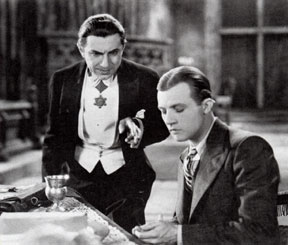
In light of Carroll’s development in the thought of ‘art-horror’, some movies might call into question the validity of films that are posed as ‘horror films’ with monsters whose presence in the world, at one time, could only be explained through supernatural means. We might then ask if adding a scientific explanation to the abnormal occurrence of some monsters in field of modern movies has effectively removed these characters from the horror genre into the fantastic. An obvious example of this move can been seen in newer vampire movies. In previous times the vampire was a creature neither dead nor alive and had definite strengths and powers which derived from his connection with evil, as in the movie “Bram Stoker’s Dracula”.

In the recent movie “Blade” this trend was officially stopped, and was substituted by a vampire whose existence could be explained by a virus. Other movies, such as “Underworld”, have followed suit, and though they retain some supernatural elements vampirism is portrayed as something scientifically plausible.
Other monsters have met similar fates. The dreaded brain-eating zombie in now routinely viewed as a freak of nature, rather than a supernatural villain. “Resident Evil” and “28 Days Later” both portray the ‘zombie’ as a global threat that began with the misuse of science, which though exaggerated, still remains possible from the viewer’s positions. The question remains as to whether or not this trend has had a greater impact on the monsters of older generations. If the newer creatures can now be understood from the view of a microscope, does that call into question the validity of older monsters in the horror genre?
The impact of the supernatural is most likely something that will not disappear from entertainment. In many ways, the supernatural carries more weight in producing the authentic experience of ‘art-horror’ rather than the use of ‘the fanatic’ as defined my Carroll. Then how are we to understand this new trend in movie production? A new twist on an old favorite usually does not go over well with most fans. Speaking for those fans, it is doubtful that many would prefer to understand Dracula as anything less than the ‘Prince of Darkness’, which carries supernatural (thus, unexplainable) connotations. At one level we might be tempted to discredit the monsters of this new trend, and yet there does appear to be room for the new creatures of the night. While many would probably like to see a return to the old days, perhaps in the end it is our definition of ‘art-horror’ that requires modification. And while natural explanations might be stretched at times in modern films, they do push the boundaries of what darkest parts of the imagination can conceive. In the end, for those of us who do believe in the supernatural, perhaps there is room a wide range of the impure, because there is always something more foul that creeps in the darkness.
Pleasant nightmares kids!


 Pinhead, a character in Hellraiser was once human. After the war, he lead his life as an explorer of hidden treasures. His transformation to the Dark Prince of Pain comes through his opening of the Demonic Lament Configuration. His character creates the emotions of terror and disgust. In the movie, Kirsty bargains with Pinhead offering him more souls to spare hers. He tortures his victims, making their deaths long, drawn out and death does not end his victims sufferings. This character qualifies as a monster under Carroll's view because he is impure, his creation is outside of what science tells us, and he evokes the fear and disgust noted before.
  As far as Michael Myers character goes, he defies death in every film. He seems to be unbeatable and when you finally think you have one, it turns out that he is not dead after all. His nature of cheating death makes him a mystery to science today. He is an impure character as seen in his love of killing and his yearning to kill his sister. His mere presence is terrifying because he has the tendency to be found in the background unseen by anyone and no matter how fast his victims run, he is always right behind them. His mask may not be the most terrifying mask out there, yet his large body and threatening demeanor made him into the terrifying monster he is today.
 Freddy Krueger has to be one of the most terrifying monsters to date. He would torture and kill the children from his neighborhood in the boiler room of the power plant where he worked. He had a special room in his basement with his torture devices and newspaper clippings from his crimes. His wife found his secret room and he killed her in front of their child for "snooping around in daddy's special work. He was arrested but because the search warrant was not signed correctly he was released. Parents of the murdered children found Freddy in his boiler room, trapped and killed him. Before he died, three dream demons appeared and gave Freddy the ability to "Be forever," and turn dreams into reality. His powers enabled him to inhibit the minds of his victims as they were dreaming. Any physical harm occurring in the dream world would transfer over into reality making it easy for him to commit multiple murders. His face is distorted from his death which immediately causes terror on sight. He is impure which is seen as he kills multiple people before and after death. His life after death and his special powers defy and knowledge of science to date. He is the classic monster exemplified by the emotions cast on the audience members.


