Monday, July 14, 2014

Freeland and the Appeal of Graphic Horror

I was reading Freeland's chapter on graphic horror and I found a few curious details that sparked my interest. Earlier in the course, I was discussing the nature of slasher villains and the idea that foes like Jason Voorhees tend to inspire audience support (especially from fans) rather than detractors. Fans typically praise Jason and follow him on his adventures through the numerous sequels and remakes. What drives that interest? Why can people identify with a monster?

Freeland makes some great remarks about the appeal of graphic horror films. Most notably, she links it towards three main characteristics, each a development of the idea that graphic scenes of gore/violence function like "numbers" (heightened sequences of spectacle and emotion that appear to interrupt the plot and produce pure visual experiences of stunning power and capacity - a perverse sublime if you will): (1) they can further the plot and narrative, (2) produce emotional/cognitive effects, and (3) provide general aesthetic pleasures that have to do with audience knowledge and appreciation of the genre.

Function 3 is what interests me the most. This type of aesthetic pleasure is what the typical horror cinephile gets attracted to once they've become enveloped by the genre. For example, I'm a diehard fan of John Carpenter's remake of The Thing. One of the main reasons I prefer this film is its sheer ingenious mechanical effects - I know what type of blood, sweat and labor went into the making of them (and the fact that Rob Bottin, the lead makeup FX guy, had a breakdown after the film says something of how much effort he put into it). The gory visual spectacles are gross, obviously, but they aren't just artifacts of violence for violence' sake. Which leads into the second idea, that graphic horror is sometimes appreciated due to intertextuality and a meta-level aesthetic appreciation of specialized knowledge and interest. Freeland writes (especially concerning horror sequels), "Sequels have a special appeal to the fans of a genre. They often prompt a switch from involvement in a film's plot to a metalevel sort of aesthetic appreciation based on special knowledge and interests. Graphic horror sequels enable fans to study and comment upon cinematic techniques: plot variations, allusions, style, effects, wizardry, parody, and 'in jokes'" (p. 262).

This is the pure artistic appreciation of what the filmmakers can create, as for example in The Thing. Concerning the types of monsters in these films, Freeland writes, "Despite their individual differences, monsters like Pinhead, Freddy, Leatherface, and Jason function alike in one key way - they take graphic visual spectacle to new extremes. They figure in films whose numbers are given over to what I called function 3, display for its own sake. Their presence is inked to frightening displays of forces of destruction that can simultaneously be disgusting yet enjoyable" (p. 268).

So, there we have it, perhaps. Spectators can be attracted to these slasher monsters because of the cinematic creativity that they embody, the spectacular nature of their deeds, and the specific knowledge that comes with knowing them. Specific knowledge here of course representing that a fan of Jason will know and recognize the many different ways that he and his methods have been portrayed throughout the series (intertextual references begin to come into the fray in later sequels which reference Frankenstein and the idea of resurrection through lightening).

Furthermore, Freeland argues that the very extreme nature of the violence depicted in these films renders them more comedic and cartoony than anything. The violence becomes sublimated and stripped of its negative aspects. Unlike the realism of other films, graphic horror focuses on the spectacle entirely and becomes so utterly unrealistic that it borders on camp. Of which I would agree. 

I had specified that I thought horror slashers were popular among fans because they tend to develop a cult like status through subsequent films. All of these observations, be it the cinematic creativity, cartoonish violence, or references to other works (and in-jokes or more esoteric knowledge) can be developed in that framework. 

So, back to the paradox of horror and Mr. Carroll. Why horror? Why do we enjoy it? If graphic horror offers any insight, then certainly we like it for its spectacular visual display and creativity. Of course, not all horror functions in this manner. The advancement of plot and eliciting of emotions and cognitive interests (functions 1 and 2 of numbers) also play much larger roles in a work such as Stoker's Dracula, in which the violence or moodiness is clearly meant to support the narrative and upset the reader (the blood transfusions are still unsettling to me for some reason). 

Thus, it would seem that part of Freeland's account is once again in line with Carroll's in that horror ties into narrative expectations. Carroll believed that horror was the price we paid for a disclosure of the plot and the nature of the monster. Similarly, Freeland is arguing that graphic horror can be a vehicle for plot and narrative, enhancing it or just taking it to the extreme in a visual excess.

---------------------------------------------

What about non-cinephile horror viewers? Perhaps they won't enjoy graphic horror as much as fans would. I'm not entirely sure what to make of a "fresh" viewer - someone who isn't acquainted with the background and/or localized knowledge of a specific monster or movie series. Perhaps they can enjoy graphic horror through its advancement of the plot and the interplay with cognitive emotions. 

Personally, I know that as a fan of horror cinema, many of the works I went into fresh were those that helped me develop my sensibilities and acquire a taste for these types of films. It's difficult to pin down this evolution and development because we're dealing with a heavily phenomenological process which is much too complicated to boil down into a few telling criteria. The more I think about it, the more I think Deleuze was right: cinema and life are one and the same.

Tuesday, July 08, 2014

I, Chitti

Robots, love triangles, dancing, and art-horror oh my! Greetings, fellow sojourners of the Spectral Symposium. Today I come out of writing retirement to offer you a brief and hopefully compelling glimpse into the wonderful world of South Indian Cinema by showcasing my personal favorite film of all time: the 2010 film Enthiran (translates to Robot in English). This unbelievable tour-de-force masterpiece of cinematic excellence combines the best elements of Pinocchio, Terminator, the Matrix, and Frankenstein into a 3 hour sci-fi techno thriller horror musical extravaganza that will leave you exhausted, invigorated, and amazed. Known internationally as the “Avatar” of Kollywood (not to be confused with Bollywood), this film is just about the most perfect thing ever committed to film, but don’t let my enthusiasm get in the way of the post…

In southern India the summers are long, hot, and dirty; poverty is extreme, and every year millions of people flock to cinemas with hopes of escaping everyday life for awhile. This dreary backdrop helps encourage movie makers to go ‘full out’ with providing a dazzling visual experience at the cinema, as well as raising the bar for suspension of disbelief with on-screen action.


The star of Enthiran is the incomparable Superstar Rajinikanth. Known by his hundreds of millions of fans simply as Superstar, this Chuck Norris-of-India commands a pseudo-religious cult fan following. In fact, producers are often forced to cast multiple roles for him in each of his films since they cannot kill a Rajinikanth-played character in a film for fear of rioting movie-goers destroying the theater (yes that is an actual thing). His performances are known for their unrivaled swagger, cool masculinity, and skilled dance moves, despite his age (born 1950), and Enthiran might be his magnum opus.


Summary


The film opens with Dr. Vasee (played by Rajinikanth) finishing his decades-long project of building a perfect android robot made in his image and likeness, for usage in the Indian Army. After a rousing opening dance number, Vasee’s robot downloads the sum of human knowledge and goes out for his first human interaction, an awkward and necessary part of his training. While at a family dinner, Vasee’s mother affectionately names the new robot “Chitti” (also played by Rajinikanth). Chitti and Vasee both prepare for the upcoming international robotic conference while Vasee’s gorgeous, frustrated, but faithful girlfriend Sana (played by former Miss World Aishwarya Rai) waits patiently for some quality alone time with the Subaltern Superman (tension builds!)


Chitti debuts to raucous praise and amazed onlookers at the conference, where our nemesis and Vasee’s old mentor Dr. Bohra fumes with jealously over his inability to make a better android. (hint, he makes robots for evil, whereas Chitti is made for good). With his superhuman knowledge and abilities, Chitti quickly endears himself to Sana and aids her with everything from cleaning to cheating on her med-school exams, while saving her from muggers and noisy neighbors in the process. Sana slowly begins to rely more heavily on Chitti than Vasee (tension!) but Chitti can’t feel emotion so Vasee has nothing to worry about.... After failing a key test before the Artificial Intelligence Research and Development Institute (headed by Dr. Bohra), Dr. Vasee, frustrated with Chitti’s failure, adjusts his “neural scheme” to feel emotion, seeking to accelerate Chitti’s evolution and chances of passing the final test. After slowly showing a romantic interest in Sana (uh oh, here we go...), Chitti is scolded by Vasee. Chitti, in protest, intentionally fails his army examination and is subsequently destroyed in a fit of rage and disappointment by Vasee and left in a heap of parts at the junkyard, where a waiting Dr. Bohra hatches an evil plot...


Bohra revives Chitti and inserts a red microchip containing his “destruction mode”, intent on weaponizing Chitti and manufacturing an army of robots to satisfy his evil German weapons dealer 'clients' who have been angrily awaiting a final product. Needless to say this plan totally backfires on poor Dr. Bohra. “Chitti 2.0” swiftly murders him and sets forth on his plan to rule the world and capture Sana for himself. What follows is some of the craziest action I have ever witnessed in a film(that claim is saying something considering my intense viewership of Steven Seagal and Jean Claude Van Damme) as Chitti and Vasee clash over the fate of Sana and the world. See the clip below for yourself...
Chitti 2.0, as he is known, is purely malevolant, thanks to Dr. Bohra's red chip, and rampages all across Chennai and Southern India. His goal is to capture Sana and have an unholy hybrid child together, as he bends the universe to his will in a creepy and unstoppable plan. To accomplish this, Chitti 2.0 clones himself into a vast army of interconnected Chittis that rapidly overwhelm local police and military. Left helpless, the authorities turn to Dr. Vasee in a desperate attempt to save Sana and civilization. An epic showdown between Creator and Creation! Good stuff... Dr. Vasee hatches an ingenious plot to neutralize Chitti and return him to his likable non-murderous state, and in the end all is well in the kingdom, but not before the authorities order Chitti to be permanently decommissioned. In a touching denouement, Chitti, as he is disassembling himself, reminds us that everybody has a red chip of envy, lies, and deceit in their heart, but that love will survive.


Analysis: Do Robots Dream of Electric Dance-offs?


      There is a surprisingly large amount of thematic and philosophical material to chew on in Enthiran. What makes a robot a robot? What makes something human? Can robots love? Do you need emotion and free will to be moral? Chitti is caught between Vasee and Bohra's dreams but nobody cared to ask him about his.
      The central philosophical theme of Enthiran is one of the most basic philosophical questions: what makes something “human”? This is not new to fiction or even film. We have seen in it played out many different times. Indeed, one of the very first films, Frankenstein, occupied itself with this question. Enthiran focuses on one aspect of humanity: emotion. For quite a long time now,science- fiction has been suggesting that emotion is at the heart of what it means to be human. For some classic examples, Kirk and McCoy endlessly inform Spock that logic isn't everything and in order to be truly human, one must accept and embrace emotion. In Blade Runner, the Voight Kampf test is designed to determine whether or not a test subject is a human or a replicant (an artificial human). 
      If the subject does not display empathy, then the subject must not be human. Enthiran seems to go down this path, but does it? After the tragedy at the burning apartment where Chitti saves a naked bathing girl, who subsequently kills herself from shame, it is determined that Chitti needs to have some sort of emotion chip added so that he will understand cultural morays among other things. In short, he needs to become more human in order to understand human ways.  When the new program is added, it of course throws Chitti into a confusion ultimately leading to a permanent rift between himself and his creator. On the surface, it appears to be a classic example of logic vs emotion—logic is controlled and calm while emotion is confusing passionate and destructive and human. Vasee in an emotional rage quite literally destroys Chitti. But this doesn't truly suggest humanity does it?
      Provocatively, in the epilogue when a student asks “why was the robot dismantled?” Chitti replies “because I started to think”. This line reveals that the film is operating on a slightly deeper level than a simple emotion vs. logic motif. It is creative thinking, not mere emotion, nor basic logical processing that makes something become more human. This is an important distinction. Emotion itself cannot be what distinguishes the human from the non-human. Dogs have basic emotions, as do cats and probably even squirrels. But these creatures do not show evidence of creative thinking. But simple logical processing cannot be what makes something human either given that computers can do this (of course with the guidance of human programming).  The film seems to suggest that it is some combination of emotion and logical processing that defines humanity. Some philosophers, such as the Stoics, believe that human emotion is a fundamental part of reasoning (here thought of as something distinct from simple logical processing). Perhaps, then, what is essential to humanity is logical thinking informed by emotion. This is all debatable, of course. Maybe human beings are just walking computers with a vestigial emotional system cobbled together by evolutionary forces to keep us from falling off tall cliffs and getting eaten by tigers.

      Fans of sci-fi and horror will find many familiar elements in Enthiran, ranging from the classic creation rebelling against creator archetype (though more parts Pinnocchio than Frankenstein), science over-reaching and generating an uncontrollable situation, an unstoppable robot apocalypse (think of Carroll's monster-by-massification), and a fair share of visually horrifying images (for example, Chitti's face melts off during his initial destruction).


Conclusion: Music and Magic


     Indian films are as much about the music as they are about the movie, and Enthiran follows suit admirably. The music video interludes (about 4 or 5 in total) are visually gorgeous, and very skillfully choreographed. The tunes themselves (by A.R. Rahman) are hummable ear worms (hopefully the only Indian worm you catch) that will have you YouTubing them over and over for a week.


     Like a good chicken tikka masala, Enthiran is impossible to describe in few words. Is this film over the top? Yes, but it’s not a mindless Michael Bay-vian orgasm of robot warfare. This movie has a soul. It tells a story with characters you care about, and just happens to have some of the most outrageous action sequences ever conceived peppered in for good measure. Is the film three hours long? Yes, but the storytelling is well paced and cleanly laid out, with refreshing musical interludes when the on-screen action loses some momentum. Is this film a scary movie? No, but it certainly echoes of the horror genre, especially when Chitti 2.0 (our monster) goes on his horrific rampage and outlines his unnatural plans for Sana and the globe with a truly creepy confidence. There is something about Enthiran that is refreshingly honest and charming. It isn't stained by the cynicism and “realism” that plagues many of today's Hollywood blockbusters. If you need a reminder of why movies can be called magical, you should watch Enthiran. If you go into this film with an open mind and willingness to suspend disbelief, I guarantee that you will fall in love and have the biggest smile on your face as the credits roll, as you quickly fumble for your cell phone so you can tell all of your friends. I hope this brief glimpse is enough to whet your appetite for this Majority World Masterpiece and convince you to find it and watch it. If anybody is interested in watching it in the original Tamil (not the lesser quality Hindi dub)I am more than willing to share my copy.


 Happy watching,


 Here are some more images from the lovely film
Monday, July 07, 2014

Qualms With Freeland

For this week, I thought I'd take a slightly different approach. Freeland discusses Repulsion and Silence of the Lambs, noting how each film represents evil as an entity in the world. Each reaches a different conclusion as to how we engage the existence of evil. To briefly summarize, evil in Repulsion is both seen in male sexuality and as a free floating, external force which drives the protagonist to her psychosis. The film concerns how Carol cannot make a genuine response to the evil in her inability to act. She cannot escape the gaze and objectification of both the other diegetic characters and the gaze of the viewer - the audience. In line with her feminist reading, Freeland argues that Repulsion suggests that when women fight back, there will be no psychological satisfaction or judicial support, which is why the film ends in despair.

Silence is the more complex, and perhaps, more interesting film to my mind. Freeland argues that it presents two tales: an internal one, in which Buffalo Bill is evil simply because he transgresses traditional gender roles. The external one involves Lecter's relationship to Clarice and how they develop their individuality and their alliance. Lecter's evil stretches back to traditional monsters like Dracula in his ability to mesmerize and his fascination with blood. Lecter's evil becomes appealing because he functions as a mentor for Clarice, he resists categorization by normal science (Freeland discusses the attempts by the psychiatrist and Clarices' survey) and he's just an interesting monster. Lecter becomes an individual and creative artist who constructs his own particular moral code of self creation (like Nietzschean values). Thus, on the one hand, we have the inner story of the film that deals with the re-affirmation of patriarchal values (because Clarice must enter the world of the FBI through Lecter's help and become the heroine who saves the damsel in distress and defeats the bad guy), and the outer story that deals with individuality, transgression of social values, and creative resistance.

"Repulsion puts us in the head of the murderer and shows that this is an unbearable place to be, that she ended up there because of an unbearable world. The Silence of the Lambs holds us back from the head of its primary killer, but it slyly implies that this would be an interesting place to be and that he got there through creative resistance against a mediocre and boring world" (p. 211).

I think that Freeland has done an excellent job reading these films. However, I think her treatment is more of a dialogue with the idea of individuality and the triumph of the will of persons. Her take on evil is less convincing to me and seems to posit more of a fascination with wanting to see someone triumph in the face of adversity. I've listed a few problems I have. My suggestion here will make more sense in light of the idea of evil and its presence in the world and how these characters interact with it.

Problems With Her Take On Repulsion
(1) Page 192 discusses the sexual repression hypothesis for Carol's attitude. Though Freeland is quick to reject it, it seems very fitting for much of the film. Later, she seems to affirm some of it. On p. 195, "Repulsion strongly hints that Carol's psychosis and sexual repression stem from a history of child sexual abuse. Some disturbing sequences of the film convey Carol's nightmare memories of sexual assault." Now, Freeland believes that the POV identification with Carol and the evil as depicted as stemming from male sexuality render her a sympathetic figure. But this does not rule out sexual repression.

(2) Freeland argues that the audience is driven to empathize with Carol and consider her as someone who cannot make a genuine response to the generalized evil in the world. I find many problems here. On the one hand, Freeland suggests that male sex is the locus of evil, then moves on in p. 198 to suggest that it is free floating and external, perhaps located in the surroundings of the film, the other people, and even the gaze of the viewer. My question is, how has evil moved from male sex to this free floating entity? 

(3) "Instead, Repulsion presents a sort of anti-narrative about the inability to act, a continual waiting, passivity, and suffering that is something out of Samuel Beckett rather than Sophocles" (p. 198.). That sums up part of her intuitions. This is why I think her treatise is more about personal willpower than evil. Evil doesn't need to be a prerequisite for the inability to act, nor does it need to be present for suffering, passivity or waiting. The evilness of male sexuality may be present in the film, that it doesn't entail the free floating, almost cosmic evil she is discussing. Freeland seems more concerned with the loss of personal will in a fragmented and disjointed world. She mentions how Carol's acts are more like reactions rather than authentic deeds. I see this as the anxiety over a loss of will, of which her account of evil is not necessary. 

Problems With Her Take on Silence
*The significant problem here is the last one, which relates to the idea of personal will and individuality.

(1) "The audience is prepared to accept all this because of who Jodie Foster is and what she brings to her cinematic role here" (p. 204). Freeland believes Clarices' transgressive attitude is informed by Foster's sensibilities off screen. Perhaps it enhances it but does one need to be intimate with Foster's background in order to enjoy the film?

(2) "But The Silence of the Lambs leaves both characters alive at the end, able to pursue their own creation of self. 'Good' does not combat 'evil' here because they are in effect mirror images of one another, not polar opposites" (p. 209). This is part of Freeland's idea that both Clarice and Lecter practice an individual approach to life and their deeds. Lecter favors individual self creation and defeating the system, of which Clarice must partly do by consulting a maniacal character such as himself. Freeland underscores much of Lecter's evilness (and its appeal) in his creative artistry and his ability to beat the system and resist categorization while fostering intrigue and mystery, kind of like Dracula. 

There are a few relevant points here. On the one hand, these characters aren't mirror images of one another. I think they simply share common methods and outlooks, as Freeland describes. Yet they are radically different - that's what she misses. On the other, Lecter's creative artistry and personal individuality tie into a bigger concept. They affirm the whole idea of the triumph of personal will that I brought up initially, but they also tie into the idea of evil as being ambivalent. In the film, I would argue that it isn't good or evil that's being involved, but simply evil combating other evils. This renders the notion of evil as nebulous - we don't know what evil is concretely. Is Lecter evil? He's helping out Clarice. What about Buffalo Bill? The dude seems irrevocably evil, yet he's doing his own thing and trying to follow his own personal code. What is good? What is evil? I see it less black and white than I think Freeland does.

Why Freeland's Take Amounts More Towards Will Rather Than Evil
Freeland's discussion need not involve concepts of evil. I think she does a great job fleshing out the appeal of it and how it works in these films, but I'm less convinced in her treatment of evil as a floating force in Repulsion. Evil in Silence seems more like an amoral take, rather than a specific type of evil. And in each case, the will of the protagonists is tested. Carol cannot react genuinely, and Clarice is threatened by the patriarchal world of the FBI that she is desperately trying to inhabit. She consults Lecter - the creative, individual genius - to learn how to cultivate her will and promulgate her own value system, much like Lecter's own moral code that distinguishes his killing from that of Buffalo Bill's. So, to my mind, Freeland's analysis tells us more about the anxieties of the loss of personal will, and how it completely fails in Repulsion but triumphs in Silence. That's why the two central characters (Clarice and Lecter) are left intact at the end.

Thus, I think that Freeland's analysis concerns traditional patriarchal values and all that jazz - but simultaneously, I don't think her treatment of evil gels very well because it concerns more of an anxiety about the individual and the exertion of our will. Now, those things can be threatened by evil, but I would like to see a better metaphysical description of exactly where evil comes from and what its nature is like. Freeland vacillates between male sexual evil and external, worldly evil in Repulsion, which leaves me a little confused. In Silence, she provides an excellent depiction of Lecter's evil as being informed by monsters like Dracula, with a touch of style and artistic flourish that speaks of a transvaluation of values. But these films assume evil that exists in the world from the present - or, that's at least how I read Freeland and her account. I'm interested in exactly what makes evil truly evil, and how these characters incarnate it in their actions and deeds. Her suggestion that we enjoy Lecter's evil because it's about "beating the system" and his interesting character seems more about that exertion of will against the facticity of the universe (to borror Sartre).

Monday, June 30, 2014

The Uncanny

My reading of Freeland this week prompted me to look back at Freud's essay on the uncanny. There's a lot going on there, and he seems to be turning the notion of the uncanny as pronounced by Jentsch completely on its head. He investigates the word and its origins, noting that it trends towards an ambivalence, descending from something initially familiar to something unfamiliar and perhaps concealed (and dangerous). His reading of Hoffman's Sandman story is interesting, though in typical Freud fashion he finds a particular neurosis to blame for the kid's problems. Though I must say he does argue fairly well for it. He connects the fear of the Sandman to the fear of losing one's eyes, and subsequently, to the castration complex. Again, not surprising given Freud's love of this stuff. He tries to trace the uncanny back to childhood complexes, involving a bit of the doubling and loss of the self. I thought the most interesting stuff concerned the recurrence of situations that he discusses. It seems like much of his work concerns the idea of deja vu. Of course, he reduces this to a repetition/compulsion within our minds, so that we become lost in this uncanny recurrence of events. I think he places emphasis here too on the idea of fate and coincidence. It would seem as if Freud is driving towards the fact that we fear a loss of control in our lives. I loved his dive into the distinction between literary and real (experienced) uncanniness. His argument that the uncanny is much easier to produce and understand through fiction is understandable, and it does seem as if the true uncanny doesn't happen quite as much in real life. His essential argument, that the uncanny is produced by the revival of repressed infantile complexes or the confirmation of primitive animistic beliefs, is interesting because he tries to cover himself by not reducing everything to a neurosis or a complex. Or, more basically, the experienced uncanny might trend towards more of the complexes, while fictional uncanny concerns more of the primitive beliefs (and omnipotence of thoughts he discusses).

There's a lot to unpack in Freud, but I wanted to get some of that out there because I think Freeland wrongly dismisses his view. She claims that he is too reductive - that everything reduces to a psychological abnormality. And I agree, it kind of does, because it either involves a repressed complex or an old belief that we've cast out which comes back into the fray. Yet, he still makes a distinction between fictional and real uncanny horror, and Freeland seems to miss it completely. She opts for what she calls a "fear of dark metaphysics." I think Freud's account could fit that, given his distinction on primitive beliefs. Beliefs about the world are going to be tied into the nature of metaphysical beliefs, and perhaps we might fear a dark metaphysics or a cosmic horror because it represents a threat to established norms of thinking and perception. Either way, the human, psychological element is going to come back. I'm not saying she's wrong for disregarding Freud, but she might have left out some of the more important parts of his work.

Although, given that Freeland is working more with notions of the sublime (or an anti sublime which threatens the self), I can understand her criticisms of Freud. It's interesting to note that some of her observations about the Shining tend to coincide with some of Freud's distinctions. She mentions the doubling of reality through mirrors, and similarly, Freud discusses the doubling of the self (when Jack enters the hotel bathroom in the scene with Grady, there is a definitive possibility of the doubling of his self).

I like Freeland's idea that the Shining is a type of cosmic horror that threatens our sense of self and, rather than reinforcing it like the sublime, threatens to break it down and disintegrate it. Her insights into why we enjoy uncanny horror seem to tie into Carroll. She mentions how we might like the aesthetic presentation because it challenges us to think and reflect about the horrors presented, feeling dread and repulsion to better respond. It would seem that Carroll's idea of internalizing the narrative of horror stories would fit well here. In both cases, we're internalizing the horror presented.

A couple of nitpicks: She goes a bit too far with the critique of patriarchy - it's not essential to her investigation. Also, she argues that Jack's fatherliness is threatened and that he fails the father-figure role. I've always thought that the cook in the film took that role and ran with it.

Monday, June 16, 2014

Freeland and Cronenburg

Freeland's discussion of Cronenburg was definitely interesting and it got me perplexed about one issue in particular that she discusses. Throughout her analysis of his work, she eschews one of the main themes of his films as theatricality - the theatricalization of the horror image. She contends that this contrasts horror with the elements of the everyday that are presented, first by noting how Cronenburg's work is set in familiar, "normal" places and how horror disrupts the flow of the "everyday."

"His characters are usually middle-class professionals. All of his horrific characters, men and women alike, work at jobs in realistic urban settings that often require the performance of identity in ritualized situations that do, after all, compose our normal everyday working life" (p.90).

"The contrast between the often extreme bodily transformations in Cronenburg's film plots and the cool realism of his style is what I call his theatricalization of horror - his treatment of horror as a form of shocking and yet pleasurable cinematic spectacle" (pp.90-91).

She goes on to discuss how Cronenburg sets this theatricality along the backdrop of processes which call attention to the medium of film itself and the idea of watching the horror. "His movies highlight the very nature of witnessing horror as a spectacular theatrical event, and often, as in Scanners, they include scenes of audiences watching a demonstration or film that somehow goes wrong or is dusturbing" (p. 99).

Note how close Freeland is to Carroll in some of her interpretations. She mentions how Cronenburg's work is a variation of the classic Frankenstein myth and the mad scientist (his films are overreachers). Her analysis of The Fly as a meditation on embodiment and the elements of classic tragedy is very relevant to Carroll's Aristotelian-inspired investigation, for it seems that horror and tragedy focus on similar elements and devices.

Now, Carroll believed that the price of horror was what we had to get past in order to enjoy the disclosure of the narrative. It seems to me that Freeland is drawing a closer distinction to that price specifically, focusing on Cronenburg and his theatricality. Her idea of horror in his films as being shown watched is perhaps the most exciting claim in this chapter because it naturally raises further questions. I've found myself asking why, if this is the case, does Cronenburg do this? What's so special about the theatricality of his images of horror and the fact that people in his films witness horror either through their own eyes or through mediated devices such as cameras and televisions?

I think she provides a partial answer to this: "Horror filmmaking requires a delicate balance between the presentation of beauty and an utter disruption of the serenity of the image. In movies like Cronenburg's, this can contribute to the exquisite enjoyment of extremely painful and disturbing material" (p. 120). So, in contrast to Carroll, I think she's at least drawing more towards spectator involvement with a specific film. Rather than just focusing on narrative, she she's the contrast and the flow between the familiar and the horrific as part of the enjoyment of it. This I can partially agree with, but I'm still not satisfied with it. I'm still curious of what to make of people who go for the price of horror itself - for them, the rest of the "beauty" is probably going to be filler until the next horrific image is displayed.

This theatricality of horror is very perplexing. On the one hand, it can tie into Freeland's distinction of the "artist" in horror skillfully rendering objects of disgust and dread in enjoyable ways. But there must be more to it. I do agree with her that Cronenburg's films (and many others I think) pose a serious interplay between the reality of normal, familiar life and the emergence of horror. I think her distinction of the horror shown as being watched by others is perhaps the key here, and maybe so for some of Carroll's developments. My theory is this: if we as an audience see other people watching something horrific, that adds both to our empathy with and fear of whatever is being portrayed. It's one thing to depict a monster on the screen; that might be scary, but if you take characters and contextualize their reactions and involvement with the horror, it becomes twice as potent both in a sense of fear and empathy for the characters (provided it's done in an appropriate tone). This would lend some weight to Carroll's idea that the characters in a horror film perform a normative function of showing the audience an appropriate reaction. If the people in Scanners are horrified, we might just as likely be. And naturally, setting horror amidst realistic settings allows us to feel like it could happen right here.

Of course, Freeland is drawing more distinctions toward horror as being watched through an apparatus in many of Cronenburg's films. I'm more willing to generalize and say that the very act of watching and witnessing itself, as undertaken by the characters, helps to make a deeper connection to the audience.

Deeper down though, I think the nature of horror as a simple spectacle is possibly the ultimate attraction to it. Horror escapes any type of normalcy; in fact, horror is perhaps the one genre that emphasizes how easy the narrative norm can be broken. No matter what view of it you take (it's gross, disgusting, repulsive, reprehensible, awesome, whatever), it's inherently interesting because it represents some type of attack on normalcy. You might say the same for action, suspense and other tropes in film.

Monday, June 09, 2014

Horror and Ideology

Horror and its relationship with society and culture has always been a fascinating thread for me. I've enjoyed reading Carroll's account of it, specifically his arguments against the notion that horror is always either (a) a vehicle for political repression, or (b) an emancipatory medium that calls the motives of the status quo into question. I think that he rightly points out that horror can be used for either end, and if we can't give a definitive, thoroughly general scheme for how all horror objects seek to achieve either end, then the notion that horror is ideologically politically repressive or progressive (all the time) is untenable.

His attack on the structural model of horror (that horror narratives move from normal---abnormal---back to normal, back to affirmation of cultural and societal norms) is also compelling because he notes that many horror fictions do not end with the monster being subdued or normality being restored. Carpenter's version of the Thing is an excellent example because we don't clearly know which character, if either, is safe in the end (much of Carpenter's work is particularly bleak in its outlook....in They Live, he openly attacks capitalist culture and the world of commodities, clearly not establishing the status quo). Carroll is right to point out that it's more about seeing how objects of horror can apply these themes to either stigmatize or valorize certain norms. Once again, horror can be repressive or progressive.

I also like that he links horror to postmodernism. I agree with his intuitions here, especially with regards to the idea that both look to the past with nostalgia, both portray the person in tenuous terms, and they tend to address social uncertainty and unease.

I think that, finally, someone has given me partial insight into the remake craze as of recent. Carroll says, "It proceeds by recombining acknowledged elements of the past in a way that suggests that the root of creativity is to be found in looking backwards. The horror fiction of the present, though not lacking in energy, also refers back to earlier times, to classic monsters and myths, as in a gesture of nostalgia" (p. 211). This might serve to partially explain why we're so fascinated with remaking everything. I might add that our present cycle is lacking in energy, so it's turning toward the past to reignite a palette for horror.


Tuesday, June 03, 2014

Freeland's Take on Vampires

I thought Freeland's discussion of vampires was pretty interesting. She sets out with some basic premises: (1) Vampire films involve erotic transgression, (2) they make us rethink our conceptions of good and evil, and (3) they provide aesthetic or cinematic pleasure in virtue of their invoking classic vampire tropes and myths and either building upon, deconstructing or adapting them (a nice case in point is John Carpenter's Vampires - the ghouls in this film hate sunlight and wooden stakes will send em' off, but there's no way garlic or crosses will deter them). There's a certain familiarity to the genre in which the audience feels comfortable with all the stakes, crosses, absence of reflections, coffins and so on, but modifications are sometimes allowed and even welcomed provided they stay within acceptable parameters.

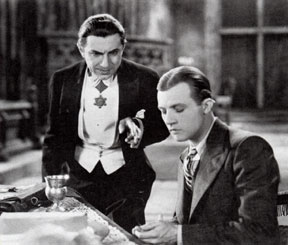
She traces these themes through the three film versions of Dracula quite nicely. In particular, I like her account of Browning's Dracula as making Lugosi an ambivalent figure who is neither male nor female but possesses qualities of both. His ambivalence is contrasted with the rise of western patriarchy and the attempt of the men to thwart the count's plans. In the end, Freeland seems to think this type of vampire is evil but in a less interesting way: his evil is merely one dimensional - he's the threat to the established moral order of decency that must be wiped out.

I've never seen Badham's version of Dracula but I think Freeland's account seems accurate. The evil of Dracula, as she argues, is downplayed due to his striking visuals and the fact that Lucy chooses to be with him. He seeks her for the human qualities she possesses, entailing a value of human existence. This is more of the romantic Dracula rather than a flat out evil that must be extinguished.

Freeland seems to have much more respect for the Coppola version than myself. I've seen the film a few times but it never really struck me as very engaging. Of course, I agree with her that it does remain the most faithful to the erotic transgressions of Stoker's novel, and it does seem to call into attention the nature of artifice and spectacle (on p. 141, Freeland goes into detail about the scene in the movie theater, stating that the audience is engaged in a method of recognition as much as Mina is.....we recognize the Dracula character, albeit portrayed a bit differently). Dracula in this film also asks us to join him and calls into question our notions of good and evil. Instead of Western patriarchy coming out on top, the idea of love trumps everything according to Freeland's account.

I also like how Freeland links the on screen presence of vampires to their real life actors; this is part of the fascination with vampires for her because they are portrayed by well known and famous actors. The immortality of the vampire is partly linked to their imprint within film (it would be a "file" today, in accordance with the digital era). Her key conclusion is that the vampire asks us to join a spectacle of seduction, whereby the audience desires vampires for their otherworldly and spectacular qualities that live on in images. The vampire desires us not for our blood but for what is inherently human: our flesh and blood. "Vampires are, after all, cold and dead. They are weak and pale creatures without us; they need our admiration and passion more than we in the end really need them. They are images, we are flesh and blood" (p. 157).

Freeland also develops an argument that vampires are powerful symbols of evil, mostly because they call into question the nature of good and evil in many of these works. Having thought about it, I think the vampire cannot be a poor symbol of evil as Alford would have it (I am not familiar with his work but in so far as Freeland's account of him is correct). Vampires just seem inherently evil to me, perhaps because of their formal qualities, but more so because they are, to borrow Carroll's terminology, always threatening and impure. They threaten us immediately because they consume our blood for life, and they're impure because they violate the categories of the living and the dead. The vampire is both alive and dead - undead. They also consume human flesh, which most of us normally hold to be a violation of the category of acceptable things to eat for a human diet.

I suppose what I want to know is why have vampires developed into such aesthetically pleasing models and archetypes? In other words, why are the fashionable, spectacular and romantically appealing vampires so prevalent today? You don't see many feral vampires; their violence is always contrasted with their allure and their gracefulness (the vampires in Interview, Badham's Dracula). John Carpenter's version of the vampire happens to be my favorite, but it's a largely forgotten sub-species of the vampire, and I suppose that's because Stoker's novel set the paradigm for suave vampires, and this model was subsequently lifted into many film and novel versions (just look at Twilight, the absolute zenith of vampire accessibility). Freeland admits that Dracula has been made more attractive and sympathetic in most of the film adaptations (modern novels also take it a step further as well). I'm just interested in why the vampire must be romanticized in this fashion, or why this has developed in contrast to more primitive vampires. I think the answer is partially because we have other monsters to draw upon for all our feral viciousness we wish to get out on screen (think werewolves, zombies). The vampire is something special in modern media - a strange amalgam of qualities both appealing and disgusting.

A final point worth mentioning. Freeland acknowledges that, within the vampire film, the narrative focuses on intellectual fact gathering. The male investigators have to deal with the burden of proof of the monster, thus echoing some of Carroll's distinctions about narrative and aesthetic pleasure. Though, I think Freeland wants to develop more of a feminist critique here. "Narrative closure is achieved by some device of incorporation within the patriarchal order. Thus, narrative puts an end to the spectacle (our vision of the monster and of the woman/victim)" (p.158).

More on Dracula as I finish the novel..........

Wednesday, May 28, 2014

Carroll - Plotting Horror

There's a LOT of material in chapter 3 of Carroll's text. At times, I thought that his taxonomy of horror narratives was fairly respectable and well-thought. At others, I felt that he was stretching some of his criteria to make most horror films fit the bill. Either way, his work is impressive because he breaks down most narratives into forms of Complex Discovery or Overreaching, each of which tie into our relationships with the unknown (whether it be knowledge that is forbidden or our lack of knowledge in certain events). Carroll thinks that themes of discovery, knowledge, the burden of proof and the hypotheses to the best explanation play into our cognitive pleasure in these films. As I see it, he's arguing that audiences take pleasure in how the characters reconcile the nature of the unknown or the fantastic through the processes of reason and logic. Interesting.

All told, I only had a few complaints here and there. I don't think we can form an exhaustive taxonomy of horror films, to which Carroll admits to. He also argues that the audience internalizes the events of a narrative, taking into account the reasonable alternatives that can be expected in erotetic format. This is fine, but I would argue that an audience only does this in so far as it cares about what is happening on screen. If a film is boring, no one is going to internalize the events in the narrative as easily as Carroll thinks. Again, it's a small grievance though.

I liked his treatment of the fantastic and the subsequent analysis of Cat People. There is a bit of a bone I have to pick though. Carroll argues that the supernatural explanation in the film becomes solidified once we see Irena attack the psychiatrist. "The audience does get a brief glimpse of the panther after Irena has killed the psychiatrist; and by the end of the film, the case for the supernatural interpretation is secure" (p. 153). Now, I'm not certain whether Carroll is arguing that the supernatural explanation is obviously and unquestionably the right inference, or just that the supernatural case is at least objectively plausible. I believe he's simply arguing that the case for the supernatural can be made as strongly as that of the natural, but at first glance, I seemed to interpret him as saying that the supernatural was unquestionably the best explanation. If this is what he intends, then clearly he's wrong. One of the hallmarks of the film is how Irena keeps returning the zoo and the panther in the cage. The psychiatrist notes at one point that many imbalanced people wish to do evil or cause a type of harm. Irena could've been letting the panther out of the cage for the entirety of the film without us or the characters knowing. Again though, I think Carroll recognizes this, perhaps I'm just tripped up on his wording.

His analysis of narrative and suspense is interesting because the formulas apply to many films. Aliens is definitely a case of onset, confirmation and confrontation in large part because the creatures were already discovered in Ridley Scott's original. I was thinking that the classic Tremors is a clear cut case of onset, discovery, confirmation and confrontation. We see the initial results of the graboid (the giant worms) attacks in the beginning; subsequently they're discovered by the two protagonists, Val and Earl. Later, they have to prove to the townsfolk that these are real creatures, which of course culminates in the confrontation in the desert where they kill the last of them with grenades and a well positioned cliff side.

I just watched The Fly recently and again, this could be an example of the overreacher plot. Jeff Goldblum's character isolates forbidden knowledge in the form of teleportation, conducts an experiment (which goes really awry), and then has the confrontation with Gina Davis at the end.

In thinking about these films and Carroll's formula, I think I'd like to analyze a few films using his methods to see how they play out. In effect, I'll treat Carroll's distinctions like Sinnerbrink's in regard to how films accomplish philosophy: investigate a horror film, apply the criteria, and see what happens. So, I'll be considering the monsters, the narrative, audience interaction and other key elements. I'm also interested in resolving the paradox of horror myself: why are we so attracted to horror films? As a lifelong fan of horror, I've often asked myself that question multiple times. I've had family ask me why I watch these strange things, and every time I try to explain it, I come up empty handed.

I'm going off on a huge tangent here, but I've always thought that some horror films and their monsters take on a superhero type status. My favorite is Jason from Friday the 13th. With a billion sequels under its belt, the franchise clearly stepped out of the element of pure horror to pure cheese: by Friday part 6 and 7, most fans (including myself) were rooting for Jason. The epitome of this attitude is the 2003 release of Freddy Vs. Jason in which each titular monster battled it out for domination. These guys become less like horror icons and more like superman - we wait to see what situation Jason is going to get himself into next. And he ALWAYS comes back, just like superman always triumphs. There's a weird play of reliability and fascination going on here, like these slasher villains will always deliver (and seeing how campy Freddy became in the late 80's and 90's, it's no surprise that fans begin to treat these characters less like monsters and more like heroes...perhaps anti heroes). So, perhaps part of the paradox is that fans get caught in this wave of "superhero fetishism." Yep, that's what I'd call it. 

Monday, May 19, 2014

Carroll - Chapter 2, Relating to Fictions

What is particularly interesting in the second chapter of Carroll's book is his take on the "paradox of fiction." Indeed, it's something that has troubled me long in my thinking about fiction and how we enjoy it. How is it that I can relate to something emotionally that I know is fake?

I think Carroll's knockdown of illusion and pretend theory is pretty strong. Illusion is just ridiculous - if it were the case, then I would definitely try to flee from the horrifying monsters I believed I was encountering. Pretend theory is just too demanding - and we can't control the art-horror response, I absolutely agree with Carroll here.

His idea of thought theory is very clean and worked out; the separation of belief from emotion is particularly strong. I think this is kind of common sense. There are plenty of thoughts that can cause an emotional response, many of which I could attest to personally. I remember a math test in college that I was about to receive my score on. I had no belief content whatsoever for it - I didn't know whether it was true or false that I had performed well. Yet I can remember sweating and fearing for the result. Carroll's example of the thought experiment where we are told stories without any truth component is key here because it demonstrates that we can be affected by something even though it's fictional. As he says, upon learning of the stories, we might inquire whether they were true or false, yet still admit being emotionally affected by them. Fabrication does not entail a dissipation of emotion, but perhaps a switch - in the case of learning that we've been lied to, from genuine emotional to anger.

Carroll's stuff on linguistics is also interesting. Horrific monsters (or objects) come to represent a certain sense, rather than an explicit referent with truth content. The name Dracula conjures up all the propositions, details, descriptions and attributes that Stoker intended. And we can entertain these thoughts because, according to Carroll's notion of character identification, we share similar culture and appraisal of the monster. That seems to be pretty powerful. In his eyes, character identification involves an assimilation of the totality of the situation in which the characters are present. As I see it, it's a matter of the audience being omniscient while the protagonist is clearly embedded within the context of the story. Emotions, as Carroll argues, won't parallel because we're dealing with two different methods of viewing. It seems that he's asserting that what will overlap and display symmetry is our evaluation of the monster in question. When a promiscuous camp counselor is beset by Jason Voorhees, it's not that I share that character's emotion. Rather, I identify with the appraisal of Jason; he's a threatening dude with a machete that's quite capable of killing someone. The character realizes this as well but responds to the object in question, while Carroll seems to think that my response would involve sympathy towards the character and a general understanding of the situation overall. He sneaks a sort of altruism in there in that we can concerned with other characters, but naturally so to deflate any objections where true fear must consist in a concern for our own wellbeing. I think he's right to do this because we can clearly be concerned for characters who have no impact on our own egoistic intentions.

Carroll's methods work across film, literature and other mediums. I think he's crafted a fairly powerful cognitive-affective theory. But is he right to disregard belief? Aaaron Smutts argues that our beliefs play a large role in our emotions towards horror. Basically, it's harder to prove that things don't exist than to say that they do. We have no way of proving that vampires exist - but that's precisely what makes the belief hard to disregard. Smutts thinks these beliefs get trapped and etched into us from childhood, and it's the job of the skeptical characters in horror films to enact a "belief-revival process" that obliterates the audience's doubt towards the monster. Perhaps belief does play a role here, but I think that we can give Carroll the benefit of the doubt because he's merely asserting that belief is not always tied together to emotion. It could be, but it need not be, especially in the case of horror.

I'm thinking that an interesting first paper would be a sort of "inventory" of an art-horrific monster using Carroll's terms and methods........more coming on this....

Tuesday, May 13, 2014

Carrol's Account of Horror and the Enlightenment

Reading through the first chapter of Carrol's book, I was particularly intrigued by his idea that the Enlightenment provided a conception of nature that the horror genre could thrive in and rebel against. His account of the mechanistic view of the universe echoes with that of some feminist scholars, especially Carolyn Merchant and her view of the "death of nature." Essentially, the enlightenment was in a time in which nature was seen as subordinate to mankind's powers of reason. Through science, we could understand the workings of nature much like we could analyze the parts of a clock. Thus, a rational, logical worldview is promulgated. Horror would definitely have been much more threatening in an atmosphere like this. The average Joe who buys into the ideas made popular by enlightenment thinkers would confront the objects of art horror in extreme and tense ways. Carrol is definitely on to something here, I think. The violation of nature by horror is made possible by its ontology and cosmological contents. This seems to make sense with Carroll's earlier suggestion that horrific monsters are horrible in virtue of their violating the ontologies of the filmed worlds they inhabit. So, a troll in the Lord of the Rings isn't seen as art-horrific because it's a part of the world naturally. That seems to be the crucial distinction.

Of course, I have to ask, is it possible for something to be more terrifying in virtue of its being a natural part of the world? For example, take Annie Wilkes in the novel (and film) Misery. She's a normal human who just happens to be crazy. She doesn't violate any norms of ontology or nature. She doesn't seem to contradict any cultural categories, nor is she a product of fusion, fission, massification or magnification. She's just a regular person who happens to be very threatening. One may argue that her qualities are stretched to the point of the supernatural to make her more like a monster. I would tend to argue that her natural qualities are what make her terrifying. That is, because she is a part of the world that we know and are comfortable with, (and because she represents a violation that is all too possible in that world, a violation that takes place on real terms in real spatio-temporal limits) we find her horrifying. Lots of horror aficionados talk about this type of horror - the darkness inside of us. John Carpenter believed that horror could be digested into two types: it was either "out there" in the world or inside of us. Perhaps that horror can be a part of us is more terrifying than something that violates nature ontologically or categorically.

Despite this, I find Carroll's criteria for the identification of art horror objects fairly interesting.

Sunday, December 12, 2010

brains... Brains... BRAINS!!

Ever wonder why it's so common a theme for the 'mindless' zombies to be seeking brains? They're simply the scarecrow from the wizard of oz, searching for some smarts. The only difference is that instead of having a convenient wizard to give them brains, they, in their faulty logic, think they can gain knowledge by eating other people's brains. It's really quite a sad story.

In all seriousness though, I find that the rise of the zombie in pop culture as our figurehead of the modern monster makes an interesting comment on our society. Have you noticed that Vampires, although still a popular figure, are no longer scary? I'm not just talking about the kind that glitter. Even in other shows (i.e. Vampire Diaries, True Blood, etc), the Vampire is more of a Romantic figure. They've become the Byronic Hero of horror, the misunderstood loner with their own set of morals, and have crept into daytime dramas. Zombies, on the other hand, are doing quite well in the horror film business (even if they touch on the comedic at times). We replaced a lethal intelligent being, with mindless drones of lethal beings. Is it that we don't find intelligence scary anymore? or is it that intelligence was just too much to handle.

I think there's an ingredient in the recipe for monsters that Carroll doesn't mention. Not only does a monster have to be threatening and bizarre, but it also has to be something that we think we can defeat. If there's no chance of human survival, what's the fun in seeing the human race struggle as it gets obliterated. If you really think about it, Vampires could wipe us out without much struggle. They're intelligent, have superhuman strength and other powers, and have very few limitations (oh, they have a curfew during the day, big deal). Zombies on the other hand, have their masses, and their mindlessness, but can be taken out with shotguns, machetes and other household items you can pick up at Home Depot. With Zombies, we've still got a chance.

My inspiration for this comparison actually came from 'I AM LEGEND'. As per usual, the movie was awesome, but the book was still better. In the book, the people that have been infected by the virus turn into Vampires, not Zombies. One scene in the book that I found particularly haunting was when the main character can hear his friend and neighbor calling to him from outside the house. This neighbor is calling to him, so that he can eat him. The ending is quite different too, but I don't want to ruin that for anyone. (you should all go read it!!) Overall though, Hollywood has once again made the cunning foe, into a mindless mass.

Thursday, December 09, 2010

When Its All Said and Done...

After a semester ( actually two if you count the facy that I took Phil. of Horror as a summer class once) of looking into all the theories of horror, I can truly gain an appreciation for the form. Horror never has been, nor will it ever be, my genre. Yet, if nothing else, I leave the class with an understanding of the complexity of the study.

More than anything I've learned it is okay to be scared by horror literature/film/etc. In fact, that is the point. I'm not a wuss or a baby because I cringe and cower as I watch horror films. In fact, that must just mean they are relatively good, or atleast effective, horror films.

Wednesday, December 08, 2010

My Own Horror Story

It was a usual day when we heard the story... but then, it's always the ordinary days that bring the most extraordinary news.
The neighbor was gathering up her mail as she always did, and happen to mention the latest news to my mother.
"Did you hear about that sighting a few days ago?"
"Sighting? Of what?"
"Apparently the Cooper's lost a few of their dogs to some kind of black creature. Old Mr. Cooper swore up and down that it was a panther."
My mother laughed.
"A panther? This far north? That is ridiculous. Where would it have come from?"
The neighbor shrugged.
"Isn't there a wild animal dealer a few miles away? Maybe it got loose from there."
My mother remained skeptical, rolling her eyes.
"What are the odds?"
Both of the women laughed as they flipped through their mail and waved goodbye.
Neither one of them thought that this would be the beginning. Neither one of them would have suspected what was to emerge out of the seemingly innocuous forests and corn.

The first to see it was the neighbor's daughter, Candice. She had gone out to call her dog, and a smear of black dashed across her peripheral vision. The dog came, whimpering, holding his tail between his legs, and Candice thought she heard a low growl. Her mother called my mother a few moments later, the warning clear: keep the kids inside, something is out there. I remember being forced to stay inside...just in case.

It wasn't until a few days later that I truly began to believe that there was something inhabiting the woods that didn't belong there. The neighbor had seen it: Big, black, and ungodly fast. But she didn't know what it was. Something with yellow eyes and a strange growl.
A few days later, old Mr. Cooper lost two of his chickens. Raccoons my mother theorized, or coyotes. Both were notorious for their poultry appetites. But when Mr. Cooper described the way one of his best dogs had dragged it's self home, four long slashes in his belly, we all began to worry. The dog died a few moments after Mr. Cooper found him.

I still remember the day I heard it. It was a gorgeous day: Sunny, warm, and quiet. But as I walked down the driveway, I could have sworn that someone, or something, was watching me. Just as I headed back to the house, I heard it, a scream that chilled the blood within my veins. It sounded almost like the scream of a woman, as though every pain, sorrow, and agony had been concentrated into her last dying scream. My eyes scanned the silent wood, the still corn.... Nothing. I started back towards the house, and bolted the last few 100 feet when I could have sworn that I saw something black dash out of the corner of my eye. When I turned back to look, nothing was there.
After that day, there were no more incidences for a few weeks. But more was to emerge from those quiet woods.

The first time I heard my brother's story, I laughed. But the way his eyes got wide when he told me, the pure fear manifested on his face, convinced me that there was something more than raccoons in our woods.
"They were huge Brianna." He kept saying. "Those red eyes...the slobber..."
He and his buddy, Phil, had been playing "Army" out in the woods when the...creatures... came. As the boys headed back to the house for lunch, they heard a snarl behind them. My brother looked back at his buddy and shouted for him to hurry. Behind him, 6 or 7 hair-covered, slobbering, red-eyed dogs were crouching for the pounce. Phil tripped and the dogs lunged for him. My brother swung his wooden gun at them, and dragged Phil to his feet.
"We got lucky. If we hadn't run, they would have killed us. I just know it." He told me, his face white. Of course, our parents didn't believe them. The only reason I did was because I had always felt as though something was in those woods.
My brother and I went out to see if we could find some kind of prints, and found more proof than we thought we would. Giant paw prints were just barely visible. Someone...or something...had tried to swipe them away with some kind of branch or broom. There were still some patches of what I could have sworn were drool on the ground, but that wasn't what convinced me. The smell was overwhelming. It triggered the image of a maggot-infested rotting carcass in my mind. Never before in my life had I ever experienced such an awful stench. After that, my brother and I never allowed anyone to venture into the woods alone. It was months before any of us went near that forest.
Two weeks later, my dog disappeared into those woods. I haven't seen him since.

No one ever saw those creatures, but every now and then, someone would complain about a dead cat, or chicken, or the sound of growling in the night. Some people blame the coyotes you can hear yipping on a cool summer night, and say that my brother has one hell of an imagination. All I know, is that when I read in the paper about a wild animal dealer being arrested for holding illegal predatory animals in captivity, my heart skipped a beat. Apparently, or so the story goes, the man had a special bond with his "pets", and when the government threatened to take them away, he released them as vengeance on the authorities.

Was it the mournful scream panther I heard that afternoon? Were the wild dogs a figment of my brother's imagination? It's impossible to know for sure. But ever since then, strange things are heard coming from that forest...especially in the middle of the night. And on one goes in alone. Ever.

Sunday, December 05, 2010

Horror Short Stories: Who Let the Dogs Out?

When looking over and re-reading the short stories from the beginning of our syllabus, I noticed a connection that I hadn't seen before: there is a heavy emphasis on monsters either based on or members of the animal kingdom. Specifically, I'm dealing with panthers, ants, cat people, and squid in my paper. Why can we be just as frightened by animals as we are by monsters based on human beings? A few thoughts:

1) I think that it's frightening when intelligence exists where it should not. To be chased by a cunning human is one thing, but for some reason its just more "wrong" when the cunning attacker is an animal.

2) Animals provide good targets for the horrific biology techniques presented by Carroll: they can be massified and magnified much more easily and with much greater effect than a human foe. (Trying to apply the "twenty square miles" of ants in Leiningen to humans doesn't work so well.)

3) Pitting man against nature in horror stories provided a method of expression for the conflicts going on at the time of these stories' publishing: imperialism and colonization. European authors saw nature, including both its animals and its unfamiliar cultures (given no more respect than animals), as a primary foe. These horror stories provide a window into the history of this conflict.

Generally, the stories I studied were examples of natural horror and the animals presented as monsters were an extension of nature's power. Zombies, vampires, ghosts, and demons have their place in the genre, but for short horror stories written in the 19th and early 20th centuries, the natural world seemed to be most prominent.

28 Days Later

People give me really funny looks when I tell them that 28 Days Later is one of my favorite movies. So I'm going to spend some time defending this intelligent modern zombie movie. (spoilers, in case you want to watch it. but if you don't, maybe this will make you interested in it :))

The cinematography is not your run of the mill Hollywood shoot-em-up flick. It's art. When the main character wakes up, 28 days after he got hit by a car and went into a coma, he can't find anyone. London is empty. He wanders around the city for awhile and walks into the main part of a church. The camera shows us that the pews are filled with dead bodies, or so we think at first. The bodies, in the lighting and the colors, reflect the stain-glass window perfectly above them. Something about the similarities between the church and the dead bodies gives us a thrill of cosmic terror. There are interesting shots like this one throughout the movie, that allow the movie to rise above Dawn of the Dead and others like it.

The story, portrayed by great actors, is also much more interesting than a regular old zombie movie. A group of four people get together in the story and hear a radio announcement that says that there is a group of military men who say that they have a cure to the rage-infection that has swept London. So the group heads to the military base, only to find a group of men that bother us from the beginning. Something just seems wrong about them. Again, this is nicely done--subtly, so we're really not sure if we're imagining it. Until we find out that the commander feels that he should let his men rape the 20something year old women and the 13 year old girl that are part of the group we've been following. He tells us that, after only 28 days, he feels that they need to feel they have a future, and a future means women and continuing the race. The main character does not agree, and so they arrange to have him killed. He escapes, however, and when he does he sees an airplane. That's it. Just a shot of an airplane. Subtle. And then we know that the apocalypse is not really one after all. It cannot have reached the whole world if he's seeing an airplane. And he goes back to save the girls anyway. He ends up fighting one of the military men to get him off of the girls. He's so enraged by their behavior, that the girls wonder if he has been infected by the rage-virus when he brutally kills one of the military men. The symbolism is interesting in that this group survives all the zombies, only to meet the true threat: other people. When even the main character seems like he could be as violent as one of the zombies, we see the darker truth the film is telling us: there's a blood-thirsty part in all of this. This movie is intelligent in that it is reflecting real, human problems by using the zombie genre.

Modern Vampire Portrayals Suck

While working on my final project, I did an analysis of Buffy the Vampire Slayer and decided to write my final blog comparing the modern day vampires’ versus the ones that were created earlier. What I've found is that the vampires whose characters were created over ten years ago are considerably more frightening and scary than those that have come into existence lately.
For example, the seductive vampire character has appeared in both older works and modern works. Anne Rice’s novels, such as Interview With a Vampire and her series The Vampire Chronicles feature sympathetic and seductive vampires, however they are still portrayed as monsters. They still inspire fear. No fear is inspired by Edward Cullen in Stephanie Meyer’s Twilight series. The emphasis has become more on star crossed love stories and less on the horror of the vampire. Twilight is more Romeo and Juliet than it is Dracula.
Similar to Twilight, in Buffy when there are seductive vampires, such as that of Spike and Angel that become love interests to Buffy it is more of an exception than the rule. The Cullens’ in Twilight are supposedly rare forms of vampires that don’t kill humans and the vampires Buffy falls in love with are the rare vampires that have souls. Clearly these modern interpretations of the vampire are attempting to reconcile lore that does not fit with the traditional lore of vampires. In doing this, the creatures that once inspired fear are now merely making for good teenage angst stories and the use of the vampire character is being degraded. Personally, I am not having nightmares about vampires that sparkle in the sun, but instead vampires such as those of Dracula that have nefarious intentions such as wanting to kill and destroy the world.

Saturday, December 04, 2010

Are You Afraid of the Dark?

Bobby's post below entitled "Children's Horror" brought back memories of watching Are You Afraid of the Dark? at my Grandma's house with my little sister. Does anyone else remember the episode with the monster in the swimming pool?

Behold: "The Tale of the Dead Man's Float"


Best. Episode. Ever.

Humor and Horror: A Love Story

In conjunction with our Honors class, I have been taking an independent study course that focuses specifically on zombie literature and film. In the course, we have looked at a slew of popular novels and films that feature zombies, including:

Novels
The Zombie Survival Guide by Max Brooks
World War Z by Max Brooks
Frankenstein by Mary Shelley
Breathers by S. G. Browne
Pride and Prejudice and Zombies by Seth Grahame-Smith

Films
Night of the Living Dead
Zombieland
Resident Evil: Extinction
I Am Legend
Fido
Pride and Prejudice (for comparison, of course!)
Shaun of the Dead

Although we have touched on the role of zombies in the horror genre today, we have not really discussed their influence. Some believe that the zombie fad is fading, but society’s obsession with zombies appears to be increasing. Novels, film, and television have all jumped on the flesh-eating bandwagon; nevertheless, the role of the zombie within the horror genre has evolved. Today, zombies are often used by authors and directors to create relevant satires. Each of the works listed above feature aspects of the absurd, however, only a few succeed in mixing elements of humor and horror to create a satisfactory work of satire (see the bolded works).

As Bobby discussed in his presentation last week, humor and horror have many similarities that allow them to work seamlessly together – especially in works of satire. Satire, which depends on the conventions of dark humor, strives to enact change in society by emphasizing social ills. Authors and directors of horror films today often use zombies to achieve this goal. This practice goes back to George Romero’s Night of the Living Dead (1968), which utilizes zombies as a means to comment on themes such as communism, sexism, and racism. In my final project for my independent study course, I decided to examine the use of satire in zombie literature and film and to share this examination with you.

For my project, I designed three posters. The first is a collage that depicts some of the instances of satire featured in the works listed above. These include commentaries on consumerism, communism, racism, sexism, patriotism, medical ethics, the American cowboy mythos, violence, and romance (you can click on the pictures to make them larger):


The second and third are protest posters designed in the spirit of the various Rights Movements (i.e. the Civil Rights Movement, the Gay and Lesbian Rights Movement, and the Women's Movement):


My main inspiration for this project was the film Fido. Out of all the novels and films (except Shaun of the Dead) this film best represents the synthesis of horror and humor and best demonstrates an effective use of satire. I highly recommend it!

Dracula- Cincinnati Shakespeare Company version

Let’s watch Dracula, again. I’ve already seen a few movie versions, read the book and discussed it in class but let’s go watch a play of it too, why not? Before going to see the play, I really didn’t think I would find it entertaining at all. I figured, if I already know the story line and ending, how could it be entertaining? I was very wrong though.

First off, I like how they changed the order of the plot. I feel the flashbacks made the story more dramatic. It allowed you to be introduced to all the characters, and then see what previously happened. It also gave the scenes at the Count’s castle more meaning because of the timing it is presented. The timing of it was in the middle of Lucy’s becoming “sick.” The flashbacks therefore showed what was going on with Lucy after it had already begun. The book, however, has the scenes at the Count’s castle first, and then when everything happens with Lucy, you already know what’s going on.


The cast selection was also done very well. The man the cast to play Dracula was truly creepy. He walked in a very smooth, flowing way. His bone structure also made him seem very rigid which made him seem stronger. Something about the way he held himself just gave me a very eery feeling.


The rest of the cast as well played their parts very well. The best one, I believe, was Reinfield. That actor did an excellent job in his performance. The way he moved and spoke really made him look crazy. His eyes, however, are what I remember the most. He truly seemed out of his mind.


I also really enjoyed the scene where they were all traveling towards the Count’s castle because while they were stationary, they still created a sense of movement and intense suspense. I feel with many plays that the scenes involving traveling are done in a very cheesy way. They did it very elegantly though.

Overall, the Dracula play that we saw was by far my favorite version of the story. While the casting and change of plot helped. I believe that seeing the story in person is what made it better than the other versions.