In the wake of seeing Dracula, I thought it would be especially relevant to discuss how Cynthia Freeland would perhaps have analyzed the play. While the plot way very similar to that of the novel, I found that the portrayals of certain characters and the degree of sexuality expressed in the play differed from that of the original work from which it was derived.
In terms of genre familiarity, there is no doubt that the play is very much like the novel in the sense that it establishes the very characteristics that we now expect to see in all vampire films/plays/etc. In the play, Dracula was portrayed as a stately, perhaps aristocratic man with a personality as mysterious as his accent. He displayed a hatred of light, mirrors, and religious artifacts, and there were many scenes in which a coffin was present or implied. In fact, even the doorway leading into Mina's room was coffin-shaped. In this way, there is no doubt that Freeland would agree that the play followed all of the norms of vampire genre familiarity.
Freeland's next condition can also be found within both the play and the novel. According to Freeland, vampires must violate the boundaries between life and death. In doing so, they exist as a contradiction to how humans usually consider life; they are, in a sense, both alive and dead simultaneously. The play effectively portrayed this dual nature; the scenes in which Harker, Mina, Van Helsing, and others strove to first figure out what Dracula was and later how to defeat him presented the very existence of the vampire as a puzzling metaphysical problem.
Finally, I think Freeland would agree that the play portrayed Dracula as a creature that violated the norms of femininity and masculinity; perhaps even more so than the Dracula in Bram Stoker's novel. In the novel, Dracula had the desire to drink blood from all humans; both male and female. This is also true in the play. The scene in which Harker first cuts his neck, however, goes above and beyond Freeland's stipulation in the sense that it definitely generated homosexual undertones. This is not to say, however, that Dracula was in any way homosexual; there were numerous scenes that possessed blatant heterosexuality, such as the scene in which Mina is forced to drink from his chest and the scene in which Dracula forces himself onto Lucy's bed. Scenes such as these demonstrate the dual nature of the sexuality present in both the play and the novel; which proves Freeland's point that true vampires must in some way violate the norms of femininity and masculinity.
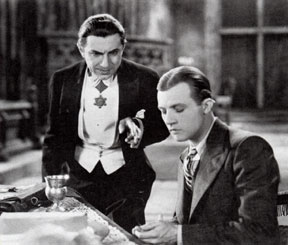
Monday, November 22, 2010

Friday, November 19, 2010

Thursday, November 18, 2010
Just thought I'd share...
I'm not sure how very relavent this is, but I thought it interesting and wanted to share it here.
I read today that energy use in the frontal cortex of the brain increases 30% during a nightmare. Being scared is like exercising, then, right?
Info from: J.M. Bourre, "Effects of Nutrients (in food) on the Structure and Function of the Nervous System: Update on Dietary Requirements for the Brain. Part 2: Macronutrients," The Journal of Nutrition, Health, and Aging, Vol. 10, No. 5, November 5, 2006
I read today that energy use in the frontal cortex of the brain increases 30% during a nightmare. Being scared is like exercising, then, right?
Info from: J.M. Bourre, "Effects of Nutrients (in food) on the Structure and Function of the Nervous System: Update on Dietary Requirements for the Brain. Part 2: Macronutrients," The Journal of Nutrition, Health, and Aging, Vol. 10, No. 5, November 5, 2006
Wednesday, November 10, 2010
Essentialism and the Haunted House
I recently read that some states in the US have disclosure laws that force realtors to state whether they are selling a "stigmatized home." What's that mean? Well, they have to tell you whether they're selling you a potentially haunted house, essentially. If something happened in the house at some point that would creep people out -perhaps a murder or something similar- the government forces them to tell you about it. Now what's the rationale for this? The house is cleaned and sterilized, all new carpet and furnishings, it's a perfectly good house in all physical and tangible ways... only it maintains a "certain something else" and "essence" that we attribute to it. And this belief in an essence is obviously not confined to the sophomoric superstitious -there are state laws. The City Council of Glancester, England ordered the destruction of a home where a couple raped, and killed several young girls, burying them in the garden and under the basement floor. The council made a point of removing all the bricks, crushing them into dust, then scattering them in a landfill at a secret location. A similar intervention occurred at the apartment where Jeffery Dahmer lived; it is now a parking lot.
This idea of an "essence" is an idea associated with a person or object, and though it's recognizably irrational, it's something many of us can't bring ourselves to overcome. A certain psychologist once conducted studies during which he asked people to try on a sweater that once belonged to Adolf Hitler. Needless to say, the subjects were reluctant to do so. And why? Isn't this sweater just like every other sweater that was manufactured at that same factory? Yes, it is. Same color, same texture, same thickness -all identical. Yet we regard objects not only as a compilation of their tangible and perceivable characteristics, but also as individuals. It's not just a sweater, it's that sweater, it's Hitler's sweater. We attribute an intangible characteristic to objects that ultimately affect our attitudes toward them. And it's this arbitrary assignment that's often more powerful than the actual properties the item has if forming out attitudes toward it.
Talk about the power of the mind.
This idea of an "essence" is an idea associated with a person or object, and though it's recognizably irrational, it's something many of us can't bring ourselves to overcome. A certain psychologist once conducted studies during which he asked people to try on a sweater that once belonged to Adolf Hitler. Needless to say, the subjects were reluctant to do so. And why? Isn't this sweater just like every other sweater that was manufactured at that same factory? Yes, it is. Same color, same texture, same thickness -all identical. Yet we regard objects not only as a compilation of their tangible and perceivable characteristics, but also as individuals. It's not just a sweater, it's that sweater, it's Hitler's sweater. We attribute an intangible characteristic to objects that ultimately affect our attitudes toward them. And it's this arbitrary assignment that's often more powerful than the actual properties the item has if forming out attitudes toward it.
Talk about the power of the mind.
The Evil Dead, Art-Horror, Art-Dread, and the Phenomena of Ash Williams

(NOTE TO DR. LANGGUTH: THIS IS A REPRINT OF A PREVIOUS POST FROM THE HORROR CLASS. THIS IS NOT NEW MATERIAL)
In light of this class' ability to actually use and comment on the blog, I have decided to repost one of my posts from my time in the Horror Film class that used the same blog. Unfortunately, during that run, not many people read the blog... hopefully you all enjoy
Sam Raimi’s 1981 horror classic, “The Evil Dead” is often cited as the definititive low budget horror masterpiece, and largely holds up as a truly horrifying, suspenseful film. Raimi’s visionary direction led The Evil Dead to receive much critical praise, and ultimately, an increased budget for two sequels (which progressively moved farther away from horror and into comedy). The Evil Dead can be applied to both Noel Carroll’s account of Art-Horror and Cynthia Freeland’s account of Art-Dread, and the film is a near perfect hybrid of both.
The movie begins with five college students, led by Ash Williams (Bruce Campbell), going camping in a Tennessee cabin in the woods. Immediately after they arrive, odd things begin happening (porch swings moving by themselves, trees making noises, strange fog, etc) but the students continue and unpack.

After the cellar door flings open unexplained, Ash and Scotty investigate. While in the cellar, they find a book and a tape. The book, which is later revealed to be The Necronomicon Exmortis (a book with demonic incantations), is bound in human flesh and written in blood. The tape is of a professor who lived in the cabins deciphering the book. For thrills, the students playback the tape, which reveals the incantations to have demonic properties, and immediately the woods seem to come alive in search for revenge. Later that night, one of the students, Cheryl, is brutally attacked by the woods, and demands to return to town. Ash takes Cheryl and drives away from the cabin, but the bridge on which they came in is now in ruins, stranding the frantic campers. Ash listens to the rest of the tape and learns that humans can be possessed by Candarian Demons released by the incantations and the only way to stop the demons is through bodily dismemberment. Cheryl soon becomes possessed and attacks the campers, but is detained and locked in the cellar.
 Scotty’s girlfriend Shelly is the next to be possessed by the demons, and she attacks Ash and Scotty, only to be brutally dismembered. After burying the body, Scotty flees from the cabin and is mortally wounded by the woods. Finally, Ash’s girlfriend Linda falls victim to the demons and is possessed. Ash is left alone to find a way to defeat the demons and escape the woods. Tortured by his possessed girlfriend, Ash drags her outside and buries her (unable to dismember her). She soon rises from the grave and attacks Ash, who is at the last moment able to behead her with a shovel. A wounded Ash returns to the cabin only to find that Cheryl has escaped from the cellar and Scotty has become possessed by a demon.
Ash hurriedly grabs a shotgun and barricades the doors to prevent Cheryl from re-entering the cabin. Ash then proceeds to the basement in search of shotgun shells in what is one of eeriest sequences of the film. In the basement, the house begins to bleed, random calls of “we’re gonna get you” can be heard, clocks begin rolling backwards, and windows slam open and shut. Ash returns upstairs for the final confrontation between himself and the demon possessed Scotty and Cheryl.

Ash realizes that if he tosses the Necronomincon into the fire, then the demons will disappear. After a brutal struggle, Ash is able to toss the book into the flames and defeat the demons in the cabin. At dawn, Ash leaves the cabin, but is stalked by an unseen demon.
The Evil Dead evokes a strong feeling of art-horror. The film does have a monster as Carroll would define, which is both disgusting and fearsome. The Demons are physically, as well as categorically, disgusting. The monsters would be considered fusion monsters by Carroll. The film’s imagery is intensely horrific, with graphic violence and gore throughout (from dismemberment, to decaying corpses, to self mutilation, gouging eyes out, etc.) which adds to the overall terror and physical agitation felt by the audience. The film follows a typical onset/confrontation plot (like The Thing From Another World) where our characters are thrust into a completely isolated situation, discover the workings of a monster, and are immediately the targets of its evil. The film does have several very suspenseful scenes which accentuate the high probability of the undesired outcome, such as when Cheryl walks at night into the woods (and is attacked), when Ash goes to the basement in search of shotgun shells (and experiences preternatural terrors), and when Ash looks for the missing demon/Cheryl.
The film has an atmosphere of dread throughout, which would help place it in the category of art-dread as theorized by Cynthia Freeland. For Freeland, in order for a work to evoke art-dread, it “must depict an encounter with something terrible or unsettling that is also deep, obscure, and difficult to comprehend” (Freeland 193). Some grand themes of art-dread films include cosmic justice, Man’s place in the universe, the amorality of the universe, and the struggle between good and evil. Though The Evil Dead’s primary theme is of survival, one could make the argument that it also examines the futility of Man’s effort in the face of supernatural evil, like the Candarian Demons. Freeland also argues that “a film of art-dread must make plausible the thought of imminent danger from something that is vague but profoundly evil or unsettling” (Freeland 196). For Freeland, “The Evil Dead” would probably be too concrete in its reveal of the ‘monster’, but also very good for its vague, unsettling depiction of the ‘evil woods’. In “The Evil Dead”, there seem to be multiple monsters at work. The most obvious (and of most concern to our hero) monsters are the Demons which possessed Ash’s friends, but there is also a greater evil which seems to have possessed the entire woods which we never actually see. The greater power of the objectless evil is felt throughout the film, like when Ash attempts to drive out of the woods, only to see that the bridge has been knocked out and the metal beams holding it up folded into a hand. Several of the characters frantically scream “it won’t let us leave!”, giving the viewer an unsettling feeling about something unknown. Freeland would applaud “The Evil Dead” for its tremendously unsettling and dread-inspiring setting.

“The Evil Dead” does not merely have one or two scenes of dread, but sustains a plausible environment of dread and unsettling fear throughout the film, forcing viewers to entertain such thoughts as “is there a demon around that corner?”. Truly a masterpiece, “The Evil Dead” is primarily a work of art-horror, but definitely would fall into Freeland’s classification of art-dread.
Director Sam Raimi used several cinematic techniques to enhance and sustain an environment of dread and horror. Several point of view shots from the position of “the demon of the woods” established the potential omniscience of the evil in the film, which seemed to be everywhere. Several chilling sequences also used the point of view technique, such as when Ash first walks through the basement, Scotty looking for the missing Shelly, and scariest of all was the point of view shot from the “demon in the cellar”. The extensive use of first person shots ties the viewer intimately with the action on screen, and with the protagonist, along side of whom we as viewers are not too many steps ahead in the narrative. If Ash turns a corner, we do not know what lurks behind it, unlike many horror narratives which have at least one scene which compels the viewer to scream “No, don’t go in there you idiot!”. The use of fog, off screen sound, and generally unsettling imagery helped set the stage for a truly horrifying narrative. The acting in the film was the weakest aspect, with Campbell providing the only decent performance.
No analysis of “The Evil Dead” would be complete without mentioning the truly odd phenomena that is the character of Ash Williams. Ash has gained a mythic, global, cult following that dwarfs that of any other B Movie Horror protagonists. In later installments of the series, Ash builds his mythic stature by such macho maneuvers as cutting off his possessed hand and replacing it with a chainsaw, and perpetually wielding his “boomstick”. The character reached such popularity that the third installment of the series was officially titled “Bruce Campbell versus the Army of Darkness” in several areas. Bruce Campbell’s charismatic, accessible, and weirdly believable portrayal of Ash is a memorable aspect of “The Evil Dead”.

Overall, “The Evil Dead” still stands the test of time, and 28 years later still provides a chilling account of horror and encounters with supernatural evil.
Special Effects
Horror has many aspects to portray itself. From all the books we have read in class, there have been many descriptions to get across to the reader the feeling of fear. They usually describe the scenes so well that you could visualize everything, and in your mind, and possibly make the scene even scarier than it was ever intended. I know that while we were reading Dracula, the scene with the carriage driver scared me a lot more than it seemed to affect anyone else. I kept imaging being in the carriage alone with the odd driver who kept disappearing and with wolves surrounding me. The element of fear from reading that blew me away, and I had to keep reading to see what was going to happen next. In the movies, sometimes it almost seems that those scenes don’t have as much effect. When watching this same scene in the newer 90’s version of Dracula, Keanu Reeves didn’t seem worried at all; then again that might just have been Keanu Reeves himself. The driver, still creepy and weird, didn’t seem to have the same effect to me. He didn’t disappear back and forth and there weren’t the wolves surrounding them the whole time. More than anything I think Reeves was scared of the cliff height. Sometimes it just seems that the special effects and visual images just hold back the true horror it could release on the audience.
Special effects I think have a lot to do with how well the audience gets that feeling of horror. Some movies it just doesn’t cut it. A lot of this has to do with recent technology also. Some special effects that seem common place today were un-thought of back in the day. Even some the older ones though knew their capabilities. ¬¬I think Night of the Demon, although it would have been intimidating without the monsters shown, did a great job with the effects, especially for being in 1957 and very limited with their technology in special effects. The monster was very frightening looking with smoke and fangs, very intimidating. Another horror movie from that same time period, 1958, was The Brain from Planet Arous. This is a perfect example of a movie with ridiculous special effects that just make it humorous. The thought of a giant brain attacking from another planet is still a frightening monster but it just makes it hilarious. Even the newer ones today don’t know when to say they are out of their hands. The make-up, costumes, gore, sounds, and any other special effects really make a difference on how the movie is portrayed. I personally am not fond of scary movies but some of them just make me laugh. It makes me laugh harder when I find out they didn’t mean it as a spoof. Other scary movies, that do themselves justice with their special effects, I can’t watch because I will get paranoid and sleep with the lights on for weeks. The horror parody movies are the best at pointing out the ridiculous effects. One parody with surprisingly good gore effects is Shaun of the Dead. There are parts in there that almost make it worse to me than some of the horror movies. There is a scene when the zombies are ripping out a man’s intestine that is truly horrific looking. Another perfect example of a horror movie that has ridiculous special effects making it more of a comedy is Shark Attack 3. It was made in 2002 and it’s supposed to be a horror movie but it cannot even be taken seriously. All these special effects just add to the movie if done correctly; they can make it truly superb. However, when done incorrectly the special effects just make it another laughing matter.
Here are the four clips:
http://www.youtube.com/watch?v=bvPowFM_-XM
http://www.youtube.com/watch?v=qImQ1YBZtwg
http://www.youtube.com/watch?v=1nzd0R_OeOc
http://www.youtube.com/watch?v=LGDqYnKHHrU
Special effects I think have a lot to do with how well the audience gets that feeling of horror. Some movies it just doesn’t cut it. A lot of this has to do with recent technology also. Some special effects that seem common place today were un-thought of back in the day. Even some the older ones though knew their capabilities. ¬¬I think Night of the Demon, although it would have been intimidating without the monsters shown, did a great job with the effects, especially for being in 1957 and very limited with their technology in special effects. The monster was very frightening looking with smoke and fangs, very intimidating. Another horror movie from that same time period, 1958, was The Brain from Planet Arous. This is a perfect example of a movie with ridiculous special effects that just make it humorous. The thought of a giant brain attacking from another planet is still a frightening monster but it just makes it hilarious. Even the newer ones today don’t know when to say they are out of their hands. The make-up, costumes, gore, sounds, and any other special effects really make a difference on how the movie is portrayed. I personally am not fond of scary movies but some of them just make me laugh. It makes me laugh harder when I find out they didn’t mean it as a spoof. Other scary movies, that do themselves justice with their special effects, I can’t watch because I will get paranoid and sleep with the lights on for weeks. The horror parody movies are the best at pointing out the ridiculous effects. One parody with surprisingly good gore effects is Shaun of the Dead. There are parts in there that almost make it worse to me than some of the horror movies. There is a scene when the zombies are ripping out a man’s intestine that is truly horrific looking. Another perfect example of a horror movie that has ridiculous special effects making it more of a comedy is Shark Attack 3. It was made in 2002 and it’s supposed to be a horror movie but it cannot even be taken seriously. All these special effects just add to the movie if done correctly; they can make it truly superb. However, when done incorrectly the special effects just make it another laughing matter.
Here are the four clips:
http://www.youtube.com/watch?v=bvPowFM_-XM
http://www.youtube.com/watch?v=qImQ1YBZtwg
http://www.youtube.com/watch?v=1nzd0R_OeOc
http://www.youtube.com/watch?v=LGDqYnKHHrU
Monday, November 08, 2010
Defending Freud, and a Look at Freudian Literary Criticism
So far, the arguments I’ve seen against Freudian theory have amounted to: “Freud talks about sex, thus he is a fraud.” I don’t necessarily hold that argument against anyone personally, especially considering that in my Psychology experience during my undergrad time, it seems as though the accepted pedagogical approach to Freud is, “His theory is a crock, so we’re not going to really cover him with any depth.” There are a few inconsistencies with the Freud-bashing that I’d like to address. First, to dismiss Sigmund Freud as a fraud is ignorant on two counts: Freud’s theory does not “boil down to sex,” and his theory undeniably altered the approach to psychology, if not the way the entire world thinks about human mind. Furthermore, to use an analysis of a story through a Freudian lit. theory perspective written by a third party as proof that Freud is a fraud is an assumption that Sigmund Freud himself tailor-made his theory for a literary approach.
To say that Freud’s literary theory boils down to sex is to ignore both the primary emphasis and the final goal of his research. If anything, Freud’s research boils down to a “battle,” if you will, between natural human urges and subconscious thought, the result of which constitutes one’s personality and ability to live within society. We begin with the “id,” the natural desires which include but are not limited to sexual desires that are by their nature incompatible with social living. In other words, if our natural urges were to reign uncontrolled, killing everybody we disagree with and having sex in the streets would not be considered wrong. If the id had its way, all of that oedipal desire to kill dad and mate with mom would be a-okay. The subconscious “Super-ego,” which represents morals, justice, and all other socially acceptable ideals, fights to repress all of those nasty id ideas. Stuck in the middle of the battle is the “ego,” which is basically our conscious awareness. When the super-ego is, for one reason or another, overwhelmed by the id, that failure is manifested in our conscious behavior, in what we call neuroses and psychoses (conditions as simple as anxiety and as complicated as schizophrenia). Freud’s theory addresses the balance between base urges and social order, and the problems that arise between the two, and he formed it on the basis that an individual’s certain physical or social problems could be attributed to a problem within the mind other than something that “made sense” back in the day, like witchcraft or evil spirits. (Source) Granted this is just a nutshell version of Freud’s theories, which are far denser, but it goes to show that his ideas can’t be dismissed as a bunch of rambling about penises and vaginas.
Of course anyone could still call Freud an insignificant crackpot, had his ideas not revolutionized psychology. The fact that I’m even discussing the notion of a human subconscious and a human personality can be attributed to Freud. Right or wrong, Freud opened the door to the study of the human mind, along with psychiatry as a practice. The theories of his successors, even those who completely disagreed with him, have been sparked by his work’s relevance, and continue to shape psychiatry today. To put this in perspective, the National Institute of Mental Health reports that over 26% of Americans over the age of 18 suffer from a diagnosable mental disorder, which is about 58 million people (Source). That means that if you know anybody who suffers from anything from claustrophobia to schizophrenia, their condition may not even have been recognized had it not been for that “fraud” taking the first step into acknowledging the subconscious.

Thanks, fraud.
As far as literary theory is concerned, using a critics choice of the Freudian lens as proof that Freud himself is a fraud is ludicrous, considering that Freud himself has nothing to do with literary interpretation. Freudian literary criticism, like any other critical formula, is simply a set of ideas transposed onto fiction. This doesn’t guarantee that the critical formula will accurately fit the story. Furthermore, the interpretation does not depend on the set of ideas that the story is measured against, it depends on the way that the critic uses the ideas to view the story. Since it is dinnertime, I will use a food metaphor. Using critical literary theory is like going to a buffet. You pick and choose things on the buffet, and what you put together you call a meal. The way you put things together might be different from the way the guy behind you puts them together. The point is, if there is anybody to be blamed for a lousy critique, it is the critic, not lens.
In addition to this, an interpretation of the losing-eye-horror from other critical lenses could seem just as ridiculous. In fact, a feminist critic might propose that losing the eyes can be interpreted as a fear of emasculation, because without eyes with which to see, man can no longer be the dominant sex. This isn’t very far from a Freudian interpretation, yet if the feminist lens was used to depict a situation of fear over emasculation, I doubt that there would be accusations of fraudulent thought against feminists.
The word “fraud” seems like one of those weighty words like “hate,” that shouldn’t get used very often because they are pretty strong. Yeah, I know Freud’s name is only one letter away from it, and I have my own problems with the foundations of Freud’s theories, but I can’t deny that his theories had an impact; a big impact, on modern thought, and he’s about as far from a fraud as it gets. If we dismissed every idea that had novel yet somewhat disturbing conclusions, we would still be afraid to fall off of the flat edge of the earth, and we’d still be letting sick people bleed out in order to get rid of the bad spirits in their blood.
"I don't drink... wine"
The Dracula play we most of us saw Friday was my, and I'm sure many of your, favorite representation of Dracula so far. The acting was amazing in about every aspect. The accents were well done and not over stated, and Dracula was easy hear and understand. Harker was the right amount of confused and easily manipulated, unlike Keanu Reeves "Whoa there's Dracula" in the film version.
I really enjoyed the special effects of the play. Despite the small cast and I'm sure limited budget, the use of blood and fog created and eerie and at times truly frightening setting. Renfield's heart being ripped out of his chest by Dracula was impressively believable. The scene could of came off as cheesy and over acted but instead it was executed beautifully.The scenery was excellently used with such limited stage size. The separation of the three platforms to use for narration of the various letters and diary entry and one for the insane asylum maybe the play easy to fallow and fit the book better than any other representation I've seen so far. The use of the trap door was excellent and added a creative element to the small set.
One of the best parts of the play in my mind was the actor who played Renfield. His laugh was perfectly creepy and very disturbing at times. The scene in the book that I found most disturbing was Renfield's rant right before his death and the play's representation of this scene was even more horrifying than I had imagined it when reading the book.
The cast did an amazing job sneaking around by the seats and popping out of unexpected places. The actors really worked to make the audience become part of the production. The blood splatter was an interesting tactic to involve the audience. I came out with some ricochet blood on my leg but i enjoyed the affect and it washed out just fine.
Overall I'd give the play a solid 5 bloody vampire wives out of 5.
Well done Cincy Shakespeare Company
Sight Over Sound- No Contest
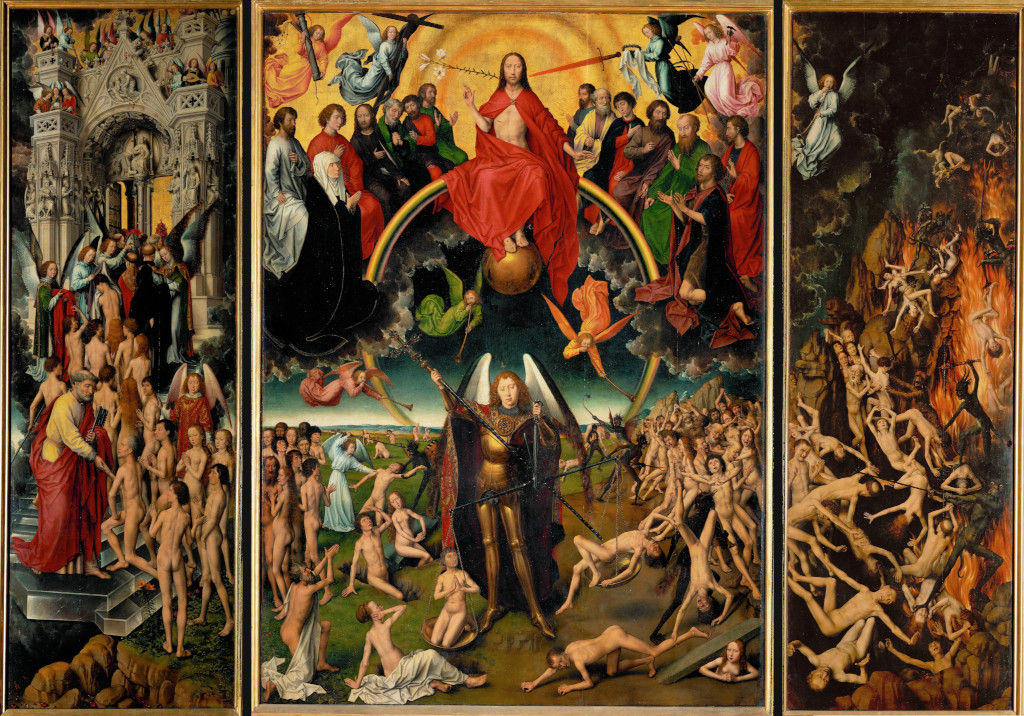
As the handout on ‘the Sinister Resonance’, Penny’s post, and subsequent discussion have effectively shown, sound can be a medium of art-horror. You can use Carroll’s formula with a slight modification: I am occurently art-horrified by a sound X….(and so on). While this may be true, I would strongly argue that sound can never be on par with sight as a medium of art-horror. As Edmund Burke noted in his 1756 masterpiece on the sublime and beautiful, “the passion caused by the great and sublime in nature is astonishment, and astonishment is that state of the soul in which all its motions are suspended, with some degree of horror. The mind is so entirely filled with its object that it cannot entertain any other, nor reason on that object which fills it. Astonishment is the effect of the sublime in its highest degree; its inferior effects are admiration, reverence, and respect”.
Reverence, respect, horror, astonishment, sublimity: all of these things are best realized in an image. Take any piece of art that inspires feelings of sublimity (I like to think of Memling’s “The Last Judgment”). This sort of awe and horror can be achieved also in the horror genre of fiction, particularly with images of the art-horror monster.
For example, take the massive, 500 foot tall, thunder-emitting three headed dragon beast King Ghidorah, of Toho fame.
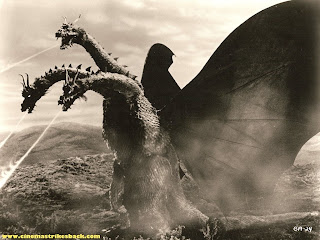 The mere sight of this monstrous, horror and awe inspiring creature generates art-horror, and any deaf man can appreciate that! At some point, the methods of Cat People and The Haunting, though their subtle hints at the supernatural are indeed frightful, must play second fiddle to the medium of sight. Seeing the monster does not categorically make it less scary (is the monster in Alien LESS scary when it shows its acid blood/three layers of razor sharp teeth/unstoppable killer instinct? Any reasoned analysis would say no. Also, if I were to hear a creeping King Ghidorah around a dark alley corner, I would not be as art-horrified as if I saw him thrashing through the air over a major metropolitan area.
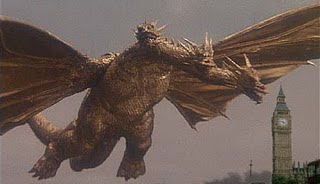
In conclusion, sound can never be what sight is to the horror genre, or to notions of sublimity. Actions speak louder than words, and sights horrify more than sounds.
Robert
Reverence, respect, horror, astonishment, sublimity: all of these things are best realized in an image. Take any piece of art that inspires feelings of sublimity (I like to think of Memling’s “The Last Judgment”). This sort of awe and horror can be achieved also in the horror genre of fiction, particularly with images of the art-horror monster.
For example, take the massive, 500 foot tall, thunder-emitting three headed dragon beast King Ghidorah, of Toho fame.
 The mere sight of this monstrous, horror and awe inspiring creature generates art-horror, and any deaf man can appreciate that! At some point, the methods of Cat People and The Haunting, though their subtle hints at the supernatural are indeed frightful, must play second fiddle to the medium of sight. Seeing the monster does not categorically make it less scary (is the monster in Alien LESS scary when it shows its acid blood/three layers of razor sharp teeth/unstoppable killer instinct? Any reasoned analysis would say no. Also, if I were to hear a creeping King Ghidorah around a dark alley corner, I would not be as art-horrified as if I saw him thrashing through the air over a major metropolitan area.
In conclusion, sound can never be what sight is to the horror genre, or to notions of sublimity. Actions speak louder than words, and sights horrify more than sounds.
Robert
Sunday, November 07, 2010
Whoops I Meant Freud . . . A Response
I too find Freud to be, well, a fraud. Ever since we reviewed the story "The Sandman" I have found the loss of eyes to be within so much of the media, literature, television, and more that we are exposed to on a daily basis. Is EVERYONE trying to address the issue of loss of sexual organs through the metaphor of eyes?
I find this hard to believe.
How can the loss of male reproductive organs, however important they may be the the well-being of the world, be the center of so many metaphors? One could speculate that Freud had wisdom beyond the average man, and he is able to just understand the representations of the mind by interpreting them through his infinite psychological wisdom. The average man only subconsciously represents these things through images such as eyes, wombs, and more.
Yet through Freud our world boils down to sex, sexual desires, and sexual fears. Is that ALL that humankind is concerned with? Reproduction and pleasure are, of course, important but I would argue that people are concerned with far more things than just this. Not EVERY part of our conscience or sub-conscience deals with that which Freud boils our world down to.
Nathan, you are right. Freud is a fraud.
I find this hard to believe.
How can the loss of male reproductive organs, however important they may be the the well-being of the world, be the center of so many metaphors? One could speculate that Freud had wisdom beyond the average man, and he is able to just understand the representations of the mind by interpreting them through his infinite psychological wisdom. The average man only subconsciously represents these things through images such as eyes, wombs, and more.
Yet through Freud our world boils down to sex, sexual desires, and sexual fears. Is that ALL that humankind is concerned with? Reproduction and pleasure are, of course, important but I would argue that people are concerned with far more things than just this. Not EVERY part of our conscience or sub-conscience deals with that which Freud boils our world down to.
Nathan, you are right. Freud is a fraud.
Saturday, November 06, 2010
An Alarming Development
I was browsing the Web this morning and found this article. As we know, this cannot end well.
Tuesday, November 02, 2010
The Night of the Vampire
Please have a listen to a classic ode to vampires and the vampiric performed by the great Roky Erickson.
Saturday, October 30, 2010
The Smell of Fear


Will's magnificent post on infrasound has inspired me to contribute my thoughts on a similar subject. Just as undetectable sonic stimuli can be effective in inducing fear in people, so, too, can smell and, in particular, pheromones. I'm sure most of you have heard someone, somewhere, talk about smelling fear, and this is something that you can actually do. Nervous people smell nervous and terrified people manufacture a certain "eau d'horreur" of their own. All that talk about lions being able to smell you when you're afraid wasn't any rubbish either. It's true, I promise. In fact, it's a lot like being able to smell when a dog or other animal is nervous or scared (don't believe me? Just step inside any veterinarian's office and you'll see -er, smell what I mean).
But does the smell of fear make us afraid? Not necessarily. Oftentimes, if anything, the smell of fear can serve as a warning, indicating that all is not hunky-dorey and that you might want to keep a look out. I've wondered if this is why some people think watching horror films in the theatre makes them so much scarier. Perhaps it's not the surround sound and ten-foo image that does it, but rather the encouragement to trepidation by all of the fear you can smell from the people around you. You egg each other on, so to speak.
What has been proven to induce true fear, however, are panic pheromones. In studies with colonial animals which rely heavily on group communication (such as bees, and ants -that and an ant farm makes a much simpler test subject than a group of meerkcats) the release of panic pheromones, and even synthetic imitations of these pheromones, can almost instantaneously unsettle all of the animals in proximity. Such forms of unspoken communication evolved specifically to spread the message of danger quickly and in no uncertain terms.
Now, I'll admit I'm much less familiar with the use or even existence of such pheromones in humans... but I can't help but wonder... I mean, one might argue that, being very sociable and verbal animals, we don't need such a communication mechanism. We can scream and people usually get the picture, right? Well, sure, but then why do we still emit pheromones when we're around that girl we've got a crush on, or that really cute guy at the checkout counter? That "chemistry" people talk about having is a real thing. If we can do it in that arena, why not in horror? The existence of such unspoken communication might explain how an individual can step out into a small crowd a people and know that something is not right, without having to be told. It might be able to explain how, no matter how good they are at hiding it, we can sometimes sense someone else's worry or fear.
Granted, if chemists got to making a synthetic version of some kind of human panic pheromone, I'm sure it would be a coveted weapon among terrorists and a black market commodity among horror filmmakers alike. But it's an awful fun thought to entertain...
But does the smell of fear make us afraid? Not necessarily. Oftentimes, if anything, the smell of fear can serve as a warning, indicating that all is not hunky-dorey and that you might want to keep a look out. I've wondered if this is why some people think watching horror films in the theatre makes them so much scarier. Perhaps it's not the surround sound and ten-foo image that does it, but rather the encouragement to trepidation by all of the fear you can smell from the people around you. You egg each other on, so to speak.
What has been proven to induce true fear, however, are panic pheromones. In studies with colonial animals which rely heavily on group communication (such as bees, and ants -that and an ant farm makes a much simpler test subject than a group of meerkcats) the release of panic pheromones, and even synthetic imitations of these pheromones, can almost instantaneously unsettle all of the animals in proximity. Such forms of unspoken communication evolved specifically to spread the message of danger quickly and in no uncertain terms.
Now, I'll admit I'm much less familiar with the use or even existence of such pheromones in humans... but I can't help but wonder... I mean, one might argue that, being very sociable and verbal animals, we don't need such a communication mechanism. We can scream and people usually get the picture, right? Well, sure, but then why do we still emit pheromones when we're around that girl we've got a crush on, or that really cute guy at the checkout counter? That "chemistry" people talk about having is a real thing. If we can do it in that arena, why not in horror? The existence of such unspoken communication might explain how an individual can step out into a small crowd a people and know that something is not right, without having to be told. It might be able to explain how, no matter how good they are at hiding it, we can sometimes sense someone else's worry or fear.
Granted, if chemists got to making a synthetic version of some kind of human panic pheromone, I'm sure it would be a coveted weapon among terrorists and a black market commodity among horror filmmakers alike. But it's an awful fun thought to entertain...
Thursday, October 28, 2010
Infrasound: Your Worst Nightmare
I’m sure that almost everybody in the seminar has seen the TV shows in which a team full of wildly pierced twenty-somethings (Paranormal State) or a couple of very skiddish middle-aged men (Ghost Hunters) travel to locations that have been “haunted” in order to do “research” (I’m making the finger quotation marks and speaking with sarcastic tone). Now don’t get me wrong, I’ll be the first person to admit that I believe in the supernatural, and that for the most part if people claim to have encountered a ghost or spirit, I’ll likely believe them. However, there is a scientific explanation for that sinking I-think-something-wants-to-devour-my-soul feeling, as is outlined in an article that I recently stumbled on. What’s really giving you that feeling, apparently, is “infrasound.”
To sum up the article, a scientist named Vladimir Gavreau was working in his robotics laboratory when he noticed one of his researchers was bleeding from the ears. For one reason or another, Gavreau thought that perhaps vibrating steel pipes were the problem. Turns out they were. He discovered that at the right wavelength, sound from the vibrating steel pipes could induce unpleasant effects on those within earshot. However, the “sound” couldn’t actually be heard. Sound waves of between 7 and 19 Hz are below the level able to be heard by humans, though Gavreau proved they could cause feelings of dread and panic. Just below that number is the proper frequency for “the brown note,” which for those of you who have never watched TV is the frequency at which it is rumored (though not proven) that you will uncontrollably defecate.
Perhaps the scariest aspect of Gavreau’s research was that it was conducted as part of an attempt to create acoustic weaponry that could be employed by the military to cause crippling pain in the nerve endings of enemy troops. Think that’s crazy? Nobody would actually subject anyone to a test of this, would they? The United States 1st Air Cavalry Psy-Ops Division conducted field tests of infrasonic weaponry during Vietnam, though no decisive conclusion could be made as to whether or not this worked (Source). Infrasound has, however, been blamed as a possible cause of death when in which a student at a club told his friends that the bass from the speakers was disturbing him, and promptly keeled over and died of Sudden Arrhythmic Death Syndrome (Source).

Hit ‘em with the sound guns, boys!
How does this relate to the supernatural? Well, suppose you happen to be tiptoeing through your dark house in the middle of the night, and are suddenly taken by feelings of panic and dread. They could be the demon sitting in your recliner waiting for you to come downstairs so he can devour your soul. Or, as the article above postulates, it could be the air conditioning unit producing infrasound as part of its normal operation. While this may sound kooky, the current accepted scientific conclusion as to why infrasound affects humans is that it is an evolutionary response to noise that some predatory animals make (you guessed it: infrasound) that humans cannot hear, but recognize subconsciously as a warning sign.
While this explains how natural infrasound affects humans, how could this be applied in the horror film world? Penny’s recent blog post on sound in horror films raises good questions, and I would definitely agree that sound can be used to create horror in a very powerful way. I’m not saying that filmmakers are pumping out infrasound in order to make your skin crawl. The human hearing range begins at 20 Hz, and I can only imagine the height of a producer’s eyebrow-raising when a director says, “I want to scare people by using sound they can’t hear.” However, knowing that just below the human hearing range is a sound that induces fear, it could be argued that as sound approaches that threshold, it may cause some mild to moderate discomfort.
This also touches on a much more natural explanation as to why horror movies scare us, and perhaps why we want to see them even though they do so. If we look at the human response to certain things such as natural sound and rapid motion, the question has to be raised that it could simply be that horror films engage our fight-or-flight response, that hair-raising, heart pounding feeling we get when we are scared out of our wits. If this is so, then why do we pay our hard-earned money to get scared? Don’t shoot me for saying this, but I think a Freudian wish-fulfillment theory has some merit here (and no, I’m not talking about testicles). Perhaps the real reason that we go to have this biological response induced by art is because we physically enjoy the sensation of being scared. Before you try to discredit this, keep in mind that while fight-or-flight may be part of our daily lives, for the most part few of us will have life-threatening encounters. If this is the case, perhaps answering the question of why we go to horror films is that we simply go for the rush; for the physical excitement that occurs when we are threatened.
Wednesday, October 27, 2010
Everyone Loves Horror
Tonight, I was subjected to so many references to horror that I felt compelled to share them, so here I am. The serendipity of it seemed surreal and I just had to share the most notable ones:
Tonight on South Park, the creative staff made fun of the BP oil spill by saying they also accidentally drilled a hole to an alternate dimension, culminating in the release of C'thulu (or however you spell it) rising from the sea while a newscaster talks about how a local cult has upstarted in honor of the entity. They also had Cartman recreating a scene from A Clockwork Orange where the main character, Alex, attacks one of his own mates for challenging his authority.

Also today, a webcomic I read has been referencing Cathoosey (or, rather, a feline version) for the past few strips in a manner that also references the Sandman story we've read - click on images to expand them:


Another C'thulesque reference was made (although I might be putting it there more than anything else) on buttersafe.com, another great webcomic:

And on a final note, I'm playing Fallout: New Vegas, a new videogame that takes place in a post-apocalyptic distopia filled with so many depressing and horrifying images. I present you the nightstalker, one of the many very able-to-kill you creatures in this world (imagine being completely by yourself, hearing a howl and a hiss unnaturally molded together coming from behind you, turning around just in time to see seven ungodly creatures rushing to you with their mouths agape while you stumble to draw a weapon - that was what it was like for me to meet these things for the first time):

I guess what I'm trying to get at is that everyone seems to be okay with identifying horror as a valid cultural artifact, or at least the people who I enjoy as artists.
Tonight on South Park, the creative staff made fun of the BP oil spill by saying they also accidentally drilled a hole to an alternate dimension, culminating in the release of C'thulu (or however you spell it) rising from the sea while a newscaster talks about how a local cult has upstarted in honor of the entity. They also had Cartman recreating a scene from A Clockwork Orange where the main character, Alex, attacks one of his own mates for challenging his authority.

Also today, a webcomic I read has been referencing Cathoosey (or, rather, a feline version) for the past few strips in a manner that also references the Sandman story we've read - click on images to expand them:


Another C'thulesque reference was made (although I might be putting it there more than anything else) on buttersafe.com, another great webcomic:
And on a final note, I'm playing Fallout: New Vegas, a new videogame that takes place in a post-apocalyptic distopia filled with so many depressing and horrifying images. I present you the nightstalker, one of the many very able-to-kill you creatures in this world (imagine being completely by yourself, hearing a howl and a hiss unnaturally molded together coming from behind you, turning around just in time to see seven ungodly creatures rushing to you with their mouths agape while you stumble to draw a weapon - that was what it was like for me to meet these things for the first time):
I guess what I'm trying to get at is that everyone seems to be okay with identifying horror as a valid cultural artifact, or at least the people who I enjoy as artists.
Sunday, October 24, 2010
Cat People: Carroll Evaluation
The film "Cat People," was an interesting case in the Horror Genre. It opened the doors to discussing the subtle differences in sub-genres such as the "pure fantastic," "fantastic marvelous," and "fantastic uncanny." Interestingly, the application of any of these genres depends upon the final conclusion reached in the particular work. Fantasitc marvelous ending in a supernatural conclusion, fantastic uncanny a naturalistic one, and the pure fantastic being unresolved.
In relation to "Cat People," it is somewhat unclear which category of Art Horror it should be confined to. Because we never actually see the transformation of Irena, one could say that there is no conclusive evidence that what happened was truly supernatural. My own interpretation, however, was that the occurance was supernatural, but due to technological limitations at the time the film was made, the transformation scene was not obtainable.
The fact that Irena also stole the key to the panther's cage raises questions. The naturalistic viewer would want to believe that Irena never actually transformed, rather she used the panther to do her bidding. The problem with this theory, however, is that there were never any signs throughout the film that Irena had any bad intentions whatsoever. To the contrary, she refused to even kiss her husband in fear she would devour him after.
Because neither one of these views (naturalistic and supernatural) are conclusive at the end of the film, I am inclined to deem this film a work of "pure fantastic." However, using Carroll's own evaluation methods of determining whether a work is a work of Art Horror, I'm not completely sure this is a work of horror.
The first thing one must ask is if there is a monster. I'm not sure how to answer that in terms of "Cat People." If it isn't Irena transforming into a cat, then the obvious answer is no since panthers exist according to science and they aren't disgusting. At the same time, however, even if Irena is transforming into a cat, that isn't necessarily disgusting. I suppose disgusting in that case could be thought of as a disturbance in social norms, seeing as how there aren't many people transforming into cats (not that I've ever noticed, anyway). Also, there must be a complex discovery plot. The onset (when monsters make their appearance) never actually happens. At no point in the movie does the viewer or the characters themselves come in contact with a "cat person." Because of this, I don't believe that one can classify the film "Cat People" as a true work of horror.
However, I have problems with Carroll's technique to determining works a work of fiction. I don't believe a specific plot structure is needed to form a genre. In fact, I believe that it is the openness in a plot structure that allows for the continued development and interest in a particular genre. If every story were completely the same in structure, I believe that a genre would never be able to grasp the amount of attention from viewers to even become and sustain itself as a literary/artistic genre.
In relation to "Cat People," it is somewhat unclear which category of Art Horror it should be confined to. Because we never actually see the transformation of Irena, one could say that there is no conclusive evidence that what happened was truly supernatural. My own interpretation, however, was that the occurance was supernatural, but due to technological limitations at the time the film was made, the transformation scene was not obtainable.
The fact that Irena also stole the key to the panther's cage raises questions. The naturalistic viewer would want to believe that Irena never actually transformed, rather she used the panther to do her bidding. The problem with this theory, however, is that there were never any signs throughout the film that Irena had any bad intentions whatsoever. To the contrary, she refused to even kiss her husband in fear she would devour him after.
Because neither one of these views (naturalistic and supernatural) are conclusive at the end of the film, I am inclined to deem this film a work of "pure fantastic." However, using Carroll's own evaluation methods of determining whether a work is a work of Art Horror, I'm not completely sure this is a work of horror.
The first thing one must ask is if there is a monster. I'm not sure how to answer that in terms of "Cat People." If it isn't Irena transforming into a cat, then the obvious answer is no since panthers exist according to science and they aren't disgusting. At the same time, however, even if Irena is transforming into a cat, that isn't necessarily disgusting. I suppose disgusting in that case could be thought of as a disturbance in social norms, seeing as how there aren't many people transforming into cats (not that I've ever noticed, anyway). Also, there must be a complex discovery plot. The onset (when monsters make their appearance) never actually happens. At no point in the movie does the viewer or the characters themselves come in contact with a "cat person." Because of this, I don't believe that one can classify the film "Cat People" as a true work of horror.
However, I have problems with Carroll's technique to determining works a work of fiction. I don't believe a specific plot structure is needed to form a genre. In fact, I believe that it is the openness in a plot structure that allows for the continued development and interest in a particular genre. If every story were completely the same in structure, I believe that a genre would never be able to grasp the amount of attention from viewers to even become and sustain itself as a literary/artistic genre.
Friday, October 22, 2010
Sigmund Fraud on "The Sandman"...Whoops, I meant Freud.
I remember discussing the short story entitled "The Sandman" in relation to the interpretation of the infamous Sigmund Freud. I felt the need to revisit the issue, since the preposterousness of his evaluation still lingers. Essentially, the main element of the story was the idea that "The Sandman" would come to a child's house, steal his eyes, and then feed those eyes to his own children. That's an absolutely terrifying idea. One, because the thought of anyone tearing your eyes out and the pain that would be associated is terrifying in and of itself. Two, because the thought of any being eating the eyes of another (especially a human) is disgusting. At least these are my first thoughts.
Luckily, however, Freud was there to correct me. His interpretation was that men are fearful of this story because of deep, suppressed fear inside of them of losing their testicles. In the story, the eyes were symbolizing the male genitalia. Wow. I completely misinterpreted that one I guess.
I would be extremely interested in going back and talking to the author of this story and discussing this theory. Seeing the look on his face when asked "Were the eyes a symbol of testicles in your story?" would make the trip completely worth it. Essentially, what I'm getting at is I think Sigmund Freud is an absolute joke. I understand that the man is the main contributor to psychological understanding and teachings today. In my mind, however, theories such as this one should call to question every single thing the man ever claimed. I agree with him that most of a person's psychological intricacies have been a development over time, and that an emense number of occurences in childhood have played a part in creating the person. However, I don't see the need of someone claiming that idea. To me, it seems incredibly obvious that, like in so many other things, the present is a product of the past.
I sometimes wonder what authors would think if they could hear some of the contemporary interpretations of their works. For instance, what if Jonathan Swift wrote Gulliver's Travels without any intention of making political statements? What if the entire novel was supposed to be a fun, light-hearted work of fiction? It would be fun to watch his expression as people suggested all of the many political satires throughout the novel if he had honestly no intention of creating them. However, he wouldn't be as renowned an author if that was the case.
In summation, I think Freud was completely wrong in his anaylsis as to why The Sandman was a frightening story.
Luckily, however, Freud was there to correct me. His interpretation was that men are fearful of this story because of deep, suppressed fear inside of them of losing their testicles. In the story, the eyes were symbolizing the male genitalia. Wow. I completely misinterpreted that one I guess.
I would be extremely interested in going back and talking to the author of this story and discussing this theory. Seeing the look on his face when asked "Were the eyes a symbol of testicles in your story?" would make the trip completely worth it. Essentially, what I'm getting at is I think Sigmund Freud is an absolute joke. I understand that the man is the main contributor to psychological understanding and teachings today. In my mind, however, theories such as this one should call to question every single thing the man ever claimed. I agree with him that most of a person's psychological intricacies have been a development over time, and that an emense number of occurences in childhood have played a part in creating the person. However, I don't see the need of someone claiming that idea. To me, it seems incredibly obvious that, like in so many other things, the present is a product of the past.
I sometimes wonder what authors would think if they could hear some of the contemporary interpretations of their works. For instance, what if Jonathan Swift wrote Gulliver's Travels without any intention of making political statements? What if the entire novel was supposed to be a fun, light-hearted work of fiction? It would be fun to watch his expression as people suggested all of the many political satires throughout the novel if he had honestly no intention of creating them. However, he wouldn't be as renowned an author if that was the case.
In summation, I think Freud was completely wrong in his anaylsis as to why The Sandman was a frightening story.
Leiningen vs. The Ants: Carroll's analysis
In Carl Stephenson's short story, "Leiningen Versus the Ants," the protagonist must overcome a swarm of ants in order to protect the plantation he recently acquired. Not a very typical "horror" story, but I suppose we'll allow it. In my mind, a "horror" story is merely a story in which the main motivation is to frighten the reader. This is the difference between horror stories and stories which contain "scenes of horror" (specific scenes which are terrifying but contrary to the main agenda of the plot). Noel Carroll, however, wishes to attribute some sort of scientific method for answering the question of whether a story should be considered an actual "art horror" story. Okay, well let's play along.
In my analysis of "Leiningen Versus the Ants," the short story is most definitely a work of horror. The only agenda of this plot is to terrify readers. There are no political commentaries hidden within, it is not meant merely to entertain readers, and it certainly is not some romantic novel written in hopes of making readers wish their lives were this way. The solitary, obvious point is to tell a frightening tale.
Now, according to Carroll. Is there a monster? Maybe? Define monster. Oh, he does. A monster is any disgusting being whose existence is contrary to scientific understanding. So, again, is there a monster? Yes? No? Maybe? Ants exist in real life. However, ants which mass themselves "ten miles long, two miles wide" don't seem too prevelant anywhere. I've also yet to see ants which are intelligent enough to create rafts and cross a body of water...But ants do exist. Let's just assume that these are crazy ants, the kind science has no account for. Are ants disgusting? Some might think so. That seems like an arbitrary and completely subjective question to ask. But, for the sake of arguing, let's assume they are. Congratulations Carl Stephenson, if we assume there are ultra-intelligent, mass-gathering, digusting ants which science has no account for in your story, then according to Carroll you've just written a work of art horror. Hmm...Noel Carroll, sorry, but you're definitely no Aristotle.
In my analysis of "Leiningen Versus the Ants," the short story is most definitely a work of horror. The only agenda of this plot is to terrify readers. There are no political commentaries hidden within, it is not meant merely to entertain readers, and it certainly is not some romantic novel written in hopes of making readers wish their lives were this way. The solitary, obvious point is to tell a frightening tale.
Now, according to Carroll. Is there a monster? Maybe? Define monster. Oh, he does. A monster is any disgusting being whose existence is contrary to scientific understanding. So, again, is there a monster? Yes? No? Maybe? Ants exist in real life. However, ants which mass themselves "ten miles long, two miles wide" don't seem too prevelant anywhere. I've also yet to see ants which are intelligent enough to create rafts and cross a body of water...But ants do exist. Let's just assume that these are crazy ants, the kind science has no account for. Are ants disgusting? Some might think so. That seems like an arbitrary and completely subjective question to ask. But, for the sake of arguing, let's assume they are. Congratulations Carl Stephenson, if we assume there are ultra-intelligent, mass-gathering, digusting ants which science has no account for in your story, then according to Carroll you've just written a work of art horror. Hmm...Noel Carroll, sorry, but you're definitely no Aristotle.
Thursday, October 21, 2010
Sound as a Horror Medium
I think that sound can be especially effective in the horror genre due to the fact that we live in such a visually-stimulated culture. A visual image can evoke disgust and revulsion based upon those principles that we've discussed before, an interstitial state, the violation of certain laws of nature etc.,. but sound operates on a plane that people don't use as their primary means of gathering information about their world. This makes sound particularly effective at making people uncomfortable. When a sound is experienced, the listener most always follows up with an effort to identify its origins -the sound itself leaves a gap that asked to be fulfilled. I believe this is why the concept of a disembodied sound can be so horrifying -it leaves so much to be answered. I think the concept of the "lo-fi" can be applied very readily here, for a lo-fi sound is difficult to place, adding to uncertainty. But then again, this degree of uncertainty can be played with by applying a hi-fi sound, that is, a sound that is clear and whose origins can be placed, but whose context is incongruous with the circumstances. For example, one might be able to place a deep, sonorous growling as coming from the nursery, with the horror effect originating from the inquiry as to why such a noise should come from the nursery.
Because sounds occur all the time and from known and unknown sources, for known and unknown reasons, and because the audience never seems to be satisfied with a sound in the same way we content ourselves with an image, auditory uncertainty is almost always easily attained. What makes the sounds that are heard? Do they mean something? Nothing? Do they signify the unknown, while at the same time confirming the unknown presence? They add to the complexity of the unknown.
In addition, the manipulation of sound as a musical accompaniment or score is another manner by which an audience can be toyed with. Music and sound effects are often utilized to signify and foreshadow, to accentuate the gravity of events and the emotional states of characters. Likewise, the use of silence in juxtaposition with the musical score can leave and audience squirming in their seats, as they assign significance to the absence of sound in anticipation of action. Use of volume and theme, and placement to accentuate and foreshadow are all tools that can confirm the presence of an unknown, create uncertainty ans suspense, and feed and guide the audience's emotional response to the visual accompaniment -or lack thereof- that they experience.
Because sounds occur all the time and from known and unknown sources, for known and unknown reasons, and because the audience never seems to be satisfied with a sound in the same way we content ourselves with an image, auditory uncertainty is almost always easily attained. What makes the sounds that are heard? Do they mean something? Nothing? Do they signify the unknown, while at the same time confirming the unknown presence? They add to the complexity of the unknown.
In addition, the manipulation of sound as a musical accompaniment or score is another manner by which an audience can be toyed with. Music and sound effects are often utilized to signify and foreshadow, to accentuate the gravity of events and the emotional states of characters. Likewise, the use of silence in juxtaposition with the musical score can leave and audience squirming in their seats, as they assign significance to the absence of sound in anticipation of action. Use of volume and theme, and placement to accentuate and foreshadow are all tools that can confirm the presence of an unknown, create uncertainty ans suspense, and feed and guide the audience's emotional response to the visual accompaniment -or lack thereof- that they experience.
Friday, October 15, 2010
"Real" Monsters, and How they Fit the Art-Horror Scheme
We've talked a lot about the monsters of Noel Carroll’s art-horror. Monsters in movies, monsters in plays, monsters in novels. What we haven’t really talked about is “real,” monsters, and when I say real I mean the monsters that many people to this very day insist are somewhere treading this very earth doing monster-like things, occasionally being captured in controversial photos (then again, considering the things that can be done with Photoshop, every photo is questionable). There are a few monsters (and their variations) that I find worth discussing: Bigfoot, the Yeti, and the Loch Ness Monster. What are they? Why would any sensible person want to track them down?
I. Bigfoot/Sasquatch
The self-proclaimed “only scientific research organization exploring the bigfoot/sasquatch mystery,” BFRO, provides a very detailed description of the anatomy of “Sasquatch,” a bastardized version of a Native American term meaning “Wild Man” (no that’s not a joke). Apparently Bigfoot isn’t exactly something that you’d want to run into. It’s an eight foot tall, 700 pound ape/man covered in hair and emitting a gag-inducing odor of “smegma” (in laymans terms, er……I don’t know if I should…..well okay, it means that he smells like balls). They are nocturnal, have been “observed” reaching running speeds of nearly 40 mph, and are strong enough to pick up your average double-wide trailer. While you’re laughing, take note of the fact that the source of this information is a scientific research organization.

Pictured: Bigfoot or a guy in a gorilla suit. Either way, I’m not getting close enough to confirm using the smell test.
All hilarity aside, this guy fits the bill for a Carroll art-horror monster. He’s definitely disgusting and revolting, his strength and territoriality presents a threat to anyone he encounters, and he wouldn’t be considered part of our natural order (unless you think giant smelly hairy man/apes is normal). I haven’t investigated whether or not Sasquatch has been used in a horror film, but if this is not the case, then he would make a great art-horror film monster for you aspiring filmmakers.
II. The Yeti
The Yeti is, more or less, Asia’s version of Bigfoot, also known as “The Abominable Snowman.”

Like this, only WAY more abominable.
Researching the Yeti online has been difficult, presumably for two reasons: the Yeti and Bigfoot are apparently so alike, and the Yeti lives in the freaking Himalayas, and nobody wants to climb a mountain to figure out whether a mythical beast is real or not. There is some information regarding the Yeti online, but as could be expected, much of this does not come from scholarly sources. According to the Occultapedia, the Yeti is a two meter tall (6’6” for the metrically challenged), hair covered man/ape that inhabits the snow-covered Himalayas. While I haven’t uncovered any accounts of the Yeti’s stench, we can only assume that if he’s anything like his American cousin, the Yeti stinks on ice. Another source notes that Yeti’s have reportedly raided villages for crops, preceded by a high pitched scream, and have been known to mate with human women (hey, even legendary horrifying beasts can be romantic).

“I’m gonna steal your dinner and your girlfriend!!”
The Yeti, like his cousin Sasquatch, has a lot of art-horror potential, for much of the same reasons. This monster, as described above, does not seem to fit in the natural order of things (though I’m not an authority on the natural order of the Himalayas). Keeping in mind the accounts of pillaging, the Yeti is also threatening towards humans. As far as disgusting and revolting is concerned, I think it’s safe to say that even the demon from Tourneur’s film would be disgusted by anything related to Sasquatch.
III. The Loch Ness Monster

Be afraid. Be very afraid.
Oddly enough, the only one of our characters so far to have “monster” in its name is one that would disappoint would be art-horror fiction writers and filmmakers. The Loch Ness Monster is a marine lizard related to a dinosaur that, according to researcher Mike Everheart, is something of a snake/turtle combination. This creature could be considered disgusting. However, the Official Loch Ness Monster Website claims that Nessie (as it is affectionately known) only eats small fish, which doesn’t make it very threatening to humans. In fact, it seems to be viewed as a sort of national pet. Furthermore, considering that unclassified rare aquatic life is not out of the realm of reality, it wouldn’t necessarily be anything out of the natural order. Without adding any other fictionaly element to the “real” Loch Ness Monster, it would work better as another typical Pixar animated kids movie than an art-horror flick.
IV. Why would anybody want to find these things?
While the “evidence” of these monsters’ existence is shaky at best, who is to say that Bigfoot, the Yeti, or the Loch Ness Monster don’t exist. What’s more, there are people who are actively searching for them! They take trips into the wilderness where Sasquatch supposedly roams, and they sound the depths of Loch Ness with sonar in search of something looking like a dinosaur. This makes you wonder, who in their right mind would go looking for monsters, and not only monsters, but foul-smelling, angry, car throwing monsters?
 These scholarly gentlemen, that’s who.
Carrold says that basically the reason we see art-horror films and read art-horror novels is that we’re attracted to the emotions that horror causes within us. So could the same not apply to that people who chase after Bigfoot and try to snap photos of the Loch Ness Monster? We might refer to these commonly as “adrenaline junkies.” Perhaps those people hunting Bigfoot aren’t crazy after all. Maybe they just like the prospect of being scared to death by a stinky nightmare. There’s that, and then there’s the popular notion that whoever finds Bigfoot and brings him to light is going to get filthy stinking rich. So for you non-believers keeping track, that makes them crazy, misguided, and greedy.
 I ****ing love Bigfoot!!!!
Subscribe to:
Posts (Atom)