The haunting is a film about four characters who stay in an old mansion that is believed to be haunted. Throughout their stay at "Hill House" many unusual and scary things happen. Eleanor, one of the individuals staying in the house, is especially terrified because the phrase, "Help Eleanor come home," is mysteriously written on the walls. As the movie progresses, more unusual things happen, banging on the walls and floor occurs, doors mysteriously shut, and the walls and doors look like they are breathing. Eleanor begins going insane in the middle of the film and she begins telling the others that she wants to stay in the house forever because she feels a sense of belonging she has never felt before. The doctor, another person staying at Hill House, is there to conduct an experiment. He brought the other three characters to the house to see if they would experience anything in a supernatural sense. The doctor's wife arrives one night and wants to stay in the house with the others. She decides to stay in the nursey, even when the others tell her not to. That night everyone but Grace, the wife of the doctor, stay in the living room of the mansion. This is when the banging begins again and the door begins to look like it's breathing. Eleanor decides she will give the house what it wants, herself. She runs through the house in search of the monster and discovers the noise is coming from the nursery. She rushes in and finds Grace missing. The movie ends with the doctor making Eleanor leave for her own sake. As she drives off unwillingly, something unseen takes control of her car and caues her to wreck into a tree. This is the same fate that happened to a previous owner of the house years before. Grace reappears and tells her husband and the others that she got lost in the house and ended up outside somehow.
This movie is an example of the Complex Discovery Plot. This type of plot contains four phases; onset, discovery, confirmation, and confrontation. Onset is when the audience has a clue about the monster/situation but the characters do not. An example of this onset phase is the beginning of the movie when the audience learns the history of the house but the characters, excluding the doctor, have no clue about the house's history. The second phase of this plot is called discovery. This means that a monster is discovered by at least one character. An example of the discovery phase is when Eleanor begins to believe that the house will not rest until she gives herself to it. The third phase of the complex discovery plot is called confirmation. An example of confirmation is when Eleanor tries to persuade the others into believing that she must stay in the house forever in order for the actions of the spirirts of the house to cease. The final phase of this tpe of plot is confrontation. Confrontation is when characters confront the monster in order to be rid of it or defeat it. An example of this is when Eleanor confronts an invisible spirit that is taking control of her car. She asks the spirit why it is doing this and she talks to herself saying that the house doesn't want her to leave. Her confrontation ends when Elearnor's car crashes into a tree an she is killed instantly.
Tourneur says that a monster doesn't have to be shown in a film to make the film a horror film. I believe this is the case in "The Haunting." The audience is full of suspense throughout the entire movie. Just the idea of a house doing what it does in the film is frightening to the audience. However, unless the house is considered to be the monster, Carroll wouldn't consider "The Haunting" to be a horror film because a disgusting, repulsive, unnatural monster is never actually shown.
"The Haunting" could also fit into the category of the Fantastic Marvelous. This term means that the plot is resolved on the side of the existance of the supernatural being/event. The supernatural is seen when the "spirits" of the house reak havoc on the four characters. The supernatural is also seen when Eleanor speaks from the grave at the very end of the movie.
I really enjoyed this movie and think that this is the best film we have seen yet. it seemed more real and the special effects were better. The house actually looked like it was breating for example. I think that not showing the monster was a very effective way to give the audience a feeling of suspese and fright.
Friday, May 16, 2008

Wednesday, May 14, 2008
The Curse of the Cat People - Pure Fantastic?
We debated today in class whether or not The Curse of the Cat People fits in the category of the pure fantastic. Todorov gives us his definition for the fantastic, which Carroll adopts, the audience (or reader) is presented with a series of events which could be explained either "naturalistically" or "super-naturalistically." It is extremely hard to find a work that is purely fantastic. There are not many literary works that fall into the pure fantastic category, and fewer films that are able to achieve pure fantastic. However, The Curse of the Cat People is able to achieve this. The events of the movie can be explained both naturalistically and super-naturalistically. Depending on how you perceive and explain the events of the movie you can argue either way. Some may argue that the story is fantastic marvelous or fantastic uncanny, but the fact that the film can be interpreted each way makes it pure fantastic.
First off, I'm going to explain how the movie can be interpreted as fantastic marvelous. The one aspect of the movie that lends it to the supernatural is the presence of Irena. Irena is the special friend of young Amy who appears to her after she wishes on a wishing ring. This is the first aspect of the supernatural as we see the supernaturalistic power of the wishing ring. The next aspect of the supernatural is the most prevalent in the film, the presence of Irena. It could be argued that Irena is just a figment of Amy's very vivid imagination. However, there is one scene in particular that makes it hard to explain away Irena's real presence. This is when she presents Irena with the Christmas gift. The fact that Irena accepts the gift and puts the pendant on leads you to believe that she is truly real. The events of the movie can be reasonably explained as supernaturalistic
Next, we can look at how the events of the movie can be interpreted as entirely naturalistic and therefore fantastic uncanny. The film can be interpreted as fantastic uncanny if you try to explain away Irena as a figment of Amy's imagination. We are shown many instances where Amy exhibits a vivid imagination. Amy's father, Oliver, gives us a chronicle of Amy's active imagination and his displeasure with it. The first example we see of her imagination coming into play is when she puts the birthday party invitations in the old tree. Her father told her when she was younger that the tree was a magic mailbox. The next example of Amy's imagination coming into play is on the bridge when she believes the headless horseman is coming to take her away. This makes Irena's presence seem unbelievable. We see Irena as just another one of Amy's imaginative creations. Another reason for us questioning Irena's real presence is Amy's teacher's explanation of children creating imaginary friends. She explains that it's completely normal for a child like Amy to create an imaginary friend and that she will forget about the friend when she gains a true friend. When Oliver tells Amy he will believe her and that he is her friend, Irena disappears. This leads us to believe that the teacher's explanation is correct. The events of the movie can be reasonably explained as naturalistic.
I have laid out both scenarios of how the film, The Curse of the Cat People, can be interpreted. Because the movie can realistically explained both naturalistically and supernaturalistically, it can be classified as pure fantastic. Both Todorov and Carroll acknowledge how hard it is to achieve the pure fantastic, especially in film. However, Val Lewton and Robert Wyse are able to achieve this which speaks volumes to their talent and ingenuity.
First off, I'm going to explain how the movie can be interpreted as fantastic marvelous. The one aspect of the movie that lends it to the supernatural is the presence of Irena. Irena is the special friend of young Amy who appears to her after she wishes on a wishing ring. This is the first aspect of the supernatural as we see the supernaturalistic power of the wishing ring. The next aspect of the supernatural is the most prevalent in the film, the presence of Irena. It could be argued that Irena is just a figment of Amy's very vivid imagination. However, there is one scene in particular that makes it hard to explain away Irena's real presence. This is when she presents Irena with the Christmas gift. The fact that Irena accepts the gift and puts the pendant on leads you to believe that she is truly real. The events of the movie can be reasonably explained as supernaturalistic
Next, we can look at how the events of the movie can be interpreted as entirely naturalistic and therefore fantastic uncanny. The film can be interpreted as fantastic uncanny if you try to explain away Irena as a figment of Amy's imagination. We are shown many instances where Amy exhibits a vivid imagination. Amy's father, Oliver, gives us a chronicle of Amy's active imagination and his displeasure with it. The first example we see of her imagination coming into play is when she puts the birthday party invitations in the old tree. Her father told her when she was younger that the tree was a magic mailbox. The next example of Amy's imagination coming into play is on the bridge when she believes the headless horseman is coming to take her away. This makes Irena's presence seem unbelievable. We see Irena as just another one of Amy's imaginative creations. Another reason for us questioning Irena's real presence is Amy's teacher's explanation of children creating imaginary friends. She explains that it's completely normal for a child like Amy to create an imaginary friend and that she will forget about the friend when she gains a true friend. When Oliver tells Amy he will believe her and that he is her friend, Irena disappears. This leads us to believe that the teacher's explanation is correct. The events of the movie can be reasonably explained as naturalistic.
I have laid out both scenarios of how the film, The Curse of the Cat People, can be interpreted. Because the movie can realistically explained both naturalistically and supernaturalistically, it can be classified as pure fantastic. Both Todorov and Carroll acknowledge how hard it is to achieve the pure fantastic, especially in film. However, Val Lewton and Robert Wyse are able to achieve this which speaks volumes to their talent and ingenuity.
Carroll Too Narrow...
Meow… Cat People seems to be one of the most talked about and best horror films ever created. By horror enthusiasts across the globe claim that this film has opened the door for different approaches to creating movies. Lewton did not have much to work with when he was given the assignment of creating the movie Cat People, so he had to work with what he had and wanted to make it as suspenseful, stimulating and realistic as possible. What better way to do this, other than barely showing the monster? Lewton did something the no one else had thought of in a genre like this, no show the creature that the whole movie was about.
The movie Cat People, is a psychological horror that depicts the life of woman whom is plagued by a “curse”; a curse that causes her to never be able to love, for if see really does shoe her love she will turn into a panther and kill her lover. Until the very end of Cat People, and even the sequel Curse of the Cat People, we still do not know for sure whether or not Irena (the cat woman) was really a shape-shifter, or if she was just crazy.
In our philosophy of horror film class we have discussed Noël Carroll’s idea of what it means to be considered a horror movie; and we have also discussed what categories he considers related to horror but do not quite qualify as horror. Cat People and Curse of the Cat People are both—according to Carroll—considered being movies in the genre of what is called the “Fantastic”. This genre means that the audience is left vacillating (the majority of the movie) between whether or not the series of events, or the creature being presented, can be explained in a naturalistic manner and/or can only be explained in a supernatural manner. The “Fantastic” genre can come in three forms pure, uncanny, and marvelous. Pure is just that, the audience is completely split between whether or not the event can be explained by science as we know it. A horror movie with a fantastic uncanny plot tends to lean a little towards the side of being realistic; and the fantastic marvelous leans towards the events or monster being supernatural. Cat People is probably considered along the lines of fantastic marvelous, but we are still not sure if Irena was just insane, since we only barely saw the monster once or twice. Curse of the Cat People is—according to Carroll—an example of pure fantastic, because it offers us a good dose of both realistic ways to look at the situation and also unrealistic ways to look at the situation.
I agree with Carroll that according to his definition of what the fantastic is and what horror is that both movies fit in some way with the realm of the fantastic. But who is to say that his definition of horror, fantastic, and other are correct? I feel that many of the films that he describes as being the fantastic are some of the best films that scare people: Cat People, Curse of the Cat People, The Innocents, and possibly The Haunting. These movies are among the greatest “horror” movies of all time yet according to the very narrow definition the Carroll provides us, none of them are horror films—there is something very wrong with that. I feel that any movie having a central freight tactic, which makes the audience feel key emotions such as: suspense, fear, freight, nausea, disgust, repulsion, etc. should be considered a horror film, and the majority of the public agrees on this; thus, we have many films categorized as horror. Movies like Saw, Halloween, and other “slasher” movies involving dismemberment and torture do not count as horror films because they do not have a true monster. I feel that if you really want to see something horrifying then pick up a newspaper and read about all the tragedies that take place, really read and understand what is happening. Most people realize, and if they don’t then they should, that the most horrifying things that occur happen in real life not in some sci-fi world. Why is it that the more real is the scarier? It could be that we know that the chances of something like that occurring to us are much more likely. I could be that we can relate more to the situation because it is more realistic. Whatever the answer may be, the proof is that something that is closer to real is more frightening—in general. As I grow older I am also getting more and more desensitized; thus, the more it takes to “scare” me. And the more and more technology and media we have the more desensitized we become as a society. People are also becoming less imaginative and require more and more details. The “slasher” movies are just horror movies with the freight level augmented.
Carroll himself said that movie of the fantastic genre are often very interesting and spark the imagination of the audience. This means that people really enjoy watching these movie movies because they make you think and they scare you in the process, the same goes for the “slasher” movies. The audience of a horror movie, more often than not wants to be frightened, they watch them film to obtain a certain emotion that is spawned from watching it. If the emotion they feel is the same or greater by watching “slasher” or “fantastic” then they should watch those. I am much more frightened by someone ripping another’s arm off than I am watching a man in a monkey suit swat at plastic (or electronically created) airplanes. And that emotion that they feel when watching a film is called horror, no matter what way you look at it. And to try and say that a movie that strikes horror in the audiences is not a true art-horror film is just ridiculous.
The movie Cat People, is a psychological horror that depicts the life of woman whom is plagued by a “curse”; a curse that causes her to never be able to love, for if see really does shoe her love she will turn into a panther and kill her lover. Until the very end of Cat People, and even the sequel Curse of the Cat People, we still do not know for sure whether or not Irena (the cat woman) was really a shape-shifter, or if she was just crazy.
In our philosophy of horror film class we have discussed Noël Carroll’s idea of what it means to be considered a horror movie; and we have also discussed what categories he considers related to horror but do not quite qualify as horror. Cat People and Curse of the Cat People are both—according to Carroll—considered being movies in the genre of what is called the “Fantastic”. This genre means that the audience is left vacillating (the majority of the movie) between whether or not the series of events, or the creature being presented, can be explained in a naturalistic manner and/or can only be explained in a supernatural manner. The “Fantastic” genre can come in three forms pure, uncanny, and marvelous. Pure is just that, the audience is completely split between whether or not the event can be explained by science as we know it. A horror movie with a fantastic uncanny plot tends to lean a little towards the side of being realistic; and the fantastic marvelous leans towards the events or monster being supernatural. Cat People is probably considered along the lines of fantastic marvelous, but we are still not sure if Irena was just insane, since we only barely saw the monster once or twice. Curse of the Cat People is—according to Carroll—an example of pure fantastic, because it offers us a good dose of both realistic ways to look at the situation and also unrealistic ways to look at the situation.
I agree with Carroll that according to his definition of what the fantastic is and what horror is that both movies fit in some way with the realm of the fantastic. But who is to say that his definition of horror, fantastic, and other are correct? I feel that many of the films that he describes as being the fantastic are some of the best films that scare people: Cat People, Curse of the Cat People, The Innocents, and possibly The Haunting. These movies are among the greatest “horror” movies of all time yet according to the very narrow definition the Carroll provides us, none of them are horror films—there is something very wrong with that. I feel that any movie having a central freight tactic, which makes the audience feel key emotions such as: suspense, fear, freight, nausea, disgust, repulsion, etc. should be considered a horror film, and the majority of the public agrees on this; thus, we have many films categorized as horror. Movies like Saw, Halloween, and other “slasher” movies involving dismemberment and torture do not count as horror films because they do not have a true monster. I feel that if you really want to see something horrifying then pick up a newspaper and read about all the tragedies that take place, really read and understand what is happening. Most people realize, and if they don’t then they should, that the most horrifying things that occur happen in real life not in some sci-fi world. Why is it that the more real is the scarier? It could be that we know that the chances of something like that occurring to us are much more likely. I could be that we can relate more to the situation because it is more realistic. Whatever the answer may be, the proof is that something that is closer to real is more frightening—in general. As I grow older I am also getting more and more desensitized; thus, the more it takes to “scare” me. And the more and more technology and media we have the more desensitized we become as a society. People are also becoming less imaginative and require more and more details. The “slasher” movies are just horror movies with the freight level augmented.
Carroll himself said that movie of the fantastic genre are often very interesting and spark the imagination of the audience. This means that people really enjoy watching these movie movies because they make you think and they scare you in the process, the same goes for the “slasher” movies. The audience of a horror movie, more often than not wants to be frightened, they watch them film to obtain a certain emotion that is spawned from watching it. If the emotion they feel is the same or greater by watching “slasher” or “fantastic” then they should watch those. I am much more frightened by someone ripping another’s arm off than I am watching a man in a monkey suit swat at plastic (or electronically created) airplanes. And that emotion that they feel when watching a film is called horror, no matter what way you look at it. And to try and say that a movie that strikes horror in the audiences is not a true art-horror film is just ridiculous.
Is That What I Was Afraid of?
"Is that what I was afraid of?" These are the words uttered by Byron Orlok (played by Boris Karloff) as he takes down the mass murderer who has terrorized Los Angeles. This statement resonates in your head after you have viewed the movie Targets. The movie, made in 1968, which features an insurance agent who goes on a shooting rampage through Los Angeles was extremely disturbing in 1968 and is still disturbing and disturbingly relevant 40 years later. The movie is loosely based on the University of Texas sniper, Charles Whitman, who murdered his victims from a campus tower. In the last couple years we have seen snipers targeting innocent civilians on the roadways in Columbus and Maryland, as well as campus shootings at Virginia Tech and Eastern Illinois University. It's really unbelievable how the movie carries the same relevance in 2008 as it did in 1968.
What makes the movie so terrifying is the persona of the killer. When I first saw the main character is thought the actor playing him was Ron Howard (Richie Cunningham in Happy Days). The reason I say that, is because he just looks like the All-American boy. He has the good looks, a nice wife, and a nice family. He is respectful to his family (calls his father Sir) and drives the All-American muscle car, the Ford Mustang. However, there is one very disturbing thing we find out very early in the film. He has an arsenal in the trunk of his car fit for a small army. From the beginning we know that everyting is not as it seems with this guy and something awful is going to happen.
There is an interesting paralel going on in the movie with the killer and Byron Orlok. Orlok is a frustrated and tired old actor. He feels outdated and useless. He has played the monster in horror films his whole career and now feels the times have passed him by. He feels today's culture no longer finds his characters scary. He references a newspaper article chronicling a killing spree and asks how he can he compete with that? He makes an excellent point. His audience now has been subjected to more violence and what is necessary to scare them has escalated. Byron believes that him playing a mummy or vampire no longer has the effect on the audience that it once did, when the audience is reading about mass murderers and such in the papers. We see the two stories of the killer and Byron playing out simulataneously until they cross paths in the final scene.
In the final scene at the drive-in theater, after the killer has accumulated numerous victims, Orlok takes down the killer as he becomes disoriented seeing Orlok approaching him and Orlok also on the movie screen. Orlok is genuinely afraid as he has seen many people shot including his secretary. After he apprehends the killer and he is being carried away he sees this normal looking clean cut young man and asks, "Is this what I was afraid of?" He can't believe that this All-American boy could cause so much fear and destruction. This is what makes the film so terrifying. Anyone could be capable of going on a shooting spree. You could have a killer like this living next door. What also makes this movie disgusting is the nonchalance and lack of remorse that the killer shows. He really is deranged and numb to what he's done. He best exemplifies this when he tells the officers, "I hardly missed, didn't I?" He has no regard for human life.
This film does not meet Carroll's definition of a horror film. It falls more in the category of "art-dread." The movie lacks a true disgusting monster.The killer, no matter how disgusting we find him, is not a disturbance to the natural order. Even though the movie doesn't fit into Carroll's genre of horror, it still manages to send a chill down your spine.
What makes the movie so terrifying is the persona of the killer. When I first saw the main character is thought the actor playing him was Ron Howard (Richie Cunningham in Happy Days). The reason I say that, is because he just looks like the All-American boy. He has the good looks, a nice wife, and a nice family. He is respectful to his family (calls his father Sir) and drives the All-American muscle car, the Ford Mustang. However, there is one very disturbing thing we find out very early in the film. He has an arsenal in the trunk of his car fit for a small army. From the beginning we know that everyting is not as it seems with this guy and something awful is going to happen.
There is an interesting paralel going on in the movie with the killer and Byron Orlok. Orlok is a frustrated and tired old actor. He feels outdated and useless. He has played the monster in horror films his whole career and now feels the times have passed him by. He feels today's culture no longer finds his characters scary. He references a newspaper article chronicling a killing spree and asks how he can he compete with that? He makes an excellent point. His audience now has been subjected to more violence and what is necessary to scare them has escalated. Byron believes that him playing a mummy or vampire no longer has the effect on the audience that it once did, when the audience is reading about mass murderers and such in the papers. We see the two stories of the killer and Byron playing out simulataneously until they cross paths in the final scene.
In the final scene at the drive-in theater, after the killer has accumulated numerous victims, Orlok takes down the killer as he becomes disoriented seeing Orlok approaching him and Orlok also on the movie screen. Orlok is genuinely afraid as he has seen many people shot including his secretary. After he apprehends the killer and he is being carried away he sees this normal looking clean cut young man and asks, "Is this what I was afraid of?" He can't believe that this All-American boy could cause so much fear and destruction. This is what makes the film so terrifying. Anyone could be capable of going on a shooting spree. You could have a killer like this living next door. What also makes this movie disgusting is the nonchalance and lack of remorse that the killer shows. He really is deranged and numb to what he's done. He best exemplifies this when he tells the officers, "I hardly missed, didn't I?" He has no regard for human life.
This film does not meet Carroll's definition of a horror film. It falls more in the category of "art-dread." The movie lacks a true disgusting monster.The killer, no matter how disgusting we find him, is not a disturbance to the natural order. Even though the movie doesn't fit into Carroll's genre of horror, it still manages to send a chill down your spine.
The "Cat People"-"Curse of the Cat People" Contradiction
Lewton’s “Cat People” and “Curse of the Cat People” have each been used in an attempt to provide examples for defining works of the fantastic. However, I argue that there is one key aspect linking the two movies that may dramatically alter their categorical assignment.
A work that is described as fantastic is one that leaves the audience pondering whether or not the mysterious force in the book or movie is one of natural or supernatural origin. This is a purely fantastic work in that there is no push one way or the other to support either of the explanations. An uncanny fantastic movie is one in which the audience experiences fantastic hesitation but ultimately concludes that the mysterious force is of natural origins. In contrast, the marvelous fantastic work is one in which the origins of the mysterious force are attributed to supernatural roots.
When taken at face, value both “Cat People” and “Curse of the Cat People” fit the definition of a purely fantastic work. At the end of “Cat People”, with its lack of transformation scenes, the audience does not definitively know whether or not Irena is truly a cat person or whether she is just suffering from psychological distress. Similarly, at the end of “Curse of the Cat People” the audience is unsure whether Amy has imagined Irena as an unseen playmate or if she is truly seeing the ghost or spirit of Irena. While in both movies there are strong suggestions to push the plot to one of uncanny or marvelous fantastic, no proof is presented that could stand without a glimmer of doubt.
Now, on to this key aspect that throws the entire categorization up in the air. In “Cat People” Oliver’s concluding line, “Well, she never lied to us” leaves the audience to assume that he believes Irena’s claims to be a cat person. With that in mind, a supernatural explanation is offered and the movie becomes a marvelous fantastic work. However, in the sequel, “Curse of the Cat People” he describes his experiences with Irena to Amy’s teacher in natural terms. He suggests that she killed a man and herself out of a psychologically abnormal mental state. If this were the case, “Cat People” would obviously become an uncanny fantastic work. It is this contradiction that makes or breaks the categorization of “Cat People in terms of uncanny or marvelous fantastic.
Like wise, it effects the categorization of “Curse of the Cat People” also. If the assumption that we are left with at the conclusion of “Cat People” was to carry over to the sequel, as one would suspect, Irena would be associated with supernatural activity and it would be easy to believe that what Amy is seeing is Irena as a supernatural force. This would make “Curse of the Cat People” a marvelous fantastic work as well. However, if we believe Oliver’s contradictory explanation to be true, then Irena would be seen as an afflicted woman and we would associate no supernatural power to her. This would likely result in Amy’s visions being perceived as an overactive imagination.
This contradiction holds massive implications in the way “Curse of the Cat People” is perceived. It is presented in the opening portion of the movie that Oliver is worried about Amy’s imagination and day dreaming because he believes that Irena forced herself to assume imaginary beliefs and that these beliefs ultimately killed her. If he believed in the first movie that Irena died to her activities as a cat person, then this concern of Oliver’s for Amy would not hold up. I doubt that upon making the sequel, Lewton could grasp the extent to which this slight contradiction would affect the philosophical analysis of the cinematic pairing. When analyzing horror from a philosophical standpoint it’s categorization is crucial. The guidelines that Carroll presents narrow the field in such a significant way that if a movie can not be categorized as horror or fantastic, for as much as we have read, then there is no reason to analyze it any further.
Erin Leahy
A work that is described as fantastic is one that leaves the audience pondering whether or not the mysterious force in the book or movie is one of natural or supernatural origin. This is a purely fantastic work in that there is no push one way or the other to support either of the explanations. An uncanny fantastic movie is one in which the audience experiences fantastic hesitation but ultimately concludes that the mysterious force is of natural origins. In contrast, the marvelous fantastic work is one in which the origins of the mysterious force are attributed to supernatural roots.
When taken at face, value both “Cat People” and “Curse of the Cat People” fit the definition of a purely fantastic work. At the end of “Cat People”, with its lack of transformation scenes, the audience does not definitively know whether or not Irena is truly a cat person or whether she is just suffering from psychological distress. Similarly, at the end of “Curse of the Cat People” the audience is unsure whether Amy has imagined Irena as an unseen playmate or if she is truly seeing the ghost or spirit of Irena. While in both movies there are strong suggestions to push the plot to one of uncanny or marvelous fantastic, no proof is presented that could stand without a glimmer of doubt.
Now, on to this key aspect that throws the entire categorization up in the air. In “Cat People” Oliver’s concluding line, “Well, she never lied to us” leaves the audience to assume that he believes Irena’s claims to be a cat person. With that in mind, a supernatural explanation is offered and the movie becomes a marvelous fantastic work. However, in the sequel, “Curse of the Cat People” he describes his experiences with Irena to Amy’s teacher in natural terms. He suggests that she killed a man and herself out of a psychologically abnormal mental state. If this were the case, “Cat People” would obviously become an uncanny fantastic work. It is this contradiction that makes or breaks the categorization of “Cat People in terms of uncanny or marvelous fantastic.
Like wise, it effects the categorization of “Curse of the Cat People” also. If the assumption that we are left with at the conclusion of “Cat People” was to carry over to the sequel, as one would suspect, Irena would be associated with supernatural activity and it would be easy to believe that what Amy is seeing is Irena as a supernatural force. This would make “Curse of the Cat People” a marvelous fantastic work as well. However, if we believe Oliver’s contradictory explanation to be true, then Irena would be seen as an afflicted woman and we would associate no supernatural power to her. This would likely result in Amy’s visions being perceived as an overactive imagination.
This contradiction holds massive implications in the way “Curse of the Cat People” is perceived. It is presented in the opening portion of the movie that Oliver is worried about Amy’s imagination and day dreaming because he believes that Irena forced herself to assume imaginary beliefs and that these beliefs ultimately killed her. If he believed in the first movie that Irena died to her activities as a cat person, then this concern of Oliver’s for Amy would not hold up. I doubt that upon making the sequel, Lewton could grasp the extent to which this slight contradiction would affect the philosophical analysis of the cinematic pairing. When analyzing horror from a philosophical standpoint it’s categorization is crucial. The guidelines that Carroll presents narrow the field in such a significant way that if a movie can not be categorized as horror or fantastic, for as much as we have read, then there is no reason to analyze it any further.
Erin Leahy
Monday, May 12, 2008
The Blair Witch Project, Horror or Fantastic?
This hour and a half long film has been called, “one of the creepiest films since ‘The Exorcist,” by Entertainment Weekly. Roger Ebert said, “Thumbs up! Creative, inventive and ingenious.” This film, which was finished in 1999, had taken a new twist on the already popular horror movies. The producers and directors have decided to use a rather different style of mise-en-shot; they have decided to use a first-person, amateur, first-person point of view. Almost every camera shot has some movement to it because the camera was being held by one of the characters. The camera is not always in complete focus, at least at first; and most of the shot that are taken are very long shots. The creators of The Blair Witch Project have not done any real popular films previous to this, but were able to create a box-office hit because of the uniqueness of the final product.
The film begins with brief narrative, “In October of 1994, three student film-makers disappeared in the woods near Burkittsville, Maryland, while shooting a documentary…A year later their footage was found.” This immediately grabs the audience’s attention and sets the stage for a litany of events that will soon give an answer to the question of what happened to the three students while they were in the woods. This formula of question and answer is common in many films in this industry. The movie follows the typical format of a movie in the genre of ‘Fantastic’, and never lets you really know the answer to the question. Throughout the film we are lead to believe that something super-natural is occurring but due to the unique camera-view that audience is indulged with, the audience is only able to see what the characters see. This brings up yet another point behind the uniqueness of the film. In most stories, the audience has more information than the characters in the film, the audience is often given inside information—but in this movie, that is not the case.
The onset of the movie begins with the group interviewing the local townspeople regarding the local legend of the Blair Witch. Taking the information as an introduction to their film the three students go into the woods and upon entry stumble across a pile of stones that are neatly placed. The first night in the woods the crew is awakened by some noise and when they wake and go outside they see three more piles of rocks, placed just how the others were when they first entered the woods. Since the stones were not there the night before, someone or something must have put them there. It is here that the monster’s presence is first noticed. There is an extended onset stage in the movie, because none of the three students want to recognize that there might be something un-natural out there. There was a series of unlikely and misfortunate events that took place such as: ‘losing’ their map, running low on supplies, etc. At the point where their tent is violently shaken in the middle of the night the group begins into the discovery stage of the movie, and they all decide that it is best to head back to the car and go home. Unity of the group starts to deteriorate to say the least and the group whom is now very lost in the woods sets-up the tent and will have to spend another night in the woods. When the awake in the morning one of the characters, Josh, is missing and is never ‘fully’ found. When Heather, another of the characters and the main camera worker, finds a bundle of sticks wrapped up with Josh’s shirt she opens it to find some of Josh’s body parts. At that point some type of monstrous being is confirmed for the characters, but the audience is still skeptical, because all the events that have occurred could have been logically explained.
The two remaining characters decide that they will make it back to the car and they hike all day with no such luck. As night begins to fall, the two hear what they believe to be Josh’s voice and they run vigorously to find the source; thus, coming upon an abandoned house. It is now completely dark out and the only light we see as the group runs all through the house is that of the camera, which Heather refuses to discard. Heather follows Mike—character number three in the film—to the basement where the final “confrontation” occurs. Something happens that causes Heather to drop the camera and for both of the individuals to perish.
This film has been labeled a horror flick by popular media, but as far as philosophers in this arena are concerned it may instead be considered a movie from the fantastic genre. This movie—minus the unique camera style—is very similar to Cat People, in that it never really shows the true being that is causing the chaos. In Cat People, we are given more hints and suggestions that lead us to believe that Irena is a shape-shifting panther, but in The Blair Witch Project, we are left out in the cold. Even at the end of the movie we are ‘up-in-the-air’ as to whether or not the group drove themselves crazy on their own, whether someone was following them and playing tricks on them, or whether there really was something paranormal going on. With that being said I believe that Noel Carroll would have to say that this movie is to be considered a member of the fantastic genre, because all of the events that occur could be linked to some explainable scientific reason, and that there is, in general, a lack of what Carroll would consider to be a ‘art-horror monster’. The definition of an art-horror monster says that the creature must be impure, threatening and cannot be explained by natural occurrences or be proven be any possible scientific reasoning as we understand it today. Although the movie was very successful in sparking horror in the audience, the film would not be labeled as a “horror” movie according to Carroll’s standards. This is why I believe that Carroll’s definition of what it means to be a horror movie is too narrow. Any movie whose purpose is to frighten the audience through acts of terror should be considered a horror movie. There should not be this requirement of a monster, at least no the very narrow description of an art-horror monster that Carroll details. In my opinion this is an ingenious horror film that served its purpose of making money and scaring the audiences.
The film begins with brief narrative, “In October of 1994, three student film-makers disappeared in the woods near Burkittsville, Maryland, while shooting a documentary…A year later their footage was found.” This immediately grabs the audience’s attention and sets the stage for a litany of events that will soon give an answer to the question of what happened to the three students while they were in the woods. This formula of question and answer is common in many films in this industry. The movie follows the typical format of a movie in the genre of ‘Fantastic’, and never lets you really know the answer to the question. Throughout the film we are lead to believe that something super-natural is occurring but due to the unique camera-view that audience is indulged with, the audience is only able to see what the characters see. This brings up yet another point behind the uniqueness of the film. In most stories, the audience has more information than the characters in the film, the audience is often given inside information—but in this movie, that is not the case.
The onset of the movie begins with the group interviewing the local townspeople regarding the local legend of the Blair Witch. Taking the information as an introduction to their film the three students go into the woods and upon entry stumble across a pile of stones that are neatly placed. The first night in the woods the crew is awakened by some noise and when they wake and go outside they see three more piles of rocks, placed just how the others were when they first entered the woods. Since the stones were not there the night before, someone or something must have put them there. It is here that the monster’s presence is first noticed. There is an extended onset stage in the movie, because none of the three students want to recognize that there might be something un-natural out there. There was a series of unlikely and misfortunate events that took place such as: ‘losing’ their map, running low on supplies, etc. At the point where their tent is violently shaken in the middle of the night the group begins into the discovery stage of the movie, and they all decide that it is best to head back to the car and go home. Unity of the group starts to deteriorate to say the least and the group whom is now very lost in the woods sets-up the tent and will have to spend another night in the woods. When the awake in the morning one of the characters, Josh, is missing and is never ‘fully’ found. When Heather, another of the characters and the main camera worker, finds a bundle of sticks wrapped up with Josh’s shirt she opens it to find some of Josh’s body parts. At that point some type of monstrous being is confirmed for the characters, but the audience is still skeptical, because all the events that have occurred could have been logically explained.
The two remaining characters decide that they will make it back to the car and they hike all day with no such luck. As night begins to fall, the two hear what they believe to be Josh’s voice and they run vigorously to find the source; thus, coming upon an abandoned house. It is now completely dark out and the only light we see as the group runs all through the house is that of the camera, which Heather refuses to discard. Heather follows Mike—character number three in the film—to the basement where the final “confrontation” occurs. Something happens that causes Heather to drop the camera and for both of the individuals to perish.
This film has been labeled a horror flick by popular media, but as far as philosophers in this arena are concerned it may instead be considered a movie from the fantastic genre. This movie—minus the unique camera style—is very similar to Cat People, in that it never really shows the true being that is causing the chaos. In Cat People, we are given more hints and suggestions that lead us to believe that Irena is a shape-shifting panther, but in The Blair Witch Project, we are left out in the cold. Even at the end of the movie we are ‘up-in-the-air’ as to whether or not the group drove themselves crazy on their own, whether someone was following them and playing tricks on them, or whether there really was something paranormal going on. With that being said I believe that Noel Carroll would have to say that this movie is to be considered a member of the fantastic genre, because all of the events that occur could be linked to some explainable scientific reason, and that there is, in general, a lack of what Carroll would consider to be a ‘art-horror monster’. The definition of an art-horror monster says that the creature must be impure, threatening and cannot be explained by natural occurrences or be proven be any possible scientific reasoning as we understand it today. Although the movie was very successful in sparking horror in the audience, the film would not be labeled as a “horror” movie according to Carroll’s standards. This is why I believe that Carroll’s definition of what it means to be a horror movie is too narrow. Any movie whose purpose is to frighten the audience through acts of terror should be considered a horror movie. There should not be this requirement of a monster, at least no the very narrow description of an art-horror monster that Carroll details. In my opinion this is an ingenious horror film that served its purpose of making money and scaring the audiences.
Sunday, May 11, 2008
Defining Fear
What is the definition of fear? When one fears something is it all encompassing? Are there types of fear or is it all the one same primal emotion? One can be hydrophobic, arachnophobia, or acrophobic. All of these fears are beneficial to ones survival in that fearing them prevents one from drowning, being poisoned, or falling from a great height. Typically, one’s learning pattern follows the scheme that as children we experience the most profound learning from experiences. For example, if a child burns their hand on the bright red, shiny, burner on the stove, they are highly unlikely to touch the hot burner again; however, if a parent only prevents the child from touching the burner without addressing why, it is less likely that the child will remember this lesson in the future. Fear is a teaching tool that the body’s instinct needs to assist the memory. We need fear for survival, it is a repulsion; however, it could work against us. Take the example of a wolf at your door. You have to fear the wolf because it is dangerous to you, but you must also face the wolf to defend yourself; therefore, this fear that you have for the wolf could potentially give you two things: adrenaline for the upcoming battle, or motivation to flee the situation and the energy to do it. So, the question remains, is fear beneficial? Is this why we like horror films?
A topic that surfaced today that I’ve been contemplating this week was the concept of the fear of the unknown. “What’s going to happen if I fall from this cliff, high rise, etc? Would I have less fear if I knew the answer that question? Are people entertained by the Illusion Theory fears because they are out of touch with their fear for the real world? One must admit, the real world is a truly frightening place when you really think about it. College seems like great practice, but truly, there’s not nearly as much responsibility as there could be. I also thought of this question as well: Do people accept reality? Do people disbelieve the news and television or are they just desensitized to it? Do we accept the reaction to fear involuntarily? Only if the action is close to home it seems-we only fear that which is in our immediate turf, similar to how I fear the pervert lurking on the running trail but not the terrorist in another country. It’s not that I deny the existence of the terrorist, but I think I have what some call “the KY complex.” I just don’t feel like my state has anything important enough or so highly advanced that the rest of the nation feels that KY is pivotal to Americanism.
I tried to think of universal fears. Fears that I could use for comparison to the world that would cross-cultures. Luckily I have had a bit of Asian Lit and much of that actually consisted of ghost-stories and war-tales written by soldiers in the Vietnam War from both sides. The tales revealed that in many Asian cultures, ghosts are viewed to be the direct spirits of family members; however, it contrasts sharply from American ghost lore in that it views these ghosts as at peace within their family household and they serve to protect the prosperity of their ancestors. It is quite curious and perhaps plausible that the reason American ghosts are so vicious is that America was founded on the ideals of Independence from a former traitorous and discriminating homeland. This is all up for interpretation of course and I encourage any blog-thoughts on the matter. History comparisons are really intriguing to me even though I typically dabble in literature and science mostly. The conclusion I came to was that the major mass fear that America has had was likely the fear of nuclear attack or the fear of another terrorist attack. The reason both of these fears united the country universally was because it has that “it could happen to you” concept. I think more recently, people have realized that by trying to face/fight their fears by sending troops to Iraq, etc. they risk losing what they love regardless. It really is a scary real world isn’t it? The irony of things never ceases to amaze me.
Overall, it is really that these people might be united by their fear of death; consequently, death and the afterlife have yet to be proven otherwise other than the outcome it unknown. People ultimately fear death, perhaps because they feel as if they’re not done yet with life, and mostly because it is unknown. This brought me to the musings that death in its most unexplainable occurrences is quite possible, the most disgusting, disturbing thing I could think of. I cannot explain why some people die when and how they do. It really bothers me. It rocked everything when Pepper died. I had a class with her and she came to the pharmacy I work at. It just didn’t make any sense and it caused me to really grapple with life and the preciousness of it all. I can only thank her through prayer, and I can hope that it matters. It was truly unexplainable-maybe a fluke of science they couldn’t find what they needed to in order to prevent what happened, and one can’t give or take blame for that; however, it is that fear of the unknown that keeps one ticking on the subject. I digress…
Perhaps people watch films to help them somehow prepare themselves for death-maybe avoid death-to see what other innocent characters in this game called life did right/ or wrong, in order to get the desired outcome. Maybe people utilize film and fear to avoid death and gain insight when the characters cannot destroy the “monster” it causes disinterest…or a sequel. For example, take SAW for example. (which uncannily sounds like JAWS by the way) The plot is so realistic-so possible that makes it perfectly horrifying and horror inducing that it is the perfect combination to teach a person how to avoid death that could be taken either metaphorically or literally.
Do people fear not learning? Not learning about death that is to say. And I think that people do fear what will happen if they don’t, their own reality to not learn. A college student can be prone to fearing their own graduation into the real world, I’ve witnessed it multiple times. They know what they’re good at and they like being good at it, and they don’t want to leave a system they’ve perfected to easiness. Deep down maybe we know that this is the best we’re going to have it for awhile.

A topic that surfaced today that I’ve been contemplating this week was the concept of the fear of the unknown. “What’s going to happen if I fall from this cliff, high rise, etc? Would I have less fear if I knew the answer that question? Are people entertained by the Illusion Theory fears because they are out of touch with their fear for the real world? One must admit, the real world is a truly frightening place when you really think about it. College seems like great practice, but truly, there’s not nearly as much responsibility as there could be. I also thought of this question as well: Do people accept reality? Do people disbelieve the news and television or are they just desensitized to it? Do we accept the reaction to fear involuntarily? Only if the action is close to home it seems-we only fear that which is in our immediate turf, similar to how I fear the pervert lurking on the running trail but not the terrorist in another country. It’s not that I deny the existence of the terrorist, but I think I have what some call “the KY complex.” I just don’t feel like my state has anything important enough or so highly advanced that the rest of the nation feels that KY is pivotal to Americanism.
I tried to think of universal fears. Fears that I could use for comparison to the world that would cross-cultures. Luckily I have had a bit of Asian Lit and much of that actually consisted of ghost-stories and war-tales written by soldiers in the Vietnam War from both sides. The tales revealed that in many Asian cultures, ghosts are viewed to be the direct spirits of family members; however, it contrasts sharply from American ghost lore in that it views these ghosts as at peace within their family household and they serve to protect the prosperity of their ancestors. It is quite curious and perhaps plausible that the reason American ghosts are so vicious is that America was founded on the ideals of Independence from a former traitorous and discriminating homeland. This is all up for interpretation of course and I encourage any blog-thoughts on the matter. History comparisons are really intriguing to me even though I typically dabble in literature and science mostly. The conclusion I came to was that the major mass fear that America has had was likely the fear of nuclear attack or the fear of another terrorist attack. The reason both of these fears united the country universally was because it has that “it could happen to you” concept. I think more recently, people have realized that by trying to face/fight their fears by sending troops to Iraq, etc. they risk losing what they love regardless. It really is a scary real world isn’t it? The irony of things never ceases to amaze me.
Overall, it is really that these people might be united by their fear of death; consequently, death and the afterlife have yet to be proven otherwise other than the outcome it unknown. People ultimately fear death, perhaps because they feel as if they’re not done yet with life, and mostly because it is unknown. This brought me to the musings that death in its most unexplainable occurrences is quite possible, the most disgusting, disturbing thing I could think of. I cannot explain why some people die when and how they do. It really bothers me. It rocked everything when Pepper died. I had a class with her and she came to the pharmacy I work at. It just didn’t make any sense and it caused me to really grapple with life and the preciousness of it all. I can only thank her through prayer, and I can hope that it matters. It was truly unexplainable-maybe a fluke of science they couldn’t find what they needed to in order to prevent what happened, and one can’t give or take blame for that; however, it is that fear of the unknown that keeps one ticking on the subject. I digress…
Perhaps people watch films to help them somehow prepare themselves for death-maybe avoid death-to see what other innocent characters in this game called life did right/ or wrong, in order to get the desired outcome. Maybe people utilize film and fear to avoid death and gain insight when the characters cannot destroy the “monster” it causes disinterest…or a sequel. For example, take SAW for example. (which uncannily sounds like JAWS by the way) The plot is so realistic-so possible that makes it perfectly horrifying and horror inducing that it is the perfect combination to teach a person how to avoid death that could be taken either metaphorically or literally.
Do people fear not learning? Not learning about death that is to say. And I think that people do fear what will happen if they don’t, their own reality to not learn. A college student can be prone to fearing their own graduation into the real world, I’ve witnessed it multiple times. They know what they’re good at and they like being good at it, and they don’t want to leave a system they’ve perfected to easiness. Deep down maybe we know that this is the best we’re going to have it for awhile.
Friday, May 09, 2008
Cat People and Charactor Identificaiton
Our emotional responses to fictional protagonists are thought to be genuine and are directed at objects whose ontological status is that of thought contents. Identification is common in fictions. Character identification includes the concepts that we recognize the circumstances of the protagonist to be significantly like those we gave or find ourselves in and that we sympathize with the protagonist. One possibility is to say that what is involved in character identification is the exact duplication on the part of the audience of the protagonist’s mental and emotional state. According to Carroll if the emotional states are identical between the audience member and the horror film character it seems strange because the audience member knows more details to the situation than the character. In the movie Cat People horror is communicated through the characters. The audience doesn’t actually see the monster in true form but it is the thought that makes Irena in particular terrifying. In most the scenes the audience knows more about the situations that are happening then the character. In the scene where Alice is walking alone at night the audience is aware that Irena is walking behind her. According to Carroll we cannot feel the same emotional response because we are aware of more then the character. We are aware that Irena is present so we alone cannot feel the pure fear of Alice. Also, when Alice is preparing to swim, we as the audience are aware of Irena’s presence but Alice is not. Here we cannot identify with the characters emotions because we know she is present and cannot feel the true fear of the situation. Also, according to Carroll we understand that we are watching a horror film and that the fear of the monster is the by product of the contextual thought of the being itself. We as an audience fear the monster because we find the actual thought to be terrifying. In the Cat People the fear of the audience is the thought of what Irena is. We do not actually see her as a panther but, we can presume by her actions the being she truly is. This being is what we fear. According to Carroll we only identify with the character’s state. As a human we feel for others when you do not know them. As an audience we feel the fear of Alice and Oliver when they are in the office and approached by a dark growling shadow. Even though we are not familiar with them we can feel there fear because the sense of being alone in a dark deserted place with strange noises is a common experience. We as an audience can then take the state we felt during that time and relate it to the emotional state of Alice and Oliver.
I agree with Carrols theoretical view. We cannot hold the same emotional responses as the protagonist because ewe know more details then the character as well as the understanding that we are watching a horror film and that fear is only the product of thought.
I agree with Carrols theoretical view. We cannot hold the same emotional responses as the protagonist because ewe know more details then the character as well as the understanding that we are watching a horror film and that fear is only the product of thought.
After our first week of classes studying the philosophy of film, I felt most intrigued by Carroll's accounts of how fear is elicited from an audience. He mentions such aspects as character identification and impurity of the monster, just to name a few. I felt that the ability for the audience to relate with the character may be one of, if not the most, important. A comparison of the emotional response I had to "Dracula" and "Catpeople" supports this.
In his novel, Carroll touches on the idea that in order for us to feel an emotional response to a situation it may be necessary for us to identify with a character. He discredits the idea by stating that our response is not a direct duplication of the egoistic responses of the characters, but rather a response in relation to their safety. An others-centered response.
While I agree that our responses are not a duplication, I don't feel that the necessity of a connection between characters and audiences should be down-played. In fact, I feel that this connection is of the upmost importance and the quality that directly affects this is the amount of time that is allotted to character development. The more individual characters are developed by placing them in time with regards to their background, morals, and emotions, the more connected the audience will feel to the character. This gives the audience more opportunity to identify with them and see things in the characters that relate to the audience member as an individual.
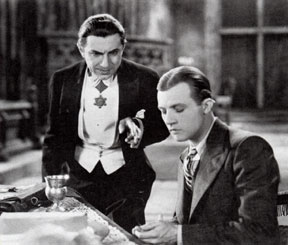
In terms of emotional response, I felt more concerned and art-horrified by the film "Catpeople" than I did when watching "Dracula". According to what I have previously stated, I believe this to be due to the amount of time that was given to developing the characters Irena and Oliver. I felt the most connected and interested in these characters. This led me to be more drawn into the movie making my emotional responses stronger. In contrast, the characters in "Dracula" are developed very minimally. They are not shown and described much more than their state at the present moment. The audience is not given a chance to relate to them and this left me feeling minimal, if any, art-horror.
In his novel, Carroll touches on the idea that in order for us to feel an emotional response to a situation it may be necessary for us to identify with a character. He discredits the idea by stating that our response is not a direct duplication of the egoistic responses of the characters, but rather a response in relation to their safety. An others-centered response.
While I agree that our responses are not a duplication, I don't feel that the necessity of a connection between characters and audiences should be down-played. In fact, I feel that this connection is of the upmost importance and the quality that directly affects this is the amount of time that is allotted to character development. The more individual characters are developed by placing them in time with regards to their background, morals, and emotions, the more connected the audience will feel to the character. This gives the audience more opportunity to identify with them and see things in the characters that relate to the audience member as an individual.
In terms of emotional response, I felt more concerned and art-horrified by the film "Catpeople" than I did when watching "Dracula". According to what I have previously stated, I believe this to be due to the amount of time that was given to developing the characters Irena and Oliver. I felt the most connected and interested in these characters. This led me to be more drawn into the movie making my emotional responses stronger. In contrast, the characters in "Dracula" are developed very minimally. They are not shown and described much more than their state at the present moment. The audience is not given a chance to relate to them and this left me feeling minimal, if any, art-horror.
The Elicitation of Emotions: Why Do We Connect With the Fictional?
Hearts are pounding, hands are sweating, adrenaline is pumping, muscles are tightening, and breathing is shorter, faster. We are watching as the main character in a horror film clumsily makes their way around a desolate field—the monster is behind them. In futility we shout at them to react, they fail to do so and become a victim of the ruthless monster. We are horrified at the gruesome results. But why?
Noël Carrol presents three theories as to why we fear fictional tales, The Illusion Theory, the Pretend Theory, and the Thought Theory. The Illusion Theory is thinking audiences actually believe the events on screen/print/radio are actually unfolding. The Pretend Theory is the belief that the emotions elicited from events on screen are not genuine, but are ‘make-believe’ fears to fulfill the experience of the fiction. The thought theory is the belief that we imagine the scenario played out in the fiction happening to ourselves and react accordingly.
One of these solutions explains our terror or the elicitation of any emotion. Let us begin with the protagonist in the story, who is, the majority of the time, a human. Humans can connect to humans, but not to monsters. These foreign creatures have little value to us and oftentimes are the cause of suffering in works of fiction. This is why we connect to the protagonist characters that triumph over the monsters. Again, this feeling of connection oftentimes elicits emotions from the audience thereby returning one to the question of why. The clearest reason given then is the Thought Theory. We imagine ourselves in the position of the protagonist, and wish for their success, hence why we scream, even in crowded movie theatres, for them to turn and see the monster behind them. There is undoubtedly a connection, and let us consider another scenario. Why did we feel for King Kong after his death? Personification. King Kong had the humanistic characteristic of love. The audience internalized the pain of never being able to have someone they so loved. Fictions can elicit emotion, and they do it even without the audience realizing it sometimes.
Noël Carrol presents three theories as to why we fear fictional tales, The Illusion Theory, the Pretend Theory, and the Thought Theory. The Illusion Theory is thinking audiences actually believe the events on screen/print/radio are actually unfolding. The Pretend Theory is the belief that the emotions elicited from events on screen are not genuine, but are ‘make-believe’ fears to fulfill the experience of the fiction. The thought theory is the belief that we imagine the scenario played out in the fiction happening to ourselves and react accordingly.
One of these solutions explains our terror or the elicitation of any emotion. Let us begin with the protagonist in the story, who is, the majority of the time, a human. Humans can connect to humans, but not to monsters. These foreign creatures have little value to us and oftentimes are the cause of suffering in works of fiction. This is why we connect to the protagonist characters that triumph over the monsters. Again, this feeling of connection oftentimes elicits emotions from the audience thereby returning one to the question of why. The clearest reason given then is the Thought Theory. We imagine ourselves in the position of the protagonist, and wish for their success, hence why we scream, even in crowded movie theatres, for them to turn and see the monster behind them. There is undoubtedly a connection, and let us consider another scenario. Why did we feel for King Kong after his death? Personification. King Kong had the humanistic characteristic of love. The audience internalized the pain of never being able to have someone they so loved. Fictions can elicit emotion, and they do it even without the audience realizing it sometimes.
Horror with No Monster Seen??
Can a movie be horrific if you never actually see a monster? According to Noel Carroll, in order to be considered an example of art-horror, a work must have a monster. Going even further, he gives requirements that the monster must be impossible according to modern science, it must be out of place in its environment, and it must be threatening and impure or disgusting. Can a monster that is never actually shown on screen meet these requirements?
Jacques Tourneur certainly thought that a good horror movie could be made without ever showing the monster. In his movie Cat People, Irena is never shown transforming into a cat. Only briefly is she on screen as a cat, and we mostly see her as a normal woman. Even so, the audience is sure that she can turn into a cat and is unnatural because of the unexplainable things that happen such as the robe being torn to shreds.
In the Night of the Demon, another one of Tourneur’s films, the monster is shown twice. This was, however, against the wishes of Tourneur, who never wanted to actually show the monster. He wanted to just give a glimpse of him. I think this move would have been more effective. Throughout the movie, we witness strange things happening such as the cyclone, the cryptic messages, and the pages being torn out of Dr. Holden’s planner. Obviously, some evil force was coming into play. As suspense builds up, the audience becomes more and more anxious about what is going to happen. Then, when the cloud of smoke and the monster come out of the sky, it is almost comical and seems unreal. If Tourneur had left the image of the monster up to the audience’s imagination, I think it would have been much more frightening.
One movie that does employ the theory of never showing the monster is the Blair Witch Project. In this movie, which is made in the style of a documentary made by three teenagers, we hear stories from people being interviewed by Heather, Josh, and Michael about an old legend concerning a witch. One lady says that the witch is a woman with thick hair like fur on her arms, so the monster was briefly described. We then see the teenagers going into the woods to investigate. Strange things start to happen in the woods. They find seven piles of stones, supposedly the graves of the seven children who were killed by the witch, and hear weird noises at night. Their tent shakes, they find three piles of rocks around their tent, and they find a ton of stick figures hanging in the woods. One morning, they wake up and Josh is not there. Later Heather finds a bundle of sticks tied together with strips of Josh’s shirt and when she opens it, there is blood inside. Because of all of these terrifying and possibly supernatural events, we know that something horrible is going on. Even at the end, when the three teenagers are supposedly killed, we do not see the antagonist. Most of the details about the monster and what happened to Heather, Josh, and Michael are left to the viewers’ imaginations.
Even if a monster is not seen, it can be threatening, impure, and disgusting because of the mere thought of it. It is not really necessary to visually see the monster if you are aware of the awful things it can do. This is especially true if supernatural things that cannot be explained by science are happening. In this case, the audience would be sure that the antagonist was not of this world. Therefore, I think that it is possible for a movie in which the monster is never actually shown to still be categorized as a horror by Carroll’s definition, and it may in fact be even more horrific than a movie in which the monster is shown.
Jacques Tourneur certainly thought that a good horror movie could be made without ever showing the monster. In his movie Cat People, Irena is never shown transforming into a cat. Only briefly is she on screen as a cat, and we mostly see her as a normal woman. Even so, the audience is sure that she can turn into a cat and is unnatural because of the unexplainable things that happen such as the robe being torn to shreds.
In the Night of the Demon, another one of Tourneur’s films, the monster is shown twice. This was, however, against the wishes of Tourneur, who never wanted to actually show the monster. He wanted to just give a glimpse of him. I think this move would have been more effective. Throughout the movie, we witness strange things happening such as the cyclone, the cryptic messages, and the pages being torn out of Dr. Holden’s planner. Obviously, some evil force was coming into play. As suspense builds up, the audience becomes more and more anxious about what is going to happen. Then, when the cloud of smoke and the monster come out of the sky, it is almost comical and seems unreal. If Tourneur had left the image of the monster up to the audience’s imagination, I think it would have been much more frightening.
One movie that does employ the theory of never showing the monster is the Blair Witch Project. In this movie, which is made in the style of a documentary made by three teenagers, we hear stories from people being interviewed by Heather, Josh, and Michael about an old legend concerning a witch. One lady says that the witch is a woman with thick hair like fur on her arms, so the monster was briefly described. We then see the teenagers going into the woods to investigate. Strange things start to happen in the woods. They find seven piles of stones, supposedly the graves of the seven children who were killed by the witch, and hear weird noises at night. Their tent shakes, they find three piles of rocks around their tent, and they find a ton of stick figures hanging in the woods. One morning, they wake up and Josh is not there. Later Heather finds a bundle of sticks tied together with strips of Josh’s shirt and when she opens it, there is blood inside. Because of all of these terrifying and possibly supernatural events, we know that something horrible is going on. Even at the end, when the three teenagers are supposedly killed, we do not see the antagonist. Most of the details about the monster and what happened to Heather, Josh, and Michael are left to the viewers’ imaginations.
Even if a monster is not seen, it can be threatening, impure, and disgusting because of the mere thought of it. It is not really necessary to visually see the monster if you are aware of the awful things it can do. This is especially true if supernatural things that cannot be explained by science are happening. In this case, the audience would be sure that the antagonist was not of this world. Therefore, I think that it is possible for a movie in which the monster is never actually shown to still be categorized as a horror by Carroll’s definition, and it may in fact be even more horrific than a movie in which the monster is shown.
Night of the Demon
According to Noel Carroll’s definition of art horror, Night of the Demon is a classic example of a horror film. The monster in the film created agitation for the audience through its physical attributes which are threatening, dangerous and impure. The methods used to create the monster were fusion, magnification and horrific metonymy. The monster, a demon, is a fusion made up of a dragon body with wings, long claws, fangs, horns, pointy ears and a hairy body, much like a werewolf. Magnification was used by making the demon very large. Horrific metonymy was established through the smoke that appeared before the demon attacked, the fluttering of the unknown creature before the demon came and the powerful winds that were present at the time of the demon and to warn Holden. All of these features were used to evoke disgust and fear in the audience.
Carroll notes in his writing that we can not fully identify with a character. To be able to identify with the character, we would have to experience the same emotions and cognitions as the character. We don’t actually do that though because we don’t run when the monster is coming at the screen. The writers of “Night of the Demon” present two characters though to which we can relate. Dr. Holden and Joanna Harrington represent two different sides of the spectrum when it comes to believing in the demon. Joanna obtains her uncle’s diary and in it reads of his belief that he will die of the supernatural. The pages of his desk calendar had been ripped out after the date of his predetermined death and he speaks of how he has seen the evil that will come for him. Joanna wants to be proven wrong that something greater was not involved in her uncle’s death, but she realizes that his death was not an accident. Holden on the other hand tries to use science to disprove what is happening. He believes in the power of psychology and hypnosis. Holden creates a response to everything that Dr. Karswell does and is very skeptical. It is not until Holden is performing hypnosis on a former cult member that he fully fathoms the danger he is in. Only then does he act accordingly to save himself and end the curse of the demon. Joanna represents the portion of the audience who come and get caught up in the suspense of disbelief. They are those that fit the pretend and illusion theories. They pretend to be fearful for the thrill or they forget about reality and their illusion is that the monster is real. Holden represents the part of the audience that needs convincing. They know the monster is impossible, but are eventually worked into being fearful of the thought of its reality, as in the thought theory. The audience as a whole ultimately experiences art horror. The key to experiencing the fear at the movie is the monster. No matter the means taken to experience horror, the monster and it’s impurity, disgust and danger is what the audience gets excited and fearful about.
Carroll notes in his writing that we can not fully identify with a character. To be able to identify with the character, we would have to experience the same emotions and cognitions as the character. We don’t actually do that though because we don’t run when the monster is coming at the screen. The writers of “Night of the Demon” present two characters though to which we can relate. Dr. Holden and Joanna Harrington represent two different sides of the spectrum when it comes to believing in the demon. Joanna obtains her uncle’s diary and in it reads of his belief that he will die of the supernatural. The pages of his desk calendar had been ripped out after the date of his predetermined death and he speaks of how he has seen the evil that will come for him. Joanna wants to be proven wrong that something greater was not involved in her uncle’s death, but she realizes that his death was not an accident. Holden on the other hand tries to use science to disprove what is happening. He believes in the power of psychology and hypnosis. Holden creates a response to everything that Dr. Karswell does and is very skeptical. It is not until Holden is performing hypnosis on a former cult member that he fully fathoms the danger he is in. Only then does he act accordingly to save himself and end the curse of the demon. Joanna represents the portion of the audience who come and get caught up in the suspense of disbelief. They are those that fit the pretend and illusion theories. They pretend to be fearful for the thrill or they forget about reality and their illusion is that the monster is real. Holden represents the part of the audience that needs convincing. They know the monster is impossible, but are eventually worked into being fearful of the thought of its reality, as in the thought theory. The audience as a whole ultimately experiences art horror. The key to experiencing the fear at the movie is the monster. No matter the means taken to experience horror, the monster and it’s impurity, disgust and danger is what the audience gets excited and fearful about.
Jacques Tourneur, A Carroll Perspective

Fear, anguish, disgust, and suspense are all emotions that Jacques Tourneur wants you to feel when you watch Night of the Demon or Cat People. These are also the emotions that Nöel Carroll describes as part of art-horror which is the emotion all horror film directors strive to evoke from their audience. The emotions of art-horror are usually cued to us by the characters we see on screen. They are derived from our reaction to the appearance of the monsters that serve as antagonists and to our perception of the emotions shown by the protagonist characters when they are beset by the monster or are at least threatened with the prospect of its sudden arrival. A good director will use both of these areas to their full effect to art-horrify the audience as much as possible. Jacques Tourneur takes two slightly different approaches to this in the two films we have seen in class, Night of the Demon and Cat People.
First, let us examine the two different monsters in the films and the approaches he uses when portraying them. In Cat People the monster is the woman Irena. Irena is a typical fission monster, described by Carroll as two separate entities

Jacques Tourneur introduces us to a standard set of characters in both films. There is the typical American Joe, Oliver Reed and John Holden; the damsel, Alice Moore and Joanna Harrington; the monster, Irena Reed and the demon; plus an auxiliary character which may have impure intent to die at the end to show the monster's power, Dr. Louis Judd and Julian Karswell. The roles he gives them determine the audience's reaction to their plight. We are happy when the American Joe escapes danger and is comforted by his respective damsel, we are art-horrified when he is under attack from the malevolent forces of evil and we are sad when he loses that which he loves. The damsel also evokes the same response, this is because she and the American Joe are seen as "the good guys" and as moral beings we want to see good triumph over evil. We can perceive their emotions and translate them into ones we can experience as a horror film audience. Some would call this character-identification, Carroll says no. He defines character identification as a duplication of the character's emotions which is impossible because as the audience we know more about the situation than the character knows and we also know that we are watching a film. We react to the monsters in the exact way Carroll says we should we are frightened by the thought of their existence and disgusted by what they are. However, the movie Cat People with its fission monster throws a twist on the standard monster response. The monster, Irena is a character that we have come to know and sympathize with over the course of the film. When she becomes the panther we are horrified by her and are only too happy when she is stabbed, but only a few moments later she has changed back to the sweet girl we knew but now she is mortally wounded. The audience feels fear and sadness at the same time. Finally we have the auxiliary character, a role that is not often explored but always used in horror films. This character is aligned on the scale of good and evil between the protagonist at the extreme good end and the monster antagonist at the extreme evil end but part of neither group. They are the character that is used to display the full brutality of the monster. In Cat People that character is Dr. Louis Judd. He continues to hold the belief that Irena is merely insane long after the other characters are convinced that she really is a cat person until he is ultimately killed by her while trying to take advantage of her. The audience's response to this is probably "ha ha serves you right" but they probably also feel a tiny bit of remorse in that he was an innocent character who was brought into help but got caught up in a situation that spiraled out of control. The opposite can be said of the character Julian Karswell in Night of the Demon, he is clearly evil though not as evil or repulsive to the audience as the demon. He may have summoned the demon but he is horrified by it and would do anything to avoid its wrath. He is responsible for placing the hex on Dr. Holden which drives the whole plot of the movie. His trickiness compels the audience to develop an intense hatred of him. This hatred is a different emotion than the fear of the demon for he is but a man and is not invulnerable, nor is he very threatening looking. Only his death would have delivered a successful climax and satisfying denouement.
Tourneur's movies put an interesting and refreshing spin on the horror genre that is worlds away from the horror films of today. We are left to our imagination for most of the film, there are few special effects to take the guesswork out of the nature of the monster and its goals. In Tourneur's movies the monsters can only be a scary as you make them.
Journal # 1 Greg Frey
Ever since I was young, I have been an enormous fan of horror films and are intrigued by random something’s out of the ordinary. The feeling of adrenalin and suspense while watching a horror film draws you more into the film to make you feel the characters emotions in your seat. The “Mise-en-shot” in my opinion is what makes or breaks the film from being considered a good or a classic movie. A director must be precise when deciding how long to film a certain scene and be careful not to draw out the effect of the characters, monsters, or storyline. If the monster is shown every few minutes, then the effect is lost and the monster seems not quite as scary or disgusting.
An example of a movie that keeps the audience on the edge of their seats shows great directing, and using sectioning of the film or “Mise-en-shot” is Dead Silence. The monster that is considered a ghost in the film possesses her beloved dolls and cuts the tongue from their victims’ mouth leaving a most disturbing image for others to find in the town. The fast and shocking cuts in the movie make the suspense last throughout the duration. Personally, I feel that many films throughout the years have lost their effect on frightening the audience due to this overexposure such as the movie series Friday The 13th Jason being in over half the movie.
Fear is the strongest emotion that we have and are instincts tells us either “fight or flight.” Art horror is the major topic we discuss in class which means that the monster in horror films are both fearsome and disgusting causing people threats of their own well-being. Noël Carroll speaks of a Paradox of Fiction which is the emotional response of any sort to a fictional character which generates a paradox and then asks why do we as the viewing audience, respond emotionally to a which we believe not to exist? We say it is human nature to care, but think about the classic film Physco. He shows no human concern and looks as humans as disposable pleasures.
Typically, the recipe for a monster is classified in five main characteristics: fission, fusion, magnification, massification, and metonymy. Since we are all familiar with them all I won’t explain them however, I feel like the fission monster is more of a believable and entertaining story. I all werewolf films the human is transformed into the wolf man which leads us to have a slight doubt that maybe werewolves can exist. This seems like the more believable a storyline the more drawn in the audience will be.
An example of a movie that keeps the audience on the edge of their seats shows great directing, and using sectioning of the film or “Mise-en-shot” is Dead Silence. The monster that is considered a ghost in the film possesses her beloved dolls and cuts the tongue from their victims’ mouth leaving a most disturbing image for others to find in the town. The fast and shocking cuts in the movie make the suspense last throughout the duration. Personally, I feel that many films throughout the years have lost their effect on frightening the audience due to this overexposure such as the movie series Friday The 13th Jason being in over half the movie.
Fear is the strongest emotion that we have and are instincts tells us either “fight or flight.” Art horror is the major topic we discuss in class which means that the monster in horror films are both fearsome and disgusting causing people threats of their own well-being. Noël Carroll speaks of a Paradox of Fiction which is the emotional response of any sort to a fictional character which generates a paradox and then asks why do we as the viewing audience, respond emotionally to a which we believe not to exist? We say it is human nature to care, but think about the classic film Physco. He shows no human concern and looks as humans as disposable pleasures.
Typically, the recipe for a monster is classified in five main characteristics: fission, fusion, magnification, massification, and metonymy. Since we are all familiar with them all I won’t explain them however, I feel like the fission monster is more of a believable and entertaining story. I all werewolf films the human is transformed into the wolf man which leads us to have a slight doubt that maybe werewolves can exist. This seems like the more believable a storyline the more drawn in the audience will be.
The Art-Horror of Night of the Demon

The movie Night of the Demon, directed by Jacques Tourneur, is an excellent example of what Noel Carroll says is art-horror. The movie deals with a monster that is seen as both threatening and impure. The first example of the monster being impure is that it is very “disgusting” looking. It is shaped as a monster that is seen as unclean, there is an avoidance of wanting to touch the monster, and the monster’s physical attributes are considered to be abnormal to what people ordinarily see as normal. The second attribute of the demon is that it is seen as threatening. The monster caused a distribution in moral order and destroyed the identity of many characters throughout the film.
The movie used two different methods throughout the film that classified the type of monster that it was. The first type of monster that someone can consider this demon is that it was a fusion monster. The reason the monster can be considered a fusion monster is that it was made up of different attributes that make it abnormal. It had wings like a bird, horns, large sharp claws, and looked like a reptile/mammal. The second type of monster that caused the monster to be threatening was that it was magnified. The monster was really tall compared to the humans and it was able to take his victims by its hand to kill them. These two types of methods of monster make the monster seem more impure and threatening, which makes the film a great example of art-horror.
Even though there was a monster there were also many parts of the film that should be mentioned that make the movie “horrifying”. Some of the attributes include the eerie noises, emphasis throughout the film, allowing the audience to know things that the characters don’t know, and allowing the audience to understand the history of the monster. The eerie noises throughout the film builds suspense for the audience because it allows the audience to believe that something is about to happen. There is also emphasis on certain objects throughout the film. For example, Mr. Holden went to his briefcase and when he went to it there was an emphasis as if there was something wrong with it. This is a great example of mise-en-shot because it provides a close up to an object at an angle to provide more emphasis. In this case the briefcase emphasis shows that there may be something in the briefcase that could harm someone. There is also a scene at the beginning of the movie where Caswell looks at a clock. This foreshadows the death of Professor Harrington who will die at 10 o’clock that night. There is also foreshadowing of the parchment. In the beginning of the movie Professor Harrington received a parchment and he stated that it went into the fire. Tthe audience later finds out that the parchment that went into the fire symbolizes some of the character’s future deaths. Another mise-en-shot that should be mentioned is the closeout of the demon which gave a more emphasis on the look of the demon and how “disgusting” and “abnormal” it looked. Also the movement of the camera following the parchment shows that the parchment was hard to catch and that it was getting farther and farther away.
There are also a lot of scenes throughout the movie that uses mise-en-scene. For example, the lighting (darkness) and use of the forest made the movie and scenes more horrifying and scary for the characters and the audience. The emphasis on Caswell’s house being isolated behind woods makes the movie and the mood more creepy and mysterious. Also, there is the scene in the hallway of the hotel where Dr. Holden was staying. In this scene, it seems as if Dr. Holden is scared that something is going to happen because of the awkwardness, noise, and darkness bringing the idea of mise-en-scene back into play.
The film also allows the audience to know things that a lot of characters don’t know. For example, the audience knows what the monster looks like and that there is actually a monster, while some of the characters believe that there isn’t a monster at all. Plus, the audience knows that Caswell is behind everything when the book in his house is opened up to a picture of the monster.
The movie also does a great job explaining the existence of the monster through Thought Theory. The “thought” of where the monster came from and the involvement of Medieval witchcraft/ruins of Stonehenge make the thought of the monster seem real in the film, even though the audience really knows that something like this would not occur in real life.
There is no reason that Night of the Demon should not be classified as art-horror. Night of the Demon provides excellent detail for the monster, from scenes throughout the movie, and tactics to how the movie was filmed. This film goes above and beyond and that’s why it is necessary to say that it one of the best art-horror movies of all time.
Cat People
Irena is a beautiful young woman who is terribly lonely and has a dreadful secret. She longs for companionship but she knows that she will only bring destruction upon those she loves most, so she does her best to keep her distance. She is successful in her isolation until she meets Ollie, whom she falls madly in love with and marries. However, her dark and unnatural biology drives a wedge between them and nullifies their marriage since a loving embrace from Ollie will initiate Irena’s transformation into a panther that will kill Ollie. However, Ollie is a man in need of love, and he finds that with his co-worker Alice. Unfortunately for Ollie and Alice, jealousy is another trigger for Irena’s frightening transformation.
According to Noël Carroll, Irena is both a fission and metonymy monster. It may be difficult for someone to view Irena as a true monster according to Carroll’s specifications, because a monster must be not only frightening but also disgusting. While there is no argument that a fearsome man-killing big cat is frightening, it could be argued that these animals are in no way disgusting. However, what I feel is disgusting, impure, or simply biologically impossible according to modern science about Irena is the fact that she is able to transfer from one biological category to another, from human to feline. This interstitial ability of Irena’s is what makes her disgusting to audiences, and is one part of two that makes her a true monster that generates art horror emotions. Irena is a fission monster much like a werewolf because of her interstitial ability. She can go from a sweet innocent fashion designer to a destructive animal with the right set of circumstances. According to Carroll, “the animal and human inhabit the same body; however they do so at different times.” We do not see the human Irena walking around with a cat tail and pointy ears because her transformation from one category to the next is a complete one. Irena is also a metonymy monster because Irena the human does not invoke disgust or horror, but her surroundings do. The first clues to her being a monster were the decorations in her apartment. They were images of powerful and fierce cats, and one picture in particular was one of a cat eyeing a bird maliciously. The most prominent display in her apartment, though, was the statue of King John spearing the very animal that her apartment’s décor was paying homage to. Ollie was disturbed by this imagery but Irena tried to explain it away as very normal for people from her homeland to have displays of. She explained to him that was King John who helped bring Christianity back to her land and to get rid of the cat people. This revelation falsely comforted Ollie because by the looks of the apartment she was a strange worshipper of cats herself! It is here that we are sympathizing with Irena because we know that she longs to be normal; she does not want to hold herself back from other people, but we also get the sense that it is simply her fate to be one of the cat people. Another form of metonymy is the fact that normal household pets are frightened to bits when Irena enters their vicinity. It is mainly cats that hiss and recoil in her presence, but other animals are intimidated by her also. These reactions from animals that we believe to be more in touch with the supernatural and possibly the sublime show a serious sense of foreboding that surrounds Irena.
The producer of Cat People, Val Lewton, felt that not showing the monster would create a more effective horror movie. Today’s horror films aim to instinctively shock, disgust, and horrify us as a knee jerk reaction very frequently. The increase in technology enables movie makers to do this very effectively without the movie looking ridiculous and invoking laughter from the audience. The technology in 1942 did not compare with today’s and Lewton did not want to create a laughable horror. His use of lighting and shadows or “mise-en-shot” effectively art horrified the audience. The movie was shot in black and white and had a very somber appearance with low lighting. I believe that this somberness helped us to anticipate the drama and horror that was entering into the protagonists’ lives manifested in the “cat people” horror that Irena has brought to America from Serbia. Irena is also associated with darkness as she claims to like the dark, and whenever the cat Irena appears it is usually a dark shadow or a flash of a black panther. The “mise-en-scene” aspect of the film showed some deep focus photography which allowed the audience to recognize the foreboding aspects of the surroundings. Whenever the monster Irena would appear we only knew it by the response of the other characters which did not make the fact that Irena was a crazed cat less believable; we were able to be horrified by the thought of Irena as a woman who transforms to a cat.
According to Noël Carroll, Irena is both a fission and metonymy monster. It may be difficult for someone to view Irena as a true monster according to Carroll’s specifications, because a monster must be not only frightening but also disgusting. While there is no argument that a fearsome man-killing big cat is frightening, it could be argued that these animals are in no way disgusting. However, what I feel is disgusting, impure, or simply biologically impossible according to modern science about Irena is the fact that she is able to transfer from one biological category to another, from human to feline. This interstitial ability of Irena’s is what makes her disgusting to audiences, and is one part of two that makes her a true monster that generates art horror emotions. Irena is a fission monster much like a werewolf because of her interstitial ability. She can go from a sweet innocent fashion designer to a destructive animal with the right set of circumstances. According to Carroll, “the animal and human inhabit the same body; however they do so at different times.” We do not see the human Irena walking around with a cat tail and pointy ears because her transformation from one category to the next is a complete one. Irena is also a metonymy monster because Irena the human does not invoke disgust or horror, but her surroundings do. The first clues to her being a monster were the decorations in her apartment. They were images of powerful and fierce cats, and one picture in particular was one of a cat eyeing a bird maliciously. The most prominent display in her apartment, though, was the statue of King John spearing the very animal that her apartment’s décor was paying homage to. Ollie was disturbed by this imagery but Irena tried to explain it away as very normal for people from her homeland to have displays of. She explained to him that was King John who helped bring Christianity back to her land and to get rid of the cat people. This revelation falsely comforted Ollie because by the looks of the apartment she was a strange worshipper of cats herself! It is here that we are sympathizing with Irena because we know that she longs to be normal; she does not want to hold herself back from other people, but we also get the sense that it is simply her fate to be one of the cat people. Another form of metonymy is the fact that normal household pets are frightened to bits when Irena enters their vicinity. It is mainly cats that hiss and recoil in her presence, but other animals are intimidated by her also. These reactions from animals that we believe to be more in touch with the supernatural and possibly the sublime show a serious sense of foreboding that surrounds Irena.
The producer of Cat People, Val Lewton, felt that not showing the monster would create a more effective horror movie. Today’s horror films aim to instinctively shock, disgust, and horrify us as a knee jerk reaction very frequently. The increase in technology enables movie makers to do this very effectively without the movie looking ridiculous and invoking laughter from the audience. The technology in 1942 did not compare with today’s and Lewton did not want to create a laughable horror. His use of lighting and shadows or “mise-en-shot” effectively art horrified the audience. The movie was shot in black and white and had a very somber appearance with low lighting. I believe that this somberness helped us to anticipate the drama and horror that was entering into the protagonists’ lives manifested in the “cat people” horror that Irena has brought to America from Serbia. Irena is also associated with darkness as she claims to like the dark, and whenever the cat Irena appears it is usually a dark shadow or a flash of a black panther. The “mise-en-scene” aspect of the film showed some deep focus photography which allowed the audience to recognize the foreboding aspects of the surroundings. Whenever the monster Irena would appear we only knew it by the response of the other characters which did not make the fact that Irena was a crazed cat less believable; we were able to be horrified by the thought of Irena as a woman who transforms to a cat.
Horror: Why Consider; by tomd
Horror, I will readily admit, is not a subject that I would choose to discuss at a cocktail party or care to bring up in casual conversation. To view a horror movie or to read book about monsters are not on my list of things to do on a rainy day, and yet I find myself taking a college course on the Philosophy of Film; in particular "horror film." I actually have a distaste for literature and films based upon stories that deal with the scary, ghoulish, creepish, gory, freakish genre that is labeled "art horror". I will admit however that I have been intrigued about what Carroll has to say about "art horror" and its empowerment over rational beings. I am starting to feel somewhat like an oddity because I don't have an attraction to the horror genre and the entertainment that it seems to bring to many thrill seekers. I have probably watched more horror films this past week than I have in the past ---- years of my life; that's a long time.
Noel Carroll in his book "The Philosophy of Horror" has been able to develop a philosophical approach and an in-depth understanding to the "art of horror" genre that has provided me with an appreciation of what lies hidden within the human person that only horror can evince and evoke. I never really considered tragedy and fear a normal part of the human experience that brings about a catharsis within the human person. Carroll doesn't accept every monster story line as coming under the heading of true "art horror" but specifies those particular elements and requirements that are necessary in order to define true horror as an art. Only true "art horror" can achieve the sublime ideals of the highest order.
What is it that causes the rational being to be drawn to what can be termed the unbelievable, at least in the truest scientific sense? Is it the thrill of peering into the "weird" and possibly the supernatural? Do we have a natural attraction to the abnormal, mysterious, and dangerous possibilities that may cower around every person's corner? Do we like to see others in danger, distress, and peril? These are the questions that I believe Carroll wants us to think about and possibly discover about ourselves. H.P. Lovecraft will surmise that "the oldest and strongest emotion of mankind is fear, and the oldest and strongest kind of fear is fear of the unknown." Could it be true as Lovecraft says that "we are hard-wired psychologically to fear the cosmic unknown" and because of this we are in a certain sense helpless to resist. Perhaps it is this idea that explains what causes traffic jams on major thru-ways because people have slowed down while "rubbernecking" to view an vehicle accident. Do we instinctively have a need to fulfill a basic human attraction to view other peoples pain, sorrow, distress and mishap or are we better than that?
The "art-horror" that Carroll wants to elicit is that kind of horror that truly brings out the deepest level of emotions in the audience. When he speaks about "art-horror" he distinguishes it from horror in the general sense of the term. He is not satisfied with a general analysis but segregates art-horror as something purgative in its makeup. The elements situated in Carroll's definition are 1) a profound elicitation of a fear emotion on the part of the audience. He knows that even though the audience is rational, and knows that what they are viewing is not real, the affect of what they are viewing elicits a real experience of fear and emotions to the highest degree; 2) the means of establishing this fear into the minds and hearts of the viewers comes about by the actions and/or reactions of the actors and the monsters within the story line. The audience in fact picks up on the emotions of the actors and a transference takes place that seems to place them in danger as well; and 3) that the monster is beyond the ordinary and naturalistic known world, literally a world that only the imagination can seek to discover and create. Carroll's monster's are disgusting, repulsive, icky, dangerous, and deadly. There is no escape from its throws. What helps to create this affect in the audience and how does it keep the viewer spellbound? This is the paradox that Carroll wants to address.
Carroll asks how is it that a rational audience can be caught up with a fiction of horror when they know beforehand that what they see and/or read is not real. His three propositions are intuitive in that he admits that somehow we as human beings are moved by fiction, that what we view or read is not an actual event but something made up from the imagination of the writer, and it seems as well that since we are caught up emotionally there is that sense that we come believe in spite of its impossibility. How and why do we respond, or become significantly afraid emotionally to that which we believe does not exist?
In the films that I watched this week, I must admit, that I have not been moved emotionally in the same way the Carroll believes an "art-horror" creation should move the viewers in the audience. However, I have been able to see elements within the film that could point to the political and social environs of the times. As discussed in class the movie "The Cat People" could be construed as an attempt to portray the political climate and relational distrust between Europe and the United States at the beginning of World War II. The good being stalked by the evil prevalent in a time of uncertainty; or the naive and undiscerning acceptance of the unknown hoping for the best in a bad situation thinking that if one thinks good things good things will certainly prevail. Perhaps there is an emotionally state that is created for some not enticed by horror watching but by which still elects an emotionally response on a deeper level; the level of a cognisant awareness of human interaction of a socio-political nature.
It is true, Carroll suggests, that the "auteur" does create his own particular art in creating film. Film and literature do not stand alone simply to tell a story of no consequence, but should tell the story of the human experience and convey a message about the way in which we live and interact with others. I guess we could call that creating something with "purpose" and it is with this purpose in mind which perhaps makes us human.
In philosophy, I believe with the ancient philosophers that our lives should have meaning and purpose. In a communitarian society we do not live within a vacuum but socially and adapt our way of live for the common good. I am hoping that as this course develops, with the help of Dr. Langgruth, that I will come to understand the "art-horror" genre as something beneficial in development my philosophical understanding of human nature and the helps that it may provide in applying that understanding to becoming a better human being and promote the common good.
Noel Carroll in his book "The Philosophy of Horror" has been able to develop a philosophical approach and an in-depth understanding to the "art of horror" genre that has provided me with an appreciation of what lies hidden within the human person that only horror can evince and evoke. I never really considered tragedy and fear a normal part of the human experience that brings about a catharsis within the human person. Carroll doesn't accept every monster story line as coming under the heading of true "art horror" but specifies those particular elements and requirements that are necessary in order to define true horror as an art. Only true "art horror" can achieve the sublime ideals of the highest order.
What is it that causes the rational being to be drawn to what can be termed the unbelievable, at least in the truest scientific sense? Is it the thrill of peering into the "weird" and possibly the supernatural? Do we have a natural attraction to the abnormal, mysterious, and dangerous possibilities that may cower around every person's corner? Do we like to see others in danger, distress, and peril? These are the questions that I believe Carroll wants us to think about and possibly discover about ourselves. H.P. Lovecraft will surmise that "the oldest and strongest emotion of mankind is fear, and the oldest and strongest kind of fear is fear of the unknown." Could it be true as Lovecraft says that "we are hard-wired psychologically to fear the cosmic unknown" and because of this we are in a certain sense helpless to resist. Perhaps it is this idea that explains what causes traffic jams on major thru-ways because people have slowed down while "rubbernecking" to view an vehicle accident. Do we instinctively have a need to fulfill a basic human attraction to view other peoples pain, sorrow, distress and mishap or are we better than that?
The "art-horror" that Carroll wants to elicit is that kind of horror that truly brings out the deepest level of emotions in the audience. When he speaks about "art-horror" he distinguishes it from horror in the general sense of the term. He is not satisfied with a general analysis but segregates art-horror as something purgative in its makeup. The elements situated in Carroll's definition are 1) a profound elicitation of a fear emotion on the part of the audience. He knows that even though the audience is rational, and knows that what they are viewing is not real, the affect of what they are viewing elicits a real experience of fear and emotions to the highest degree; 2) the means of establishing this fear into the minds and hearts of the viewers comes about by the actions and/or reactions of the actors and the monsters within the story line. The audience in fact picks up on the emotions of the actors and a transference takes place that seems to place them in danger as well; and 3) that the monster is beyond the ordinary and naturalistic known world, literally a world that only the imagination can seek to discover and create. Carroll's monster's are disgusting, repulsive, icky, dangerous, and deadly. There is no escape from its throws. What helps to create this affect in the audience and how does it keep the viewer spellbound? This is the paradox that Carroll wants to address.
Carroll asks how is it that a rational audience can be caught up with a fiction of horror when they know beforehand that what they see and/or read is not real. His three propositions are intuitive in that he admits that somehow we as human beings are moved by fiction, that what we view or read is not an actual event but something made up from the imagination of the writer, and it seems as well that since we are caught up emotionally there is that sense that we come believe in spite of its impossibility. How and why do we respond, or become significantly afraid emotionally to that which we believe does not exist?
In the films that I watched this week, I must admit, that I have not been moved emotionally in the same way the Carroll believes an "art-horror" creation should move the viewers in the audience. However, I have been able to see elements within the film that could point to the political and social environs of the times. As discussed in class the movie "The Cat People" could be construed as an attempt to portray the political climate and relational distrust between Europe and the United States at the beginning of World War II. The good being stalked by the evil prevalent in a time of uncertainty; or the naive and undiscerning acceptance of the unknown hoping for the best in a bad situation thinking that if one thinks good things good things will certainly prevail. Perhaps there is an emotionally state that is created for some not enticed by horror watching but by which still elects an emotionally response on a deeper level; the level of a cognisant awareness of human interaction of a socio-political nature.
It is true, Carroll suggests, that the "auteur" does create his own particular art in creating film. Film and literature do not stand alone simply to tell a story of no consequence, but should tell the story of the human experience and convey a message about the way in which we live and interact with others. I guess we could call that creating something with "purpose" and it is with this purpose in mind which perhaps makes us human.
In philosophy, I believe with the ancient philosophers that our lives should have meaning and purpose. In a communitarian society we do not live within a vacuum but socially and adapt our way of live for the common good. I am hoping that as this course develops, with the help of Dr. Langgruth, that I will come to understand the "art-horror" genre as something beneficial in development my philosophical understanding of human nature and the helps that it may provide in applying that understanding to becoming a better human being and promote the common good.
Monsters and Color
Through Carroll’s description of art horror, he uses a variety of monsters to display many emotions produced by the audience. The thought of a monster in a horror film leads to many actions contributed by the other characters, and the responses of the audience. Although I do not watch a lot of horror films, the ones I have seen left me with many mental images. The handful of horror films I have seen depicted monsters as unclean and disgusting.
Monsters seem to express no normal characteristics. They also can take on super natural qualities. One example of abnormal qualities that monsters sometimes portray includes magnification as seen in the movie Godzilla. We saw Godzilla take on an abnormally large size and while in this state destroy many things. Another example of monsters includes fusion such as in the case of a half man half carrot monster. Furthermore, a werewolf would be an example of a fission monster. A werewolf has human qualities during the day and transforms to a werewolf at night. An example of massification would be the movie The Birds by Alfred Hitchcock. It involves a swarming of birds. One of the major aspects I believe that relates monsters to horror films would be metonomy. Metonomy is when the environment surrounds an object and plays a key role in the depiction of the monster in the audiences’ eyes.
I feel that the category of color has a great affect on the way the audience experiences and reacts to a horror film. Some horror films are done in black and white and some are done in color. In horror films the presence of the monster coincides with both dark objects and the dark environment. The use of dark colors resembles the uncertainty of things, and leads to fear of the unknown.
The use of color was very important in Dracula. In this movie, it is apparent that the monster can not experience light. Through Dracula’s character, the audience witnesses the black cape costume he wears. Furthermore, Dracula lies in his coffin in a dark dreary basement, and only enters the lives of his victims in the darkness of the night. These show how significant darkness is as a key role throughout the film.
In Cat People, the audience can experience darkness in many ways. One of the first things that appeared in the movie is the dark cat. This animal has great significance throughout the movie, and is a type of foreshadowing of what is to come later in the film. Ulaina comes across to the other characters as a pretty and nice lady, but seems hesitant in her relationship. From the beginning, there seems to be something not quite right about her. Her obsession with the dark cat and visiting the cat in the park at night are examples of the darkness effect. Also another example of darkness is when Ulaina follows Alice down the dark street and all we hear are the footsteps. Furthermore, the audience gets a sense of how Alice is frightened by the unknown. It gives one the opportunity to question what could possibly be following her.
Through these movies we can experience good examples of the darkness of horror films. I really did not experience any disgust or uncleanliness. The horror that I experienced was due to the dark colors and the uncertainty in both films. The darkness aspect led me to contemplate what could possible be arising next, and what is in store for the characters. The two films viewed in class led me to rethink how movies are created. I’ve gained insight into what all is involved in creating a movie, and all the possibilities that can arise through monster characters.
Monsters seem to express no normal characteristics. They also can take on super natural qualities. One example of abnormal qualities that monsters sometimes portray includes magnification as seen in the movie Godzilla. We saw Godzilla take on an abnormally large size and while in this state destroy many things. Another example of monsters includes fusion such as in the case of a half man half carrot monster. Furthermore, a werewolf would be an example of a fission monster. A werewolf has human qualities during the day and transforms to a werewolf at night. An example of massification would be the movie The Birds by Alfred Hitchcock. It involves a swarming of birds. One of the major aspects I believe that relates monsters to horror films would be metonomy. Metonomy is when the environment surrounds an object and plays a key role in the depiction of the monster in the audiences’ eyes.
I feel that the category of color has a great affect on the way the audience experiences and reacts to a horror film. Some horror films are done in black and white and some are done in color. In horror films the presence of the monster coincides with both dark objects and the dark environment. The use of dark colors resembles the uncertainty of things, and leads to fear of the unknown.
The use of color was very important in Dracula. In this movie, it is apparent that the monster can not experience light. Through Dracula’s character, the audience witnesses the black cape costume he wears. Furthermore, Dracula lies in his coffin in a dark dreary basement, and only enters the lives of his victims in the darkness of the night. These show how significant darkness is as a key role throughout the film.
In Cat People, the audience can experience darkness in many ways. One of the first things that appeared in the movie is the dark cat. This animal has great significance throughout the movie, and is a type of foreshadowing of what is to come later in the film. Ulaina comes across to the other characters as a pretty and nice lady, but seems hesitant in her relationship. From the beginning, there seems to be something not quite right about her. Her obsession with the dark cat and visiting the cat in the park at night are examples of the darkness effect. Also another example of darkness is when Ulaina follows Alice down the dark street and all we hear are the footsteps. Furthermore, the audience gets a sense of how Alice is frightened by the unknown. It gives one the opportunity to question what could possibly be following her.
Through these movies we can experience good examples of the darkness of horror films. I really did not experience any disgust or uncleanliness. The horror that I experienced was due to the dark colors and the uncertainty in both films. The darkness aspect led me to contemplate what could possible be arising next, and what is in store for the characters. The two films viewed in class led me to rethink how movies are created. I’ve gained insight into what all is involved in creating a movie, and all the possibilities that can arise through monster characters.
Chapter One
In Noel Carroll’s The Philosophy of Horror, the genre “art-horror” is defined in the first chapter. His book is only taking that genre of horror and identifying it with philosophy. Horror is a category of ordinary language which we communicate and receive information. Its existence is already recognized in ordinary language. Art-horror however is different because it is generated by art that was produced first in the mid eighteenth century, with variations of Gothic forms in England and Germany. Carroll explains that monsters are the key ingredient in the recipe of art-horror. These monsters however cannot be the same as monsters in such stories as fairytales and myths. The monsters in fairytales are ordinary creatures in an extraordinary world. However, the monsters in art-horror have to be extraordinary creatures in an ordinary world. The monsters in art-horror are seen as impure and disgusting. The monsters impurity suggests that they are un-natural and not apart of our world, they are unknown and live outside the cultural categories. They also can be threatening socially, physically, and morally. In art-horror the characters also play a role as they will bring out the emotions of the audience, who can identify and relate to them on a personal kind of level. The emotions of the audience mirror the emotions of the characters. But these emotions that we feel with the characters are mere flashes such as flashes of anger, fear, and danger. We quickly move on from these emotions because they are not happening to us personally. I think these emotions can also be amplified by lighting, music, and other effects such as fog. When there is a loud burst of music, I generally get scared for a split second and a thrill of danger. As well as when there is haunting slow music and fog there is an emotion of curiosity and dread.
Carroll also explains that art-horror is made up of five categories such as fusion, fission, magnification, massification, and horrific metonymy. Fusion and fission both make up horrific biologies as fusion shows the threatening and disgusting qualities of a monster that is un-natural to society. Fission takes the role as it can divide the monster up in time as two different beings. By day the monster might be a nice guy but at night he turns into a threatening and disgusting wolf. This fission monster can however make the audience sympathize with it because of the fact that it can be two totally different beings with one that we might just be able to relate too. Magnification shows the way that monsters can be very large and bigger than many things in society such as people and buildings. The monster seems to have more power and control because it is so much larger than the victim. Massification is the category in which the monster can be in multiples also showing the power and strength it can have in mass. Lastly, horrific metonymy is the environment which surrounds the characters. The environment can be just as creepy as a monster as it goes into the unknown and mysterious. It can also have effects as a storm or heavy fog.
I never really noticed all of the attributes that Carroll explains that are in horror movies. I didn’t really think there could be so many ingredients that make it up. This chapter will be very helpful in studying and watching horror movies as I now know what to look for that will classify and tell me what kind of genre a horror movie is while I am watching it.
Carroll also explains that art-horror is made up of five categories such as fusion, fission, magnification, massification, and horrific metonymy. Fusion and fission both make up horrific biologies as fusion shows the threatening and disgusting qualities of a monster that is un-natural to society. Fission takes the role as it can divide the monster up in time as two different beings. By day the monster might be a nice guy but at night he turns into a threatening and disgusting wolf. This fission monster can however make the audience sympathize with it because of the fact that it can be two totally different beings with one that we might just be able to relate too. Magnification shows the way that monsters can be very large and bigger than many things in society such as people and buildings. The monster seems to have more power and control because it is so much larger than the victim. Massification is the category in which the monster can be in multiples also showing the power and strength it can have in mass. Lastly, horrific metonymy is the environment which surrounds the characters. The environment can be just as creepy as a monster as it goes into the unknown and mysterious. It can also have effects as a storm or heavy fog.
I never really noticed all of the attributes that Carroll explains that are in horror movies. I didn’t really think there could be so many ingredients that make it up. This chapter will be very helpful in studying and watching horror movies as I now know what to look for that will classify and tell me what kind of genre a horror movie is while I am watching it.

Noёl Carroll
The Philosophy of Horror
Carroll’s account of horror is modeled on Aristotle’s classic study of tragedy in the Poetics. Carroll analyzes the horror genre, broadly construed to include literature, film, theater, and painting, in terms of the “emotional effects” it aims to evoke in its audience. The primary such effect, according to Carroll, is an emotion that he calls “art-horror.”
Art-Horror
Carroll makes an important distinction between ‘natural horror’ and ‘art horror.’ The former is the sense of ‘horror’ captured in the statement “I am horrified at the idea of taking a summer class,” while the latter is the sense of ‘horror’ operative in statements like “ Nosferatu is a the greatest horror film ever made.”
“ “Art-Horror”, by stipulation, is meant to refer to the product of a genre that crystallized, speaking very roughly, around the time of the publication of Frankenstein—give or take fifty years—and that has persisted, often cyclically, through the novels and plays of the nineteenth century and the literature, comic books, pulp magazines, and films of the twentieth. This genre, moreover, is recognized in common speech and my theory of it must ultimately be assessed in terms of the way in which it tracks ordinary usage.” (The Philosophy of Horror, 13).
The Monster as a Necessary Condition of Art-Horror
Carroll argues that in order for a given work of art to be a member of the set of all works of art-horror it must feature a monster. Having a monster, however, is not a sufficient condition for inclusion in the set of the art-horrible (Puff the Magic Dragon is not a work of horror).
It is the hallmark of the art-horrible that it aim to produce a specific affect in its audience members. The monsters in a work of art-horror, then, must be regarded by the other characters in the work (and by the audience) as both fearful and hideously unnatural or revolting. Compare: Chewbacca and the Wolf-Man.
“The monsters of horror… breach the norms of ontological propriety presumed by the positive human characters in the story. That is, in examples of horror, it would appear that the monster is an extraordinary character n our ordinary world, whereas in fairy tales and the like the monster is an ordinary creature in an extraordinary world.” (Philosophy of Horror, 16).
Carroll contends that it is from the emotional reactions of the characters in the work that we take our cue as to the ‘violation of nature’ on display in a given monster.
Fear and Revulsion
The ideal art-horror monster is both fearful and revolting, as illustrated by the following passage from H.P. Lovecraft's At the Mountains of Madness.
“We had expected, upon looking back, to see a terrible and incredibly moving entity if the mists were thin enough; but of that entity we had formed a clear idea. What we did see—for the mists were indeed all too malignly thinned—was something altogether different, and immeasurably more hideous and detestable. It was the utter, objective embodiment of the fantastic novelists “thing that should not be”; and its nearest comprehensible analogue is a vast, onrushing subway train as one sees it from a station platform—the great black front looming colossally out of infinite subterraneous distance, constellated with strangely colored lights and filling the prodigious burrow as a piston fills a cylinder." H.P. Lovecraft
The Philosophy of Horror
Carroll’s account of horror is modeled on Aristotle’s classic study of tragedy in the Poetics. Carroll analyzes the horror genre, broadly construed to include literature, film, theater, and painting, in terms of the “emotional effects” it aims to evoke in its audience. The primary such effect, according to Carroll, is an emotion that he calls “art-horror.”
Art-Horror
Carroll makes an important distinction between ‘natural horror’ and ‘art horror.’ The former is the sense of ‘horror’ captured in the statement “I am horrified at the idea of taking a summer class,” while the latter is the sense of ‘horror’ operative in statements like “ Nosferatu is a the greatest horror film ever made.”
“ “Art-Horror”, by stipulation, is meant to refer to the product of a genre that crystallized, speaking very roughly, around the time of the publication of Frankenstein—give or take fifty years—and that has persisted, often cyclically, through the novels and plays of the nineteenth century and the literature, comic books, pulp magazines, and films of the twentieth. This genre, moreover, is recognized in common speech and my theory of it must ultimately be assessed in terms of the way in which it tracks ordinary usage.” (The Philosophy of Horror, 13).
The Monster as a Necessary Condition of Art-Horror
Carroll argues that in order for a given work of art to be a member of the set of all works of art-horror it must feature a monster. Having a monster, however, is not a sufficient condition for inclusion in the set of the art-horrible (Puff the Magic Dragon is not a work of horror).
It is the hallmark of the art-horrible that it aim to produce a specific affect in its audience members. The monsters in a work of art-horror, then, must be regarded by the other characters in the work (and by the audience) as both fearful and hideously unnatural or revolting. Compare: Chewbacca and the Wolf-Man.
“The monsters of horror… breach the norms of ontological propriety presumed by the positive human characters in the story. That is, in examples of horror, it would appear that the monster is an extraordinary character n our ordinary world, whereas in fairy tales and the like the monster is an ordinary creature in an extraordinary world.” (Philosophy of Horror, 16).
Carroll contends that it is from the emotional reactions of the characters in the work that we take our cue as to the ‘violation of nature’ on display in a given monster.
Fear and Revulsion
The ideal art-horror monster is both fearful and revolting, as illustrated by the following passage from H.P. Lovecraft's At the Mountains of Madness.
“We had expected, upon looking back, to see a terrible and incredibly moving entity if the mists were thin enough; but of that entity we had formed a clear idea. What we did see—for the mists were indeed all too malignly thinned—was something altogether different, and immeasurably more hideous and detestable. It was the utter, objective embodiment of the fantastic novelists “thing that should not be”; and its nearest comprehensible analogue is a vast, onrushing subway train as one sees it from a station platform—the great black front looming colossally out of infinite subterraneous distance, constellated with strangely colored lights and filling the prodigious burrow as a piston fills a cylinder." H.P. Lovecraft
Thursday, May 08, 2008
The Cat People
After hearing the background of the making of The Cat People, I was a bit skeptical of the quality of the picture. However, after watching the movie I realized that my doubts were totally unfounded. I am amazed at the quality of film that Val Lewton and Jacques Tourneur were able to produce given their limited resources. What they lacked in budget, time, and star power they made up in ingenuity and theatrical brilliance. It goes to show that state of the art special effects and the hottest Hollywood actors aren't needed to produce a quality film. Before I started writing this entry, I was watching some television. The movie Van Helsing was on. The special effects of this movie are spectacular, but the movie was not able to capture my attention and imagination the way The Cat People was.
Both mise-en-scene and mise-en-shot are very important contributors to the quality of the film. First, I'll concentrate on mise-en-scene. The biggest decision Lewton and Tourneur made was to not show Irena as a cat until the very end of the picture. The way they portrayed her using shadows and sound was brilliant. The two most celebrated scenes of the movie, the pool scene and the bus scene, are excellent, but one of my favorite touches comes shortly after the bus scene. You see the dead sheep (I believe), then you see paw prints which turn into heel prints. This was a brilliant way to show Irena as a fission character changing from a cat back to a woman. The set design also was no mistake. Cats were everywhere, especially in Irena's apartment. The statue of King John with the cat on his sword was especially significant for me. I felt a sense of foreboding as this statue was shown so prominently in the film (eventually Irena dies from Dr. Judd's cane-sword). The use of lighting and shadows are very important to the film. The lighting for the most part is very low and dark, which enhances the important use of shadows. What allowed them to get away with not showing the cat (until the end) was the use of shadows. The use of shdows in the pool scene, bus scene, and the struggle with Dr. Judd are brilliant. The shadows along with the growling/breathing of the cat and the reactions from the actors (ex. Alice's scream in the pool) have a greater effect on the audience then if we had actually seen a cat. These are a couple apects of the mise-en-scene excellence accomplished by Lewton & Tourneur.
The mise-en-shot style we see in the film is one that for the most part we don't see in our current day horror films. For the most part, today, we see fast paced films that try to shock the audience. The Cat People has a subtleness to it that enhances the quality of the film. We see a lot of long shots and deep focus photography. The movie was not edited to be fast paced and shocking (like we see today). The mise-en-shot aspect of the movie does not distract the audience, it helps to enhance the characters and the plot.
As I said earlier, I was wary of the quality of The Cat People. It just sounds like a corny movie, and given its many production limitations, I had doubts as to its quality. However, I could not have been more wrong. I really enjoyed this movie and respect and admire what Val Lewton and Jacques Tourneur were able to accomplish given their studio limitations.
Both mise-en-scene and mise-en-shot are very important contributors to the quality of the film. First, I'll concentrate on mise-en-scene. The biggest decision Lewton and Tourneur made was to not show Irena as a cat until the very end of the picture. The way they portrayed her using shadows and sound was brilliant. The two most celebrated scenes of the movie, the pool scene and the bus scene, are excellent, but one of my favorite touches comes shortly after the bus scene. You see the dead sheep (I believe), then you see paw prints which turn into heel prints. This was a brilliant way to show Irena as a fission character changing from a cat back to a woman. The set design also was no mistake. Cats were everywhere, especially in Irena's apartment. The statue of King John with the cat on his sword was especially significant for me. I felt a sense of foreboding as this statue was shown so prominently in the film (eventually Irena dies from Dr. Judd's cane-sword). The use of lighting and shadows are very important to the film. The lighting for the most part is very low and dark, which enhances the important use of shadows. What allowed them to get away with not showing the cat (until the end) was the use of shadows. The use of shdows in the pool scene, bus scene, and the struggle with Dr. Judd are brilliant. The shadows along with the growling/breathing of the cat and the reactions from the actors (ex. Alice's scream in the pool) have a greater effect on the audience then if we had actually seen a cat. These are a couple apects of the mise-en-scene excellence accomplished by Lewton & Tourneur.
The mise-en-shot style we see in the film is one that for the most part we don't see in our current day horror films. For the most part, today, we see fast paced films that try to shock the audience. The Cat People has a subtleness to it that enhances the quality of the film. We see a lot of long shots and deep focus photography. The movie was not edited to be fast paced and shocking (like we see today). The mise-en-shot aspect of the movie does not distract the audience, it helps to enhance the characters and the plot.
As I said earlier, I was wary of the quality of The Cat People. It just sounds like a corny movie, and given its many production limitations, I had doubts as to its quality. However, I could not have been more wrong. I really enjoyed this movie and respect and admire what Val Lewton and Jacques Tourneur were able to accomplish given their studio limitations.
Wednesday, May 07, 2008
"Dracula" and "The Cat People"
I am not a very big horror fan at all and was a little skeptical about taking this class. I just can't seem to keep my eyes open during an entire scary movie. I know they are not real but telling myself that does not matter whatsoever. So far, however, I have found this class very interesting and am learning a new approach to viewing horror movies. We have learned to notice the mis-en-scenes and mis-en shots of the horror films we watch. The focus of the camera and the scene that the camera is focused on are very important for the viewer. In Noel Carroll's book, "The Philosophy of Horror," Carroll describes horror as "art-horror." Art-horror is the emotion that horror narratives and images are designed to elicit from audiences. A central theme of art-horror is the monster. Carroll says that every horror film or literature needs to have a horror monster in order to be a true horror film/book. Carroll says that in works of horror, the humans regard the monsters they meet as abnormal, as disturbances of the natural order. In fairy tales, on the other hand, monsters are part of the everyday furniture of the universe.
In the movie Dracula, Dracula is in some ways portrayed as a monster and in some ways as a normal human being. During the first part of the movie when Harker comes to work in Count Draculas castle as a librarian, Dracula looks like a normal human being on the outside although he acts a little weird. In this movie, Dracula is an example of a metonomy monster. He is not what he appears to be on the outside and the environment helps to show that he is anything but human. I think he can also be considered a fission monster because he is part human and part animal of some sort at night. As the movie goes on, the viewer is revealed Dracula's true identity, a vampire. In the second half of the movie, Dracula is more fearful to the audience and does horrible things to frighten us. The characters show a fear of Dracula and Carroll says that the characters in works of horror exemplify for us the way in which to react to the monsters in the fiction. In film and on stage, the characters shrink from the monsters, contracting themselves in order to avoid the grip of the creature but also to avert an accidental brush against this unclean being according to Carroll. Some of the characters deceive us, however, and seem to show not fear but pleasure. Harker's fiance is visited by Dracula every night and she willingly lets him into her room to suck her blood. Her facial expressions during these scenes show pleasure and almost love for the monster and not "nausea" like Carroll says the reacton should be. He says that emotionally, these violations of nature are so fulsome and revolting that they frequently produce in characters the conviction that mere physical contact with them can be lethal. Van-Helsing and his partner show fear and hatred toward the monster but Harker's fiance shows an almost longing.
In the horror movie, "The Cat People," the monster is a woman named Ulaina. This character does not fit Carroll's discription of a true art-horror monster. She doesn't appear to be nauseating, disgusting, revolting, impure, or unclean. She doesn't elicit fear in the audience. Ulaina is an example of a metonomy monster. The environment in her apartment helps give a clue about who she really is. Her apartment is covered in cat paintings and statues, including a statue of King John with his sword through a cat. She is also considered a fission monster because she is a human and turns into a panther. She tells Oliver, her fiance/husband, that she is worried for his life and that she can't kiss him for fear of killing him. Oliver still wants to be with her until he realizes he is in love with Alice, a co-worker. Jealousy and anger are what helps turn Ulaina into a panther. As a human, Ulaina isn't threatening or impure which are two crucial elements that a horror monster must have according to Carroll. Throughout the movie, Ulaina's true identity is hidden pretty well until she confronts Oliver and Alice in her cat form in the office building. Although the cat form is Ulaina's monster form she still isn't disgusting. She looks just like a normal panther. The only abnormal thing is that a panther would be out of place in a big city. I don't really think Carroll would consider Ulaina a monster according to his definition of an art-horror monster. Throughout the entire movie I wasn't really scared and the monster was only actually seen once and it was when the psychiatrist kissed her that you saw her transform into the monster form in the shadows. Even upon her transformation the audience doesn't beome frightened. This may be because the event was seen through shadows and not the real thing. I think that one reason the monster was only shown once was because the director wanted to make the audience use their imagination for what the monster looked like. There were some suspicious parts when the audience is made to think the monster will appear but it actually doesn't. The part when Alice is walking home from work and Ulaina is following her and suddenly disappears and when Alice is in the swimming pool and hears the growling are two examples of this.
I liked "Dracula" better than "The Cat People" because it did elicit some fear from the audience. Another reason I liked "Dracula" better is because it was in color. This may seem dumb but I think black and white kind of hides the scary parts of the movie. Color can be used to show the frightening aspects of the movie. For example, blood in black and white doesn't really look like blood at all, but in color you can actually see the red color of the blood and this will help the audience elicit an emotional response.
In the movie Dracula, Dracula is in some ways portrayed as a monster and in some ways as a normal human being. During the first part of the movie when Harker comes to work in Count Draculas castle as a librarian, Dracula looks like a normal human being on the outside although he acts a little weird. In this movie, Dracula is an example of a metonomy monster. He is not what he appears to be on the outside and the environment helps to show that he is anything but human. I think he can also be considered a fission monster because he is part human and part animal of some sort at night. As the movie goes on, the viewer is revealed Dracula's true identity, a vampire. In the second half of the movie, Dracula is more fearful to the audience and does horrible things to frighten us. The characters show a fear of Dracula and Carroll says that the characters in works of horror exemplify for us the way in which to react to the monsters in the fiction. In film and on stage, the characters shrink from the monsters, contracting themselves in order to avoid the grip of the creature but also to avert an accidental brush against this unclean being according to Carroll. Some of the characters deceive us, however, and seem to show not fear but pleasure. Harker's fiance is visited by Dracula every night and she willingly lets him into her room to suck her blood. Her facial expressions during these scenes show pleasure and almost love for the monster and not "nausea" like Carroll says the reacton should be. He says that emotionally, these violations of nature are so fulsome and revolting that they frequently produce in characters the conviction that mere physical contact with them can be lethal. Van-Helsing and his partner show fear and hatred toward the monster but Harker's fiance shows an almost longing.
In the horror movie, "The Cat People," the monster is a woman named Ulaina. This character does not fit Carroll's discription of a true art-horror monster. She doesn't appear to be nauseating, disgusting, revolting, impure, or unclean. She doesn't elicit fear in the audience. Ulaina is an example of a metonomy monster. The environment in her apartment helps give a clue about who she really is. Her apartment is covered in cat paintings and statues, including a statue of King John with his sword through a cat. She is also considered a fission monster because she is a human and turns into a panther. She tells Oliver, her fiance/husband, that she is worried for his life and that she can't kiss him for fear of killing him. Oliver still wants to be with her until he realizes he is in love with Alice, a co-worker. Jealousy and anger are what helps turn Ulaina into a panther. As a human, Ulaina isn't threatening or impure which are two crucial elements that a horror monster must have according to Carroll. Throughout the movie, Ulaina's true identity is hidden pretty well until she confronts Oliver and Alice in her cat form in the office building. Although the cat form is Ulaina's monster form she still isn't disgusting. She looks just like a normal panther. The only abnormal thing is that a panther would be out of place in a big city. I don't really think Carroll would consider Ulaina a monster according to his definition of an art-horror monster. Throughout the entire movie I wasn't really scared and the monster was only actually seen once and it was when the psychiatrist kissed her that you saw her transform into the monster form in the shadows. Even upon her transformation the audience doesn't beome frightened. This may be because the event was seen through shadows and not the real thing. I think that one reason the monster was only shown once was because the director wanted to make the audience use their imagination for what the monster looked like. There were some suspicious parts when the audience is made to think the monster will appear but it actually doesn't. The part when Alice is walking home from work and Ulaina is following her and suddenly disappears and when Alice is in the swimming pool and hears the growling are two examples of this.
I liked "Dracula" better than "The Cat People" because it did elicit some fear from the audience. Another reason I liked "Dracula" better is because it was in color. This may seem dumb but I think black and white kind of hides the scary parts of the movie. Color can be used to show the frightening aspects of the movie. For example, blood in black and white doesn't really look like blood at all, but in color you can actually see the red color of the blood and this will help the audience elicit an emotional response.
Monday, May 05, 2008
A Geneology of Horror


A Genealogy of Horror
The Horror Genre and the Sublime:
As Lovecraft notes, the “weird” makes it appearance in the various arts long before the establishment of the horror genre itself in roughly the 18th Century. Lovecraft points out that one finds the “weird” in ancient tragedies and poems, in folksongs and folklore, in the various religious and mystical traditions of the world, and in towering artistic figures like Shakespeare and Cervantes.
Both the aesthetic concept of the sublime and the literary genre that we have come to call “horror” are products of the 18th Century.
Edmund Burke, A Philosophical Enquiry Into the Origin of our Ideas of the Sublime and Beautiful (1757)
“Whatever is fitted in any sort to excite the ideas of pain, and danger, that is to say, whatever is in any sort terrible, or is conversant about terrible objects, or operates in a manner analogous to terror, is a source of the sublime; that is, it is productive of the strongest emotion which the mind is capable of feeling.”
Immanuel Kant, The Critique of Judgment (1792)
Kant countenances two forms of the sublime, the mathematically sublime and the dynamical sublime in nature. The first has to with immense size that defeats our powers of apprehension, the second with the contemplation of the defeat of human products (and lives) by the forces of nature.
Rudolf Otto, The Idea of the Holy (1923)
The “Numinous”- Religious emotion has an archaic connection to terror. “It may burst in sudden eruption up from the depths of the soul with spasms and convulsions, or lead to the strangest excitements, to intoxicated frenzy, to transport and to ecstasy. It has its wild and demonic forms and can sink to an almost grisly horror and shuddering.”
“Awe” and “awfulness”, “he stood aghast”, and the German gruseln (as in “gruesome”), are terms that testify to the connection between the “holy” and the “dreadful.”
Religious Dread- “Its antecedent stage is ‘daemonic dread’ (the horror of Pan) with its queer perversion, a sort of abortive offshoot, the ‘dread of ghosts’. It first begins to stir in the feeling of ‘something uncanny’, ‘eerie’, or ‘weird’. It is this feeling which, emerging in the mind of primeval man, forms the starting-point for the entire religious development in history. “Demons” and “gods” alike spring from this root…”
“… the natural man is quite unable to ‘shudder’ or feel horror in the real sense of the word. For ‘shuddering’ is something more than ‘natural’, ordinary fear. It implies that the mysterious is already beginning to loom before the mind, to touch the feelings.”
H.P. Lovecraft, “Supernatural Horror in Literature,” 1945
“The oldest and strongest emotion of mankind is fear, and the oldest and strongest kind of fear is fear of the unknown.”
The “unknown”, and the experience of dreams, condition our emotional lives in such a way that there is “an actual physiological fixation of the old instincts in our nervous tissue.”
“The appeal of the spectrally macabre is generally narrow because it demands from the reader a certain degree of imagination and a capacity for detachment from everyday life. Relatively few are free enough from the spell of the daily routine to respond to rappings from outside…”
For Lovecraft, the appeal of the weird will continue to be felt, at least by a few, in the age of science and reason. The basic reason for this, according to Lovecraft, is that we are “hard-wired” psychologically to fear the “cosmic unknown.” In combination with imagination and wonderment, the feeling of cosmic fear nourishes the impulse to create and enjoy works of art treating of “weird” events and places.
“Children will always be afraid of the dark and men with minds sensitive to hereditary impulse will always tremble at the thought of the hidden and fathomless worlds of strange life which may pulsate in the gulfs beyond the stars, or press hideously upon our own globe in unholy dimensions which only the dead and the moonstruck can glimpse.”
The Horror Genre and the Sublime:
As Lovecraft notes, the “weird” makes it appearance in the various arts long before the establishment of the horror genre itself in roughly the 18th Century. Lovecraft points out that one finds the “weird” in ancient tragedies and poems, in folksongs and folklore, in the various religious and mystical traditions of the world, and in towering artistic figures like Shakespeare and Cervantes.
Both the aesthetic concept of the sublime and the literary genre that we have come to call “horror” are products of the 18th Century.
Edmund Burke, A Philosophical Enquiry Into the Origin of our Ideas of the Sublime and Beautiful (1757)
“Whatever is fitted in any sort to excite the ideas of pain, and danger, that is to say, whatever is in any sort terrible, or is conversant about terrible objects, or operates in a manner analogous to terror, is a source of the sublime; that is, it is productive of the strongest emotion which the mind is capable of feeling.”
Immanuel Kant, The Critique of Judgment (1792)
Kant countenances two forms of the sublime, the mathematically sublime and the dynamical sublime in nature. The first has to with immense size that defeats our powers of apprehension, the second with the contemplation of the defeat of human products (and lives) by the forces of nature.
Rudolf Otto, The Idea of the Holy (1923)
The “Numinous”- Religious emotion has an archaic connection to terror. “It may burst in sudden eruption up from the depths of the soul with spasms and convulsions, or lead to the strangest excitements, to intoxicated frenzy, to transport and to ecstasy. It has its wild and demonic forms and can sink to an almost grisly horror and shuddering.”
“Awe” and “awfulness”, “he stood aghast”, and the German gruseln (as in “gruesome”), are terms that testify to the connection between the “holy” and the “dreadful.”
Religious Dread- “Its antecedent stage is ‘daemonic dread’ (the horror of Pan) with its queer perversion, a sort of abortive offshoot, the ‘dread of ghosts’. It first begins to stir in the feeling of ‘something uncanny’, ‘eerie’, or ‘weird’. It is this feeling which, emerging in the mind of primeval man, forms the starting-point for the entire religious development in history. “Demons” and “gods” alike spring from this root…”
“… the natural man is quite unable to ‘shudder’ or feel horror in the real sense of the word. For ‘shuddering’ is something more than ‘natural’, ordinary fear. It implies that the mysterious is already beginning to loom before the mind, to touch the feelings.”
H.P. Lovecraft, “Supernatural Horror in Literature,” 1945
“The oldest and strongest emotion of mankind is fear, and the oldest and strongest kind of fear is fear of the unknown.”
The “unknown”, and the experience of dreams, condition our emotional lives in such a way that there is “an actual physiological fixation of the old instincts in our nervous tissue.”
“The appeal of the spectrally macabre is generally narrow because it demands from the reader a certain degree of imagination and a capacity for detachment from everyday life. Relatively few are free enough from the spell of the daily routine to respond to rappings from outside…”
For Lovecraft, the appeal of the weird will continue to be felt, at least by a few, in the age of science and reason. The basic reason for this, according to Lovecraft, is that we are “hard-wired” psychologically to fear the “cosmic unknown.” In combination with imagination and wonderment, the feeling of cosmic fear nourishes the impulse to create and enjoy works of art treating of “weird” events and places.
“Children will always be afraid of the dark and men with minds sensitive to hereditary impulse will always tremble at the thought of the hidden and fathomless worlds of strange life which may pulsate in the gulfs beyond the stars, or press hideously upon our own globe in unholy dimensions which only the dead and the moonstruck can glimpse.”
Subscribe to:
Posts (Atom)